


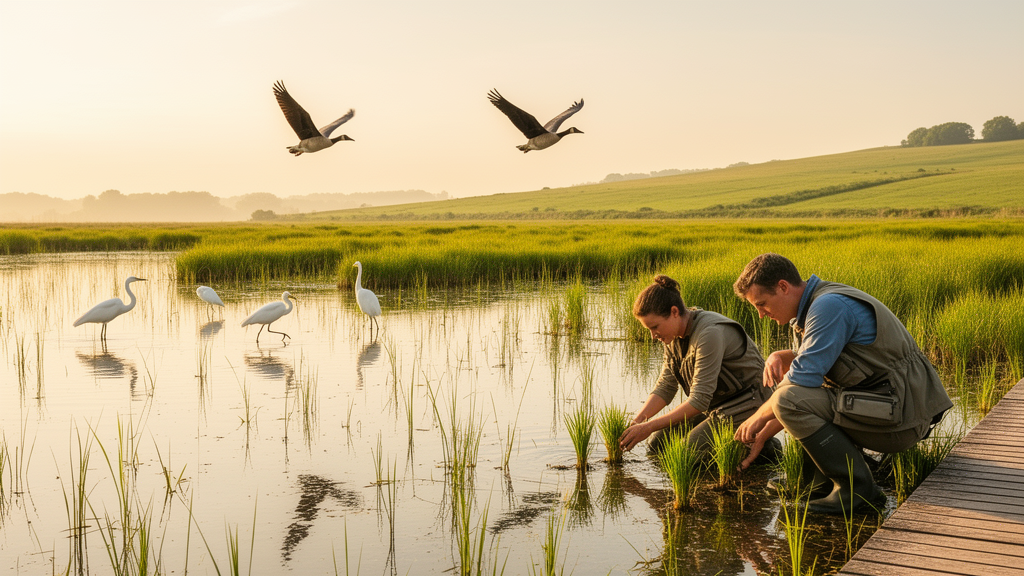
A policy-facing synthesis of European research concludes that about 80% of the wetlands present on the continent 100 years ago have been lost, while 89% of wetland habitats remaining under European Union law have an unfavorable conservation status. The paper argues that protecting functioning wetlands and restoring degraded riverine and coastal wetlands require coordinated action across policy, practice and science.
The article synthesizes interdisciplinary research, practical case studies and policy analyses presented in a special issue on European wetlands. Its recommendations were developed through interactive workshops at the fifth European Conference on Biodiversity and Climate Change, held in Bonn from 26 to 28 September 2023. The conference was organized by the German Federal Agency for Conservation and the European Network of Heads of Nature Conservation Agencies.
The review identifies wetlands as biodiversity hotspots that also provide ecosystem services, including food and water provision, nutrient retention, recreation and nature tourism. River floodplains can retain water during extreme events, while coastal wetlands form part of hybrid flood-defence systems. Wetlands such as floodplain forests and salt marshes also capture and store carbon. These functions link the condition of wetlands with social, economic and ecological well-being, including European Green Deal and global biodiversity, climate and sustainable-development goals.
Despite these functions, wetlands face severe pressures. Drainage, dams and hydropower infrastructure, water abstraction and flow regulation alter hydrological and hydromorphological conditions. Unsustainable land use, eutrophication and other pollution also contribute to degradation. Climate change exacerbates these anthropogenic pressures and, through changes in the hydrological cycle, has already contributed to severe losses of wetland habitats and species. The authors state that these pressures reduce ecosystem resilience and the prospects of wetlands surviving a changing climate.
The paper calls the existing scientific basis sufficient to support action. It characterizes wetland nature-based solutions as “no-regret options” for sustainable management of river basins and coasts because they can continue providing benefits under a changing climate. The review also cites a European Commission estimate that each euro invested in ecosystem restoration in the EU generates an estimated 8 to 38 euros in economic benefits from natural capital or ecosystem services. The authors note that measures such as rewetting or dam removal can have comparatively low or no maintenance costs after initial investment, although they do not provide a project-level cost-benefit analysis in this paper.
For policy-makers, the recommendations include making wetlands a political priority, aligning biodiversity, climate, water, agriculture, forestry, fisheries, renewable energy, coastal protection and infrastructure policies, and phasing out harmful subsidies in favor of nature-positive investment. The paper supports legally binding restoration targets, measurable deadlines, robust monitoring, long-term public funding and private investment with meaningful biodiversity criteria. It also calls for integrating wetland nature-based solutions into national biodiversity strategies, national adaptation plans and nationally determined contributions, while ensuring ecological and social safeguards.
For practitioners, the paper recommends long-term planning that accounts for climatic, hydrological and ecological uncertainty, source-to-sea approaches at catchment or landscape scale, and a stepwise program that combines ambitious goals with initial projects capable of demonstrating success. Suggested measures include conserving healthy wetlands, removing or modifying obsolete river barriers, reconnecting floodplains, restoring coastal sediment fluxes and managed realignment, and using passive restoration where suitable. It also emphasizes community engagement, stakeholder cooperation, workforce training, demonstration of socio-economic benefits and continuous monitoring and adaptive management.
For researchers, the priorities are to refine models of future climate impacts, reassess conservation priorities as species ranges shift, quantify the biodiversity, climate and socio-economic outcomes of particular restoration methods, and identify restoration areas using assessments of need, feasibility and co-benefits. The paper calls for standardized monitoring indicators at multiple scales, improved data comparability across Europe, accessible digital platforms and clearer communication. Citizen science may complement professional monitoring where appropriate. The review is not presented as a systematic review, meta-analysis, protocol or new causal field experiment; instead, it integrates the special issue’s studies, case studies, policy analyses and workshop deliberations, so its recommendations do not constitute a new quantitative estimate of restoration effectiveness.
The authors conclude that policy, practice and science must work together to reduce human pressures, build a business case for restoration, mobilize funding, address trade-offs, strengthen implementation capacity and expand restored habitat. They acknowledge that political priorities have shifted in the current EU legislative period and that efforts to simplify, delay or weaken environmental policy have made implementation more difficult. Despite those constraints, the review argues that protection and restoration should be scaled up because wetlands support biodiversity, climate resilience and water security, while the costs of inaction continue to increase.
Subject of Research: European policy, practice and research priorities for restoring riverine and coastal wetlands
Article Title: Restoring coasts and floodplains – Conclusions and recommendations for enabling action across science, policy, and practice
Article References: Kaden, U. S., Schmid, S., Wulf, S., Marsden, K., Klusmann, C., Bonn, A., Tockner, K., Scholz, M., & Duffield, S. (2026). Restoring coasts and floodplains – Conclusions and recommendations for enabling action across science, policy, and practice. Nature Conservation, 62, 383-391. https://doi.org/10.3897/natureconservation.62.184559
Image Credits: AI Generated
DOI: 10.3897/natureconservation.62.184559
Keywords: wetland restoration, river floodplains, coastal wetlands, European Union, nature-based solutions, biodiversity, climate adaptation, nature restoration, environmental policy, adaptive management, Restoring, coasts
Cite Scienmag News
Gavin Prescott. (October 20, 2026). Policy and research review identifies priorities for restoring European riverine and coastal wetlands. Scienmag. https://scienmag.com/policy-and-research-review-identifies-priorities-for-restoring-european-riverine-and-coastal-wetlands/
Gavin Prescott. "Policy and research review identifies priorities for restoring European riverine and coastal wetlands." Scienmag, 20 October 2026, https://scienmag.com/policy-and-research-review-identifies-priorities-for-restoring-european-riverine-and-coastal-wetlands/. Accessed 20 October 2026.
Gavin Prescott. "Policy and research review identifies priorities for restoring European riverine and coastal wetlands." Scienmag. October 20, 2026. https://scienmag.com/policy-and-research-review-identifies-priorities-for-restoring-european-riverine-and-coastal-wetlands/


