


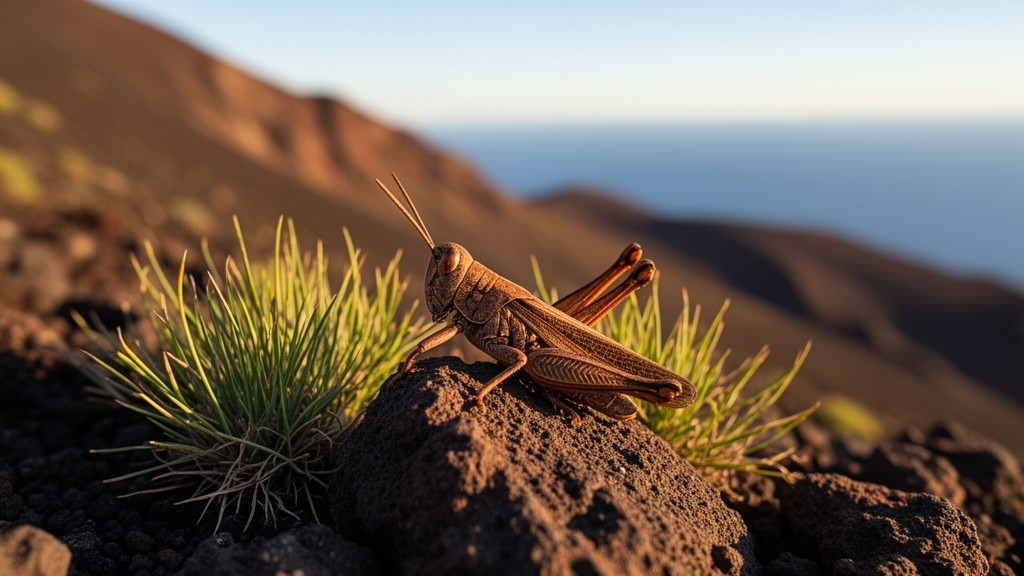
A short field survey rediscovered the endemic grasshopper Eyprepocprifas insularis at several sites in Monte Gordo Natural Park on São Nicolau, Cape Verde. The species had been known only from a single male collected in October 1980 and was subsequently declared extinct by researchers who found no further records during extensive island fieldwork from 1979 to 1982.
The rediscovery was made during a five-day visit to São Nicolau from 23 to 28 January 2023. The authors combined direct observations and specimen collection with distribution mapping and a preliminary assessment under International Union for Conservation of Nature criteria. Specimens were identified using Donskoff’s original 1982 description, and the taxonomy followed the Orthoptera Species File. Mounted specimens were measured with digital calipers accurate to 0.01 mm.
Adults and nymphs were observed at sites on northeastern, southeastern and north-facing slopes at elevations from 650 to 1,100 metres above sea level. The records included locations around Monte Cintinha, Assomada Pass, the road between Tarrafal and Cachaço, and higher parts of Monte Gordo. The species appeared to be restricted to the northern half of the natural park and immediately adjacent areas, although densities seemed low.
All confirmed locations contained the native plant Euphorbia tuckeyana, but the vegetation ranged from open scrub and grassland to denser stands of introduced Pinus, Eucalyptus and Cupressus. Adults were generally found on the ground, including among rocks and in Arundo donax vegetation, while small nymphs occurred on Asteriscus smithii. The first specimens of the 2023 survey were detected at night; later sightings were made during the day, although some individuals may have been disturbed before they were observed.
The paper provides the first description of the female, which was based on two adult specimens. Females measured 28.8–33.4 mm in total length, compared with an average of 19.0 mm for the six measured males, including the holotype. Diagnostic characters included the shape of the pronotum, female antennae and ovipositor, and the form of the terminal abdominal structures. The study also redescribed the male and translated the original French description of the genus and species.
Measurements of the male holotype and five additional males, together with two females, showed substantial sexual dimorphism. Mean body length from the frons to the subgenital plate was 19.0 mm in males and 31.1 mm in females. Mean hind-femur length was 13.3 mm in males and 20.8 mm in females, while mean pronotum length was 4.6 mm and 8.7 mm, respectively. The authors noted that the observed males varied in colour and patterning, including the width and continuity of the dark longitudinal band on the pronotum.
For the preliminary Red List assessment, the area of occupancy was calculated by summing occupied 2 × 2 km grid cells. The lower extent of occurrence was based on the minimum convex hull around confirmed records, while the upper extent incorporated the authors’ estimate of the possible geographical range. The known area of occupancy was approximately 12 km², the lower extent of occurrence was 4 km², and the maximum estimated extent was 35 km². The polygon representing the estimated possible range also covered 12 km².
Because information on population size, trends and quantitative population change was unavailable, the assessment could apply only the geographic criteria B and D2. Entering the geographic estimates and threat information into the IUCN Species Information Service produced a proposed category of Vulnerable under criterion D2, reflecting the restricted area of occupancy and the small number of known sites. This was a data-limited assessment rather than a direct measurement of population decline.
The study identifies habitat alteration, introduced vegetation, grazing, fires, erosion and tropical storms among the pressures affecting the highland environment occupied by the grasshopper. It reports that Monte Gordo Natural Park retains fragments of native vegetation but also contains extensive 20th-century plantations of introduced trees. The authors note that the grasshopper’s persistence in degraded, introduced-plant-dominated habitats indicates some resilience, while emphasizing that its population size, precise range, ecology and responses to threats remain unresolved. The rediscovery therefore confirms that the species survives while leaving substantial gaps in the evidence needed to understand its population and conservation requirements.
Subject of Research: Field rediscovery, distribution and preliminary Red List assessment of the São Nicolau endemic grasshopper Eyprepocprifas insularis
Article Title: Rediscovery of the Monte Gordo Grasshopper Eyprepocprifas insularis : An ancient brachypterous species endemic to São Nicolau, Cape Verde ( Orthoptera , Eyprepocnemidinae )
Article References: Felix, R., Jacobs, A., & Lecoq, M. (2025). Rediscovery of the Monte Gordo Grasshopper Eyprepocprifas insularis: An ancient brachypterous species endemic to São Nicolau, Cape Verde (Orthoptera, Eyprepocnemidinae). Journal of Orthoptera Research, 34(2), 159-168. https://doi.org/10.3897/jor.34.144016
Image Credits: AI Generated
Keywords: Eyprepocprifas insularis, São Nicolau, Cape Verde, grasshopper rediscovery, Monte Gordo Natural Park, field survey, IUCN Red List, Orthoptera, endemic species, habitat conservation, Rediscovery, Monte
Cite Scienmag News
Margaret Porter. (October 20, 2026). Field survey rediscovers São Nicolau endemic grasshopper and recommends Vulnerable Red List status. Scienmag. https://scienmag.com/field-survey-rediscovers-sao-nicolau-endemic-grasshopper-and-recommends-vulnerable-red-list-status/
Margaret Porter. "Field survey rediscovers São Nicolau endemic grasshopper and recommends Vulnerable Red List status." Scienmag, 20 October 2026, https://scienmag.com/field-survey-rediscovers-sao-nicolau-endemic-grasshopper-and-recommends-vulnerable-red-list-status/. Accessed 20 October 2026.
Margaret Porter. "Field survey rediscovers São Nicolau endemic grasshopper and recommends Vulnerable Red List status." Scienmag. October 20, 2026. https://scienmag.com/field-survey-rediscovers-sao-nicolau-endemic-grasshopper-and-recommends-vulnerable-red-list-status/


