


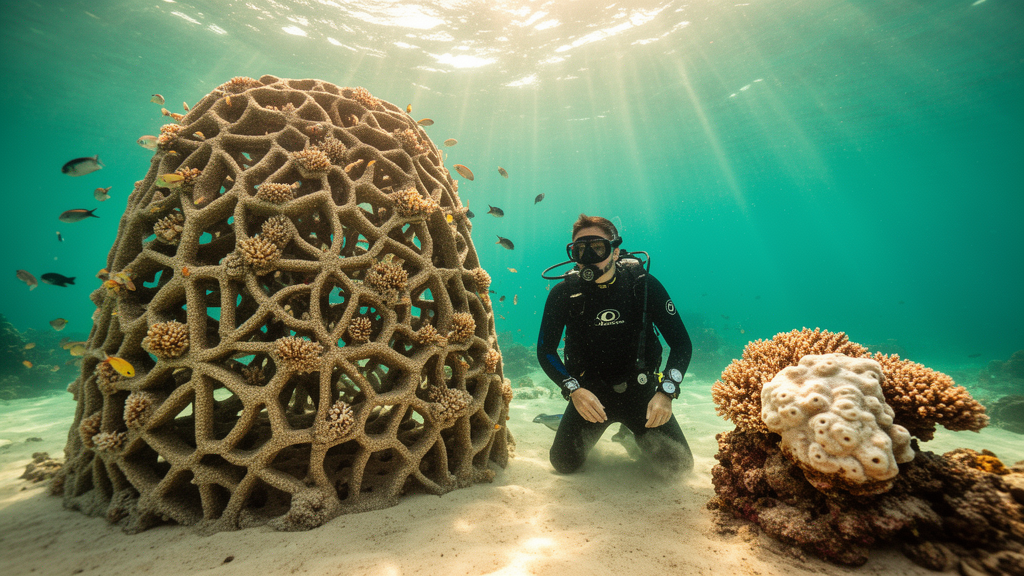
A review published in Discover Sustainability introduces a multiscale framework for evaluating bioinspired, additively manufactured artificial reefs intended for coral restoration. The proposed framework links six dimensions: restoration and site requirements; bioinspired and parametric design; material and environmental compatibility; manufacturing and constructability; multiphysics performance assessment; and validation, monitoring, and implementation. The authors describe the framework as a structured basis for assessing trade-offs and evidence strength, rather than as a demonstrated restoration intervention.
The review evaluates evidence across four hierarchical scales: material and surface, module and geometry, reef and site, and implementation and system. According to the abstract, overall performance depends on interactions among material formulation, geometric configuration, manufacturing process, site-specific conditions, and decision-making across scales. The review also reports persistent gaps between ecological objectives, material and manufacturing qualification, physical performance assessment, and long-term monitoring.
Translating bioinspired features into usable metrics requires information on chemical stability, degradation behavior, biological response, and durability. Manufacturing processes must retain intended surfaces, cavities, porosity, and structural attributes. Although hydrodynamic and structural models can support design decisions, their predictive value depends on model assumptions, material characterization, experimental validation, and field conditions. The framework therefore connects restoration objectives to design, qualification, multiphysics assessment, validation, and adaptive implementation.
The available evidence indicates that a single aspect cannot establish the suitability of an artificial reef design for ecological restoration. Instead, candidate structures require coordinated assessment of materials, geometry, fabrication, physical performance, environmental setting, biological outcomes, and implementation. The published item is a review and framework proposal; it does not report a new field trial, controlled experiment, or measured restoration effect. The supplied abstract also does not provide quantitative performance results, specific test systems, or long-term ecological outcomes, so the approach remains a synthesis intended to guide evaluation and further development of artificial reef infrastructure.
Subject of Research: A review framework for evaluating bioinspired additively manufactured artificial reefs in coral restoration.
Article Title: A multiscale framework for bioinspired additively manufactured artificial reefs in coral restoration
Article References: Vásquez Trejos, E. M., Ortega Del Rosario, M. D. L. Á., & Weeks Santos, S. (2026). A multiscale framework for bioinspired additively manufactured artificial reefs in coral restoration. Discover Sustainability. https://doi.org/10.1007/s43621-026-05048-x
Image Credits: AI Generated
DOI: 10.1007/s43621-026-05048-x
Keywords: coral restoration, artificial reefs, additive manufacturing, bioinspired design, multiscale framework, materials compatibility, multiphysics performance, ecological monitoring, multiscale, framework, bioinspired, additively
Cite Scienmag News
Denise Maddox. (October 20, 2026). Review proposes multiscale framework for additively manufactured artificial reefs. Scienmag. https://scienmag.com/review-proposes-multiscale-framework-for-additively-manufactured-artificial-reefs/
Denise Maddox. "Review proposes multiscale framework for additively manufactured artificial reefs." Scienmag, 20 October 2026, https://scienmag.com/review-proposes-multiscale-framework-for-additively-manufactured-artificial-reefs/. Accessed 20 October 2026.
Denise Maddox. "Review proposes multiscale framework for additively manufactured artificial reefs." Scienmag. October 20, 2026. https://scienmag.com/review-proposes-multiscale-framework-for-additively-manufactured-artificial-reefs/


