


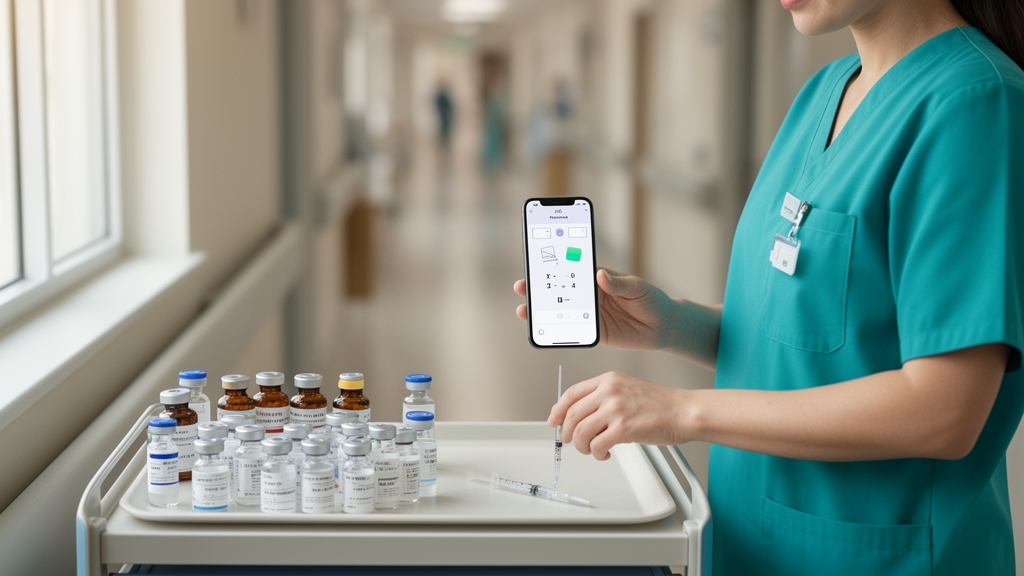
A researcher-developed artificial intelligence mobile application was associated with better drug-calculation knowledge, medication-related clinical decision-making scores and self-efficacy among 56 nurses in a mixed-methods randomized trial conducted at one non-governmental hospital in Egypt. The findings concern short-term training outcomes and do not establish reductions in medication errors or improvements in patient care.
The embedded mixed-methods study prioritized a two-arm randomized controlled trial and added post-intervention focus groups with intervention participants to examine feasibility and acceptability. Nurses directly involved in patient care were recruited through the hospital’s in-service training program and assigned after baseline assessment to either the application or traditional instruction, with 28 participants in each group.
Permuted-block randomization with a block size of four was used, with allocation stratified by clinical sector. Consecutively numbered, opaque, sealed envelopes maintained allocation concealment, and post-test assessors were blinded to group assignment. Both groups completed three training sessions over two weeks, with each session lasting about 60 to 90 minutes and the same learning content and equivalent contact time.
The intervention application presented interactive cases involving oral medication calculations, intravenous infusion adjustments, pediatric dosing, high-alert medications and error detection. Its rule-based adaptive engine altered scenario difficulty and delivered corrective feedback according to predefined criteria including accuracy, repeated errors and response time. Nurses could work with virtual charts, infusion pumps and patient reactions, and the application also generated performance analytics.
Control nurses received face-to-face lectures, guided discussion and paper-based problem-solving exercises. Outcomes were assessed immediately before training and two weeks after the final session. The 16-item multiple-choice knowledge test covered oral calculations, intravenous infusion rates and weight-based dosage; it had a KR-20 of 0.82 and two-week test-retest reliability of r = 0.86. An eight-item researcher-developed questionnaire assessed medication-related clinical judgment, safety verification, information evaluation and use of calculation results, with Cronbach’s α of 0.87 and test-retest reliability of r = 0.84. A context-adapted 10-item self-efficacy scale had Cronbach’s α of 0.90 and test-retest reliability of r = 0.88.
At post-test, 42.9% of intervention nurses reached the study’s high knowledge category, while 50% of controls remained in the low category. The between-group difference was significant in the independent t-test, with a large effect size of Cohen’s d = 0.89, and baseline-adjusted ANCOVA also found a significant difference (F = 25.32, p < 0.001). Within the intervention group, knowledge scores increased from baseline to post-test (t = 7.985, p < 0.001); 64.3% had initially been in the low-knowledge category and none had reached the high category at baseline.
Medication-related clinical decision-making scores also differed significantly between groups, with Cohen’s d = 0.90 and a significant ANCOVA result (F = 12.35, p = 0.001). In the intervention group, 42.9% reached the high decision-making category, compared with 14.3% of controls, and intervention scores increased from baseline to post-test (t = 5.665, p < 0.001). These results concern performance on the study’s questionnaire rather than observed changes in medication errors or patient outcomes.
Self-efficacy scores differed significantly between groups, with Cohen’s d = 0.81 and a significant ANCOVA result (F = 16.54, p < 0.001), while scores increased within the intervention group from baseline to post-test (t = 5.315, p < 0.001). At post-test, 25% of intervention nurses were classified as having high self-efficacy; the control group was reported as comprising 64.3% with moderate and 35.7% with low self-efficacy, with no high-category control nurses reported. Because the measure was adapted from a general self-efficacy instrument, the result represents reported confidence in the study setting rather than directly observed clinical performance.
All 28 intervention nurses joined four focus groups of seven participants each. Thematic analysis identified six themes: perceived clinical benefits, realism and theory-to-practice, confidence and competence, ease of use and engagement, training efficiency and resource saving, and challenges and suggested improvements. Participants described the scenarios as realistic, the interface as engaging and easy to follow, and the training as helpful for applying calculations to clinical cases. They also reported initial hesitation with the new technology and requested more guidance and greater content depth. The qualitative component included only intervention nurses and therefore did not compare their experiences with those of the control group.
The trial has important limitations: it included 56 nurses from a single hospital, making effect estimates less precise and limiting generalizability. Follow-up was brief, so long-term retention was not established. The outcome instruments were researcher-developed or adapted, and direct measures such as ward medication-error rates were not evaluated. Potential contamination and performance effects could not be fully excluded in the hospital setting, while the application was developed by one of the study authors. Larger multisite studies with longer follow-up are needed to assess reproducibility, clinical impact and implementation in other settings.
Subject of Research: Short-term effects of adaptive AI mobile simulation on drug-calculation training outcomes among practicing nurses
Article Title: Adaptive AI-based mobile simulation for drug calculation competency in nurses: a mixed-methods RCT
Article References: Salem, M. F. A., Sharaf, A. K., & abdelhafeez abdelmonseif Younis, A. (2026). Adaptive AI-based mobile simulation for drug calculation competency in nurses: a mixed-methods RCT. BMC Nursing, 25(1), Article 828. https://doi.org/10.1186/s12912-026-05313-4
Image Credits: AI Generated
DOI: 10.1186/s12912-026-05313-4
Keywords: nursing education, artificial intelligence, mobile simulation, drug calculation, clinical decision-making, self-efficacy, randomized controlled trial, Egypt, Adaptive, AI-based, mobile, simulation
Cite Scienmag News
Ophelia Keating. (October 20, 2026). AI mobile simulation improves nurses’ drug-calculation scores in small Egyptian randomized trial. Scienmag. https://scienmag.com/ai-mobile-simulation-improves-nurses-drug-calculation-scores-in-small-egyptian-randomized-trial/
Ophelia Keating. "AI mobile simulation improves nurses’ drug-calculation scores in small Egyptian randomized trial." Scienmag, 20 October 2026, https://scienmag.com/ai-mobile-simulation-improves-nurses-drug-calculation-scores-in-small-egyptian-randomized-trial/. Accessed 20 October 2026.
Ophelia Keating. "AI mobile simulation improves nurses’ drug-calculation scores in small Egyptian randomized trial." Scienmag. October 20, 2026. https://scienmag.com/ai-mobile-simulation-improves-nurses-drug-calculation-scores-in-small-egyptian-randomized-trial/


