


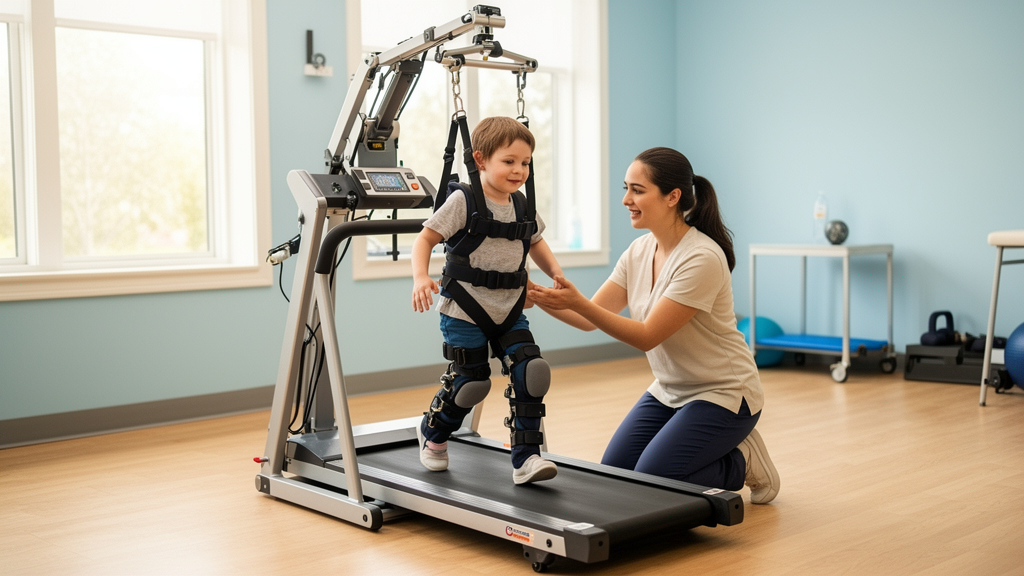
A systematic review and meta-analysis reported in the abstract of a BMC Pediatrics article found that robot-assisted gait training was associated with greater improvements in walking speed and 6-minute walk distance than conventional therapy among children with cerebral palsy. The pooled analysis included 22 randomized controlled trials involving 718 children aged 2–18 years. Twenty studies focused on cerebral palsy, two on spinal cord injury, and no studies involving acquired brain injury were identified.
The researchers searched PubMed, Embase, Web of Science, the Cochrane Library, CINAHL and ClinicalTrials.gov from their inception through 1 April 2026. Eligible studies were randomized trials comparing robot-assisted gait training with conventional therapy in children with cerebral palsy or other central nervous system impairments. Risk of bias and methodological quality were assessed with the Cochrane Risk of Bias 2 tool and the PEDro scale. Random-effects meta-analysis calculated mean differences or standardized mean differences, and GRADE was used to assess the certainty of evidence.
For walking speed, the pooled standardized mean difference was 0.58 (95% confidence interval, 0.18 to 0.98; P = 0.005). The 6-minute walk distance improved by a pooled mean difference of 38.68 metres (95% CI, 22.61 to 54.75; P < 0.00001). The abstract rated the evidence for both outcomes as high certainty. An exploratory analysis of two studies also suggested a reduction in the Physiological Cost Index, although the abstract did not report a pooled effect estimate for that measure. No statistically significant between-group differences were found for GMFM-88, balance, spasticity or functional independence.
Exploratory subgroup analyses suggested larger effects on walking speed when interventions lasted at least eight weeks. Robot type was associated with a significant subgroup difference for 6-minute walk distance, but not for walking speed; both subgroup observations were described as preliminary and requiring further validation. The evidence was concentrated overwhelmingly in children with cerebral palsy. The limited spinal cord injury evidence and absence of acquired brain injury studies prevented definitive conclusions for those populations. The abstract stated that additional high-quality trials using uniform outcome measures are needed to assess broader functional endpoints and establish whether the findings extend beyond cerebral palsy.
Subject of Research: Effects of robot-assisted gait training on walking and motor outcomes in children with central nervous system impairments
Article Title: Effects of robot-assisted gait training on walking capacity and gross motor function in children with central nervous system impairments: a systematic review and meta-analysis predominantly based on cerebral palsy studies
Article References: Wu, X., Li, X., Liang, J., Chen, Z., Zhang, J., Yang, X., Fan, Q., Guo, H., Liao, L., & Du, Q. (2026). Effects of robot-assisted gait training on walking capacity and gross motor function in children with central nervous system impairments: a systematic review and meta-analysis predominantly based on cerebral palsy studies. BMC Pediatrics. https://doi.org/10.1186/s12887-026-07359-4
Image Credits: AI Generated
DOI: 10.1186/s12887-026-07359-4
Keywords: robot-assisted gait training, cerebral palsy, pediatric rehabilitation, walking speed, 6-minute walk distance, systematic review, meta-analysis, spinal cord injury, gross motor function, GRADE evidence, Effects, robot-assisted
Cite Scienmag News
Denise Maddox. (October 20, 2026). Systematic review links robot-assisted gait training to walking gains in children with cerebral palsy. Scienmag. https://scienmag.com/systematic-review-links-robot-assisted-gait-training-to-walking-gains-in-children-with-cerebral-palsy/
Denise Maddox. "Systematic review links robot-assisted gait training to walking gains in children with cerebral palsy." Scienmag, 20 October 2026, https://scienmag.com/systematic-review-links-robot-assisted-gait-training-to-walking-gains-in-children-with-cerebral-palsy/. Accessed 20 October 2026.
Denise Maddox. "Systematic review links robot-assisted gait training to walking gains in children with cerebral palsy." Scienmag. October 20, 2026. https://scienmag.com/systematic-review-links-robot-assisted-gait-training-to-walking-gains-in-children-with-cerebral-palsy/


