


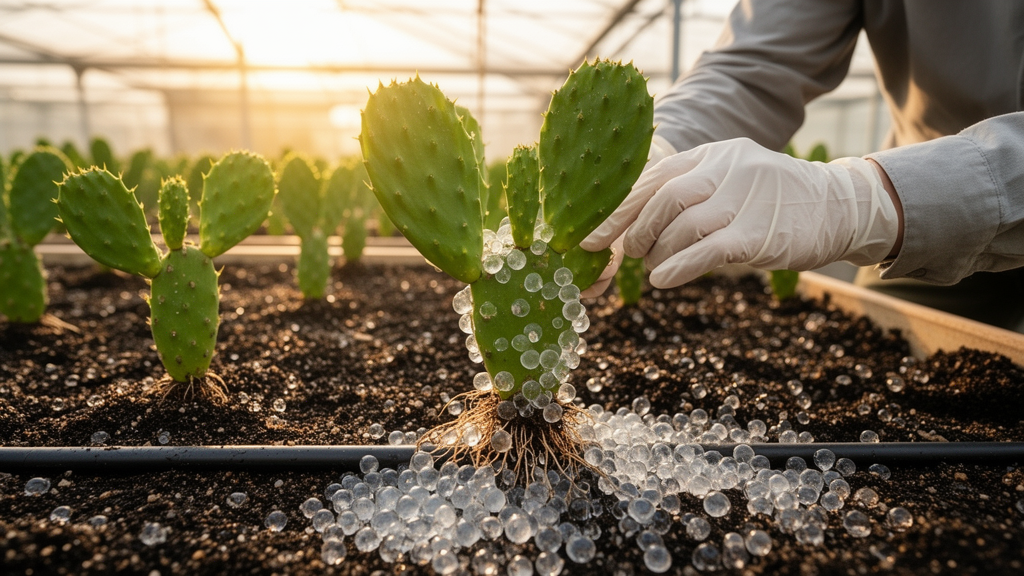
A 90-day greenhouse experiment found that responses of cactus pear (Opuntia ficus-indica) to water-retentive amendments and biostimulants varied by treatment combination and measured trait. The highest observed shoot fresh mass occurred with mycorrhizal inoculum, seaweed extract, humic acid and electron-beam-irradiated superabsorbent polymer at 2 g kg⁻¹ soil: 99.50 g per pot compared with 45.95 g for the untreated control.
Researchers crossed five physicochemical regimes—unamended soil, electron-beam-irradiated superabsorbent polymer at 1 or 2 g kg⁻¹ soil, and zeolite at 1 or 2 g kg⁻¹—with all eight presence-or-absence combinations of arbuscular-mycorrhizal inoculum, seaweed extract and humic acid. Three independent pots were used for each combination. Soil water was maintained gravimetrically at a target derived from 70% of the unamended soil’s field capacity. Continuous responses were evaluated with a 5 × 8 fixed-effects model, followed by Tukey-adjusted comparisons where appropriate, while cladode number was analyzed with a Poisson model.
The physicochemical regime, biostimulant regime and their interaction affected most continuous traits, with the interaction detected for 15 of 17 responses; it was not detected for chlorophyll b or total phenolics. The highest observed relative water content was 98.66% under mycorrhizal inoculum, seaweed extract and irradiated superabsorbent polymer at 2 g kg⁻¹, compared with 83.06% in the untreated control. The highest observed total chlorophyll was 1.835 mg g⁻¹ fresh weight under humic acid, seaweed extract and irradiated superabsorbent polymer at 2 g kg⁻¹, versus 0.770 mg g⁻¹ in the control. The highest DPPH value, 76.89% compared with 65.78%, was observed under mycorrhizal inoculum, seaweed extract, humic acid and zeolite at 2 g kg⁻¹. Principal components PC1 and PC2 described 48.34% of treatment-mean variation, while the first four components described 75.02%.
These results come from the article abstract and describe a controlled greenhouse experiment rather than field research. The authors identified combinations containing irradiated superabsorbent polymer or zeolite at 2 g kg⁻¹ as candidates for further replicated greenhouse and field evaluation, but the experiment did not establish drought mitigation, irrigation savings, mycorrhizal colonization or superiority to non-irradiated superabsorbent polymer. The observed treatment maxima therefore identify combinations for subsequent testing, not proven field benefits.
Subject of Research: Greenhouse evaluation of amendments and biostimulants for cactus pear under a reduced soil-water target
Article Title: Treatment-dependent responses of Opuntia ficus-indica to electron-beam-irradiated superabsorbent polymer, zeolite, and biostimulants at a reduced soil-water target
Article References: Hadad, M. N., & Kordrostami, M. (2026). Treatment-dependent responses of Opuntia ficus-indica to electron-beam-irradiated superabsorbent polymer, zeolite, and biostimulants at a reduced soil-water target. BMC Plant Biology. https://doi.org/10.1186/s12870-026-10020-y
Image Credits: AI Generated
DOI: 10.1186/s12870-026-10020-y
Keywords: cactus pear, Opuntia ficus-indica, greenhouse experiment, soil water, superabsorbent polymer, zeolite, arbuscular mycorrhiza, seaweed extract, humic acid, plant growth traits, Treatment-dependent, responses
Cite Scienmag News
Alan Morgan. (October 20, 2026). Greenhouse study finds treatment-specific responses in cactus pear under reduced soil-water target. Scienmag. https://scienmag.com/greenhouse-study-finds-treatment-specific-responses-in-cactus-pear-under-reduced-soil-water-target/
Alan Morgan. "Greenhouse study finds treatment-specific responses in cactus pear under reduced soil-water target." Scienmag, 20 October 2026, https://scienmag.com/greenhouse-study-finds-treatment-specific-responses-in-cactus-pear-under-reduced-soil-water-target/. Accessed 20 October 2026.
Alan Morgan. "Greenhouse study finds treatment-specific responses in cactus pear under reduced soil-water target." Scienmag. October 20, 2026. https://scienmag.com/greenhouse-study-finds-treatment-specific-responses-in-cactus-pear-under-reduced-soil-water-target/


