


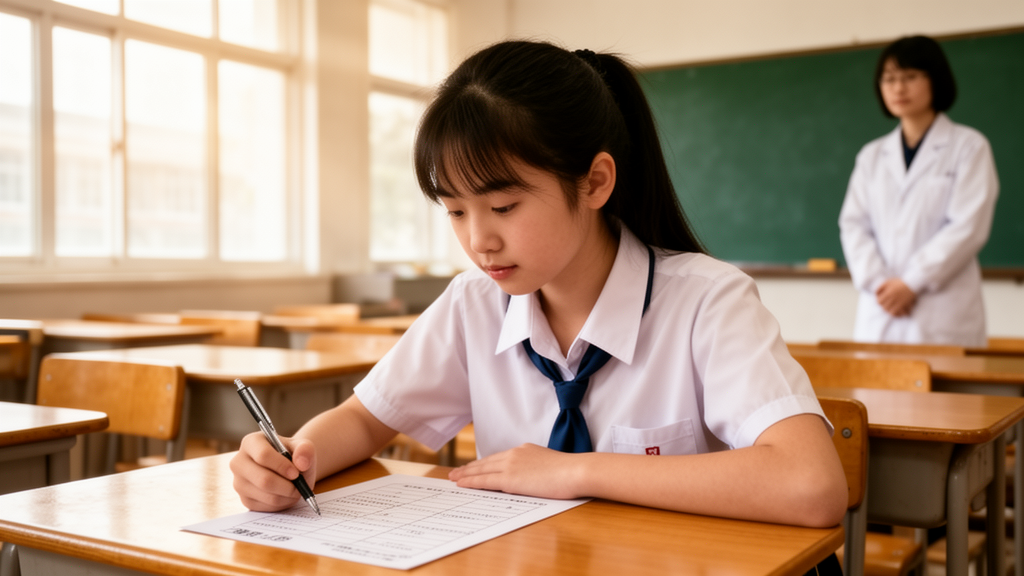
A Chinese version of the Decent Education Scale showed satisfactory psychometric properties in a school-based study of 640 secondary school students from three schools in Zhejiang Province, China, according to the study abstract. The instrument assesses students’ perceptions of six dimensions of their educational experiences: physical safety, psychological safety, an equitable environment, social belongingness, quality instruction and postgraduation programming.
The cross-sectional survey was conducted from February to March 2026. Participants included 358 boys, or 55.9% of the sample, and 282 girls, or 44.1%. Researchers translated and culturally adapted the scale through translation, back-translation, expert review and content-validity evaluation. The abstract reports analyses of item discrimination, exploratory and confirmatory factor structures, measurement invariance across gender, reliability, convergent validity and criterion-related validity with academic engagement and academic burnout.
The Chinese scale had good item discrimination and satisfactory content validity. Exploratory factor analysis indicated a five-factor pattern, with some overlap between the quality instruction and postgraduation programming dimensions. However, confirmatory factor analysis showed that the original 18-item, six-factor model fitted the data better than the alternative five-factor model. The six-factor structure demonstrated configural, metric and scalar invariance across gender, indicating that its measurement properties were consistent between boys and girls in this sample.
The total scale had excellent internal consistency, with a Cronbach’s alpha of 0.964. The six subscales had Cronbach’s alpha values from 0.878 to 0.959, split-half reliability values from 0.826 to 0.867 and composite reliability values from 0.887 to 0.960. Average variance extracted for the subscales ranged from 0.724 to 0.889, supporting the reported convergent validity. Decent Education Scale scores were positively associated with academic engagement and negatively associated with academic burnout; these cross-sectional associations do not establish causal relationships. The findings are bounded by the sample’s location in three Zhejiang schools, its cross-sectional design and the specific students surveyed. The authors concluded that the Chinese version may support future research on perceived educational experiences, school adjustment and mental health, but those wider uses were not evaluated in the reported study.
Subject of Research: Psychometric validation of a Chinese adolescent version of the Decent Education Scale
Article Title: Validation of the Chinese version of the decent education scale in a school-based sample of Chinese adolescents
Article References: Xue, B., Wang, L., Zhu, S., Zheng, J., Li, X., & Luo, H. (2026). Validation of the Chinese version of the decent education scale in a school-based sample of Chinese adolescents. BMC Psychology. https://doi.org/10.1186/s40359-026-05655-3
Image Credits: AI Generated
DOI: 10.1186/s40359-026-05655-3
Keywords: Chinese adolescents, Decent Education Scale, psychometric validation, school-based survey, factor analysis, measurement invariance, reliability, convergent validity, academic engagement, academic burnout, Validation, Chinese
Cite Scienmag News
Courtney Benton. (October 20, 2026). Chinese decent education scale shows satisfactory validation in three-school Zhejiang adolescent sample. Scienmag. https://scienmag.com/chinese-decent-education-scale-shows-satisfactory-validation-in-three-school-zhejiang-adolescent-sample/
Courtney Benton. "Chinese decent education scale shows satisfactory validation in three-school Zhejiang adolescent sample." Scienmag, 20 October 2026, https://scienmag.com/chinese-decent-education-scale-shows-satisfactory-validation-in-three-school-zhejiang-adolescent-sample/. Accessed 20 October 2026.
Courtney Benton. "Chinese decent education scale shows satisfactory validation in three-school Zhejiang adolescent sample." Scienmag. October 20, 2026. https://scienmag.com/chinese-decent-education-scale-shows-satisfactory-validation-in-three-school-zhejiang-adolescent-sample/


