

Tuesday, October 20, 2026
Science
No Result
View All Result
  • Login
  • HOME
  • SCIENCE NEWS
  • CONTACT US
  • HOME
  • SCIENCE NEWS
  • CONTACT US
No Result
View All Result
Scienmag
No Result
View All Result
Home Science News Earth Science

Strip tillage led sorghum yields and water efficiency in Ethiopian field trial

October 20, 2026
in Earth Science
Alan Morgan
By Alan Morgan Scienmag Editorial Profile - Precision Agriculture
Reading Time: 2 mins read
0
Strip tillage led sorghum yields and water efficiency in Ethiopian field trial

Strip tillage led sorghum yields and water efficiency in Ethiopian field trial

65
SHARES
587
VIEWS
Share on FacebookShare on Twitter
ADVERTISEMENT

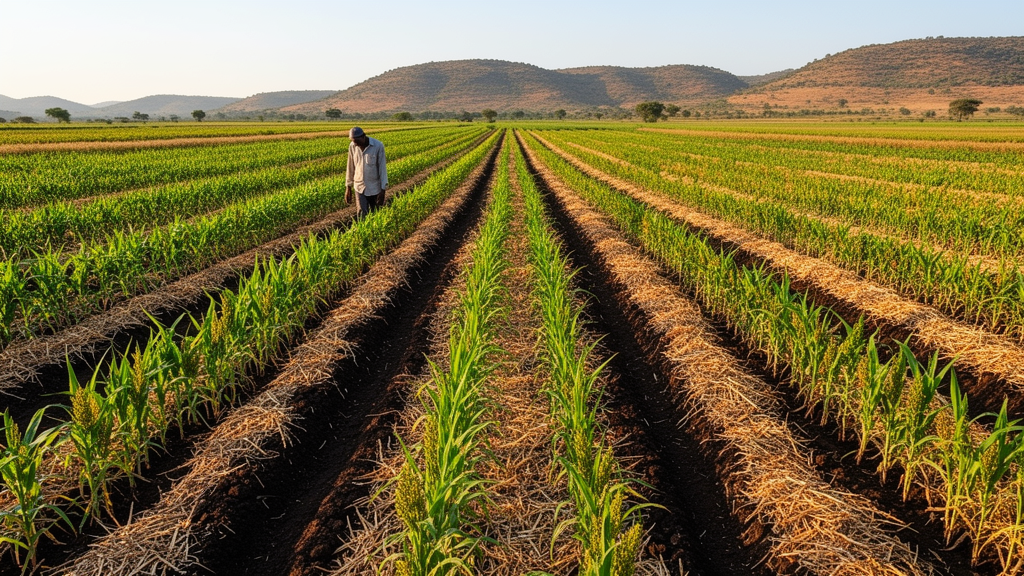
A randomized complete block field experiment in the semi-arid northern Ethiopian highlands found that strip tillage delivered the highest mean sorghum grain yield among five systems tested, reaching 3,771 kilograms per hectare. It also achieved the highest rainwater use efficiency in the trial, while conventional tillage produced the greatest surface runoff and sediment loss, including a measured sediment loss of 28.2 tonnes per hectare. The results indicate that strip tillage provided the strongest balance between sorghum productivity and the water- and soil-conservation indicators evaluated.

Researchers compared zero tillage, mulch tillage, reduced tillage, strip tillage and conventional tillage on clay loam soil. The study assessed sorghum grain yield and rainwater use efficiency alongside soil physical, chemical and hydrological properties, including soil organic carbon, total nitrogen, moisture retention, surface runoff and sediment loss. Its scope was the experimental field in the semi-arid environment of northern Ethiopia, so the findings concern the tested crop, soils and management systems rather than establishing the same ranking across all agricultural settings.

Strip tillage was the leading treatment in the reported comparison. Its mean grain yield of 3,771 kilograms per hectare exceeded the yields recorded under the other four systems, and it registered the best rainwater use efficiency. These were direct observations from the field experiment, not model projections or forecasts.

Together, the measures suggest that the strip-tillage treatment retained more effective use of rainfall while maintaining the experiment’s highest mean crop output, addressing two central constraints identified for farming in the region: water scarcity and soil degradation. The other systems showed distinct strengths and weaknesses. Mulch tillage was most effective at increasing soil organic carbon and total nitrogen and at retaining soil moisture, making it the strongest treatment for those particular indicators.

Zero tillage reduced sediment loss but generated the highest surface runoff, and that combination hindered crop performance. The comparison therefore did not show that minimizing soil disturbance was uniformly advantageous: under the experimental conditions, zero tillage limited sediment movement but did not minimize every pathway of water loss. Conventional tillage performed least well on the linked conservation measures.

It recorded both the highest runoff and the greatest sediment loss, with sediment reaching 28.2 tonnes per hectare. Overall, the findings identify strip tillage as the best measured compromise among the five options and mulch tillage as the leader for soil organic carbon, total nitrogen and moisture retention. They support targeted tillage management as a potential route to greater smallholder agricultural resilience in Tigray, while remaining specific to the conditions and indicators evaluated in the field trial.

Subject of Research: Field comparison of five tillage systems for sorghum yield, soil properties and water conservation in northern Ethiopia.

Article Title: Different tillage systems impact crop productivity and soil conservation parameters in the northern Ethiopian highlands

Article References: Kebede, M., Brhane, N., Haile, G. G., & Hagazi, N. (2026). Different tillage systems impact crop productivity and soil conservation parameters in the northern Ethiopian highlands. Discover Sustainability. https://doi.org/10.1007/s43621-026-04804-3

Image Credits: AI Generated

DOI: 10.1007/s43621-026-04804-3

Keywords: strip tillage, sorghum yield, rainwater use efficiency, soil conservation, soil erosion, surface runoff, mulch tillage, zero tillage, Ethiopian highlands, Tigray, Different, tillage

Cite Scienmag News

Alan Morgan. (October 20, 2026). Strip tillage led sorghum yields and water efficiency in Ethiopian field trial. Scienmag. https://scienmag.com/strip-tillage-led-sorghum-yields-and-water-efficiency-in-ethiopian-field-trial/


Alan Morgan. "Strip tillage led sorghum yields and water efficiency in Ethiopian field trial." Scienmag, 20 October 2026, https://scienmag.com/strip-tillage-led-sorghum-yields-and-water-efficiency-in-ethiopian-field-trial/. Accessed 20 October 2026.

Alan Morgan. "Strip tillage led sorghum yields and water efficiency in Ethiopian field trial." Scienmag. October 20, 2026. https://scienmag.com/strip-tillage-led-sorghum-yields-and-water-efficiency-in-ethiopian-field-trial/

Tags: comparison of tillage systems for sorghum cultivationcrop yield optimization in drought-prone regionsdifferenteffects of strip tillage on soil healthenvironmental benefits of conservation tillageEthiopian highlandsimpact of tillage methods on soil erosionmulch tillagerainwater harvesting and usagerainwater use efficiencysemi-arid farming techniquessoil conservationsoil conservation practicessoil erosionsoil fertility and organic carbon in Ethiopian highlandssorghum tillage systemssorghum yieldstrip tillagesurface runoffsustainable water management in agricultureTigraytillagewater efficiency in Ethiopian agriculturezero tillage
Share26Tweet16
Previous Post

Rwanda health worker survey reports childhood disability observations

Next Post

Antarctic euphausiids show six winter activity phases in seabed footage

Related Posts

Research report: The governance of Antarctic krill: exploring the interaction between CCAMLR and the BBNJ Agreement
Earth Science

Research report: The governance of Antarctic krill: exploring the interaction between CCAMLR and the BBNJ Agreement

October 20, 2026
PFAS concentrations track Queensland’s cities, not every waterway
Earth Science

PFAS concentrations track Queensland’s cities, not every waterway

October 20, 2026
PSOILICY links soil science with European policymaking across 15 partners
Earth Science

PSOILICY links soil science with European policymaking across 15 partners

October 20, 2026
Ocean Kariz pipes deep water ashore for multiple coastal uses
Earth Science

Ocean Kariz pipes deep water ashore for multiple coastal uses

October 20, 2026
Geospatial study maps urban growth and forest change in Oye-Ekiti
Earth Science

Geospatial study maps urban growth and forest change in Oye-Ekiti

October 20, 2026
Multiscale drivers of accidental epiphytism in temperate Europe
Earth Science

Multiscale drivers of accidental epiphytism in temperate Europe

October 20, 2026
Next Post
Antarctic euphausiids show six winter activity phases in seabed footage

Antarctic euphausiids show six winter activity phases in seabed footage

  • Mothers who receive childcare support from maternal grandparents show more optimized

    Mothers who receive childcare support from maternal grandparents show more parental warmth, finds NTU Singapore study

    27656 shares
    Share 11059 Tweet 6912
  • University of Seville Breaks 120-Year-Old Mystery, Revises a Key Einstein Concept

    1061 shares
    Share 424 Tweet 265
  • Bee body mass, pathogens and local climate influence heat tolerance

    682 shares
    Share 273 Tweet 171
  • Researchers record first-ever images and data of a shark experiencing a boat strike

    546 shares
    Share 218 Tweet 137
  • Groundbreaking Clinical Trial Reveals Lubiprostone Enhances Kidney Function

    531 shares
    Share 212 Tweet 133
Science

Embark on a thrilling journey of discovery with Scienmag.com—your ultimate source for cutting-edge breakthroughs. Immerse yourself in a world where curiosity knows no limits and tomorrow’s possibilities become today’s reality!

RECENT NEWS

  • CTVSeg-UNet: robust refinement for leaf vein phenotyping in curing tobacco
  • AI-assisted CT reveals distinct left atrial shape measures in atrial fibrillation
  • Research report: The governance of Antarctic krill: exploring the interaction between CCAMLR and the BBNJ Agreement
  • Mentalizing Deficits Link Epistemic Mistrust to Extremist Attitudes

Categories

  • Agriculture
  • Anthropology
  • Archaeology
  • Athmospheric
  • Biology
  • Biotechnology
  • Blog
  • Bussines
  • Cancer
  • Chemistry
  • Climate
  • Earth Science
  • Editorial Policy
  • Marine
  • Mathematics
  • Medicine
  • Pediatry
  • Policy
  • Psychology & Psychiatry
  • Science Education
  • Science News
  • Social Science
  • Space
  • Technology and Engineering

Subscribe to Blog via Email

Enter your email address to subscribe to this blog and receive notifications of new posts by email.

Join 5,150 other subscribers

© 2025 Scienmag - Science Magazine

Welcome Back!

Login to your account below

Forgotten Password?

Retrieve your password

Please enter your username or email address to reset your password.

Log In
No Result
View All Result
  • HOME
  • SCIENCE NEWS
  • CONTACT US

© 2025 Scienmag - Science Magazine

Discover more from Science

Subscribe now to keep reading and get access to the full archive.

Continue reading