


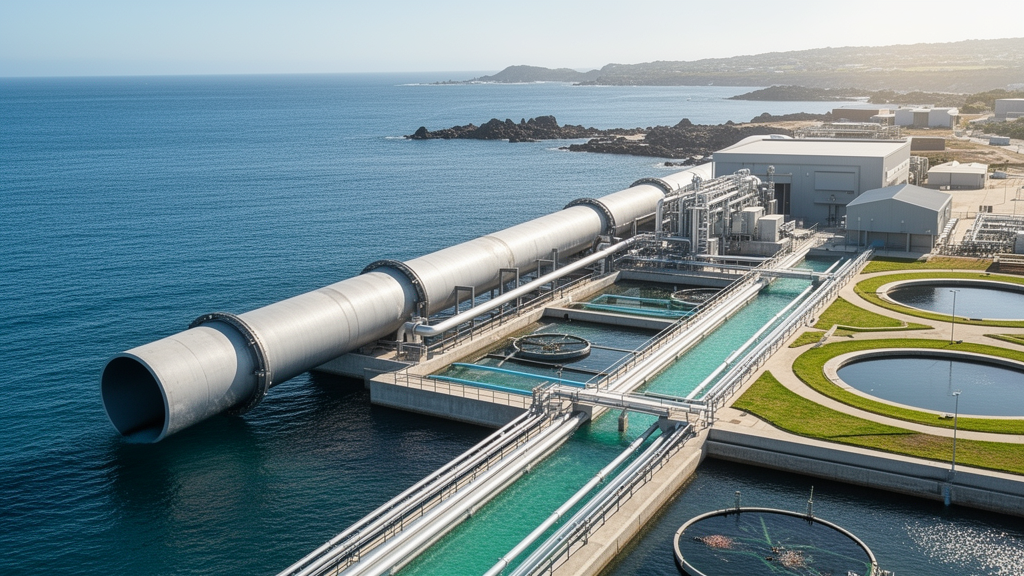
A conceptual deep-seawater delivery system could bring cold subsurface water to shore through a submerged pipeline, then distribute it among cooling facilities, aquaculture projects and other users without placing every pump far offshore. The OCEAN KARIZ proposal replaces the vertical lift of conventional artificial-upwelling systems with a large-diameter “mother pipe” running along the seabed to an enlarged, insulated and ventilated coastal terminal. A preliminary pool experiment showed that water withdrawn through such a pipe was replaced by incoming water, but researchers caution that the observation does not validate the performance of a kilometer-scale installation. The concept now calls for a field pilot that measures the relationship among withdrawal rate, terminal drawdown, refill response, heat gain, gas behavior and environmental effects.
The mother pipe would terminate offshore in a robust, perforated intake positioned at a depth of roughly 150–200 metres in the proposed pilot. Surveys of bathymetry, seabed morphology, sediment stability, temperature, salinity, dissolved oxygen and nutrients would determine the final location and depth. That distinction matters because the coldest water is not automatically the most useful. In the Arabian Sea and Gulf of Oman, an extensive oxygen-minimum zone can make cold subsurface water unsuitable for direct biological use even when its nutrients could support other applications. The same water might still serve as a thermal resource in an isolated cooling circuit. Intake selection would therefore depend on the intended application and measured water properties, not simply on how deep the pipe reaches.
For the first proposed pilot, engineers envisage a polyethylene mother pipe about 0.30 metres in internal diameter and 5–6 kilometres long. Polyethylene is attractive for marine use because it resists corrosion, tolerates bending and has relatively low internal roughness, although its structural behavior, fatigue life, anchoring and resistance to seabed abrasion would still require site-specific analysis. The pipe would follow the seabed toward shore, with enlargement and thermal insulation applied selectively in the warmest nearshore section. A larger cross-section lowers water velocity for a given withdrawal rate, potentially reducing frictional loss and providing extra storage that buffers short changes in demand.
A central hydraulic clarification in the study is that deep-water pressure does not provide free, sustained energy to push seawater above sea level. The process begins when the initially air-filled pipe is opened at its submerged intake while its coastal end remains vented to the atmosphere. Hydrostatic pressure then drives seawater into the pipe, progressively displacing air until the internal water column approaches equilibrium with the surrounding sea. Because the external pressure on a polyethylene pipe rises during deployment, filling would have to occur progressively as sections are sunk. Once equilibrium is reached, active withdrawal from the coast lowers the local hydraulic level, creates a pressure gradient and allows replacement seawater to enter through the offshore intake.
Each intended user would connect to the coastal terminal through an independent branch equipped with its own pump. This arrangement separates the long, largely passive seabed conduit from the energy and operating requirements of individual applications. A branch serving seawater air conditioning or industrial cooling could use insulation and a pump selected for a narrow temperature requirement, while another user could operate with different pressure, pipe dimensions and insulation. The authors say the architecture may allow several coastal facilities to share one deep-water intake while concentrating pumps, control equipment and maintenance near shore. It does not, however, create hydraulic energy or remove the need for pumping during normal operation.
Gas released from deep water is another engineering challenge. As the water becomes less pressurized and potentially warmer during transport, dissolved gases can come out of solution. The resulting mixture may change density and pressure loss, collect in high points or enter intermittent two-phase flow. The terminal is designed to vent at its upper end and withdraw user water from a lower level, creating an opportunity for accumulated gas to remain above the main flow. The investigators explicitly refuse to count any air-lift effect as part of the system’s primary design. Gas fraction, pressure fluctuations and flow stability would have to be measured before any secondary contribution could be quantified.
A dedicated balance line would help maintain stable withdrawal from the mother pipe. When combined demand from users fell below the selected operating range, a separate pump could remove additional water and return it to an appropriate discharge point. As customer demand rose, the balance pump would slow or stop. A proposed coastal control room would monitor total and individual withdrawal, terminal level, temperature, pressure and selected water-quality variables, adjusting the balance pump in response. This arrangement is not intended to manufacture extra supply or make controlled upwelling an automatic function of the system; it is meant to regulate turnover and reduce prolonged residence of cold water near the coast.
The only preliminary experiment reported was deliberately small. Researchers used an approximately 5-metre polyethylene pipe with a diameter of about 0.10 metres in a pool, withdrawing water for more than 15 minutes with a pump positioned roughly 0.60 metres above the water level. The water level inside the pipe fell by about 2 centimetres, and similar qualitative behavior appeared in repeated pool or pond trials. This indicated that withdrawal-induced drawdown could draw replacement water into the pipe. It did not reproduce the friction, elevation changes, heat exchange, gas evolution, installation loads or transient behavior of an ocean-scale system, so the authors treat it only as a proof of concept and not as quantitative validation.
Environmental monitoring would form part of the proposed pilot rather than follow it. Baseline samples would be collected at the intake and potential discharge site, with measurements of temperature, salinity, dissolved oxygen, nutrients, pH, turbidity, relevant carbonate-system variables and indicators of phytoplankton response. Releasing nutrient-rich deep water into surface waters could increase primary production, but excessive or poorly controlled enrichment could also promote eutrophication, harmful blooms and oxygen consumption. Carbon effects are equally uncertain: deep water may contain elevated dissolved inorganic carbon, while nutrient-driven biological production and carbon export can push in the opposite direction. Any discharge trial would therefore begin at low, controllable rates and could be reduced or stopped if monitoring detected an unacceptable response.
Even if the pilot succeeds hydraulically, it would not automatically establish environmental benefits, commercial viability or suitability for artificial upwelling. Biofouling, long-term structural durability, seabed interaction, thermal performance, two-phase flow, application economics and carbon effects remain unresolved. The proposed 150–200-metre intake is a provisional range rather than a fixed target, particularly along margins such as the Makran, where seismicity, tsunami exposure, unstable sediments, complex seabed morphology and low-oxygen waters require detailed investigation. The decisive test would be whether stable replenishment occurs during controlled withdrawal, with acceptable terminal drawdown, useful temperature preservation, manageable gas behavior and no unacceptable ecological response. Establishing that relationship would provide the empirical basis for deciding whether deeper, wider or commercially scaled installations are justified.
Subject of Research: Conceptual and pilot-scale design for delivering deep seawater to coastal users through a submerged pipeline.
Article Title: OCEAN KARIZ: a novel approach to artificial upwelling
Article References: Daei, M. A., Daei, B., Daei, B., & Daei, M. (2026). OCEAN KARIZ: a novel approach to artificial upwelling. Frontiers in Marine Science, 13, Article 1969697. https://doi.org/10.3389/fmars.2026.1969697
Image Credits: AI Generated
DOI: 10.3389/fmars.2026.1969697
Keywords: artificial upwelling, deep seawater, coastal engineering, marine pipelines, seawater cooling, ocean thermal energy conversion, oxygen minimum zones, hydrostatic filling, aquaculture, environmental monitoring, OCEAN, KARIZ
Cite Scienmag News
Violet Maxwell. (October 20, 2026). Ocean Kariz pipes deep water ashore for multiple coastal uses. Scienmag. https://scienmag.com/ocean-kariz-pipes-deep-water-ashore-for-multiple-coastal-uses/
Violet Maxwell. "Ocean Kariz pipes deep water ashore for multiple coastal uses." Scienmag, 20 October 2026, https://scienmag.com/ocean-kariz-pipes-deep-water-ashore-for-multiple-coastal-uses/. Accessed 20 October 2026.
Violet Maxwell. "Ocean Kariz pipes deep water ashore for multiple coastal uses." Scienmag. October 20, 2026. https://scienmag.com/ocean-kariz-pipes-deep-water-ashore-for-multiple-coastal-uses/


