

Tuesday, October 20, 2026
Science
No Result
View All Result
  • Login
  • HOME
  • SCIENCE NEWS
  • CONTACT US
  • HOME
  • SCIENCE NEWS
  • CONTACT US
No Result
View All Result
Scienmag
No Result
View All Result
Home Science News Climate

Research report: Drought and productivity trends in freshwater flooded forest swamps in the North American Coastal Plain

October 20, 2026
in Climate
Sloane Callahan
By Sloane Callahan Scienmag Editorial Profile - Climate Mitigation
Reading Time: 2 mins read
0
Research report: Drought and productivity trends in freshwater flooded forest swamps in the North American Coastal Plain

Research report: Drought and productivity trends in freshwater flooded forest swamps in the North American Coastal Plain

65
SHARES
587
VIEWS
Share on FacebookShare on Twitter
ADVERTISEMENT

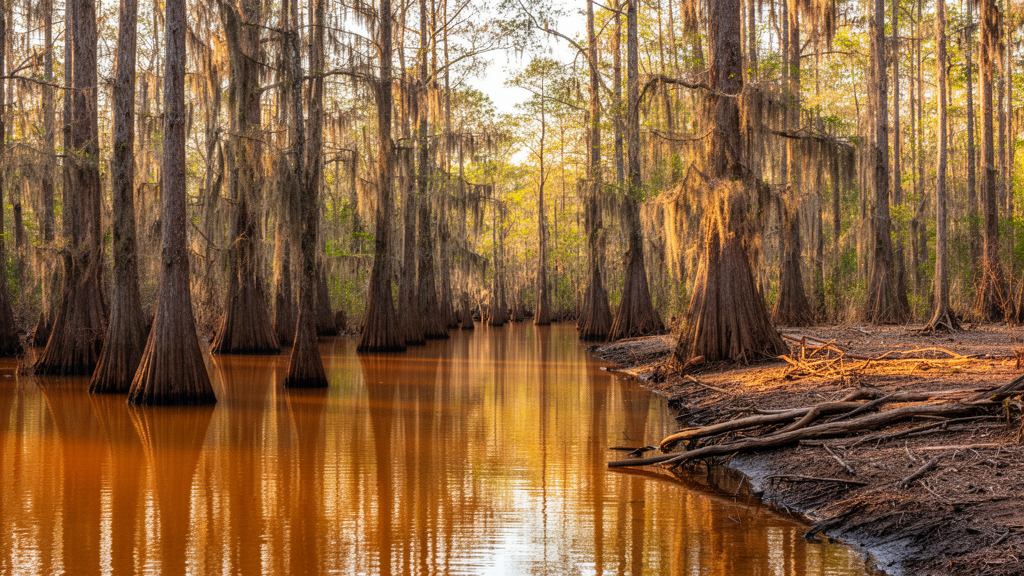
A satellite-based study of the 500 largest freshwater flooded forest swamps in the southeastern United States found no single region-wide relationship between long-term drought trends and vegetation productivity between 2000 and 2024. Associations were highly variable across locations: some coastal and southern areas experienced declining precipitation and drying conditions but had mixed productivity trends, whereas more inland and coastal northern areas showed increases in precipitation and wetness. The findings indicate that changes in cypress-tupelo swamp productivity cannot be attributed to a uniform coastal-wide response to drought.

Researchers used imagery from the Moderate Resolution Imaging Spectroradiometer, or MODIS, processed through Google Earth Engine to track changes across the 500 largest flooded forest swamps in the North American Coastal Plain. They examined three vegetation metrics—Leaf Area Index, Normalized Difference Vegetation Index and Enhanced Vegetation Index—and compared their trends with three commonly used drought indices. Seasonal decomposition and linear regression were used to assess long-term relationships, while local bivariate spatial associations examined how drought and productivity patterns varied geographically.

The overall correlations between drought trends and vegetation-productivity metrics were small, but that weak aggregate signal concealed substantial spatial variation. Coastal and southern regions, including parts of Texas, Florida and Louisiana, were experiencing decreases in precipitation. Their productivity trends were mixed rather than consistently declining.

In more inland and coastal northern areas, precipitation and wetness were increasing. These contrasting patterns show why geographic contrasts alone do not demonstrate a uniform decline in productivity or establish that drought caused the observed vegetation changes. The study supports a more complex interpretation of cypress-tupelo swamp productivity.

Precipitation and drought were among the factors associated with differences among swamps, but the results indicate that these hydroclimatic conditions do not explain productivity patterns uniformly across the Coastal Plain. The analysis is observational and is based on remotely sensed vegetation indicators rather than direct measurements of plant growth, so it does not establish the biological or environmental mechanisms behind individual local patterns. The supplied findings also do not show that wetter areas always became more productive or that drying areas always became less productive.

The authors warned that some areas may be at risk of further degradation if drying trends become more frequent under future climate change. That statement describes a potential risk rather than a demonstrated outcome, and the study did not show that drought caused ecosystem degradation at any particular site. Additional research on individual swamps is needed to determine how their vegetation productivity responds to changing environmental conditions.

Overall, the study documents heterogeneous relationships between hydroclimatic trends and productivity across the largest flooded forest swamps of the southeastern United States, underscoring the limits of treating the region as a single ecological system.

Subject of Research: Drought and vegetation-productivity trends in North American Coastal Plain flooded forest swamps

Article Title: Drought and productivity trends in freshwater flooded forest swamps in the North American Coastal Plain

Article References: Holland, I. R., Stan, K. D., & Tucker, C. S. (2026). Drought and productivity trends in freshwater flooded forest swamps in the North American Coastal Plain. Regional Environmental Change, 26(4), Article 217. https://doi.org/10.1007/s10113-026-02708-6

Image Credits: AI Generated

DOI: 10.1007/s10113-026-02708-6

Keywords: drought trends, wetland productivity, flooded forest swamps, North American Coastal Plain, cypress-tupelo swamps, MODIS, vegetation indices, precipitation, satellite imagery, southeastern United States, Drought, productivity

Cite Scienmag News

Sloane Callahan. (October 20, 2026). Research report: Drought and productivity trends in freshwater flooded forest swamps in the North American Coastal Plain. Scienmag. https://scienmag.com/research-report-drought-and-productivity-trends-in-freshwater-flooded-forest-swamps-in-the-north-american-coastal-plain/


Sloane Callahan. "Research report: Drought and productivity trends in freshwater flooded forest swamps in the North American Coastal Plain." Scienmag, 20 October 2026, https://scienmag.com/research-report-drought-and-productivity-trends-in-freshwater-flooded-forest-swamps-in-the-north-american-coastal-plain/. Accessed 20 October 2026.

Sloane Callahan. "Research report: Drought and productivity trends in freshwater flooded forest swamps in the North American Coastal Plain." Scienmag. October 20, 2026. https://scienmag.com/research-report-drought-and-productivity-trends-in-freshwater-flooded-forest-swamps-in-the-north-american-coastal-plain/

Tags: coastal vs inland wetland productivitycypress-tupelo swampsdroughtdrought impact on vegetation productivitydrought trendsflooded forest swampsFreshwater flooded forest swampsGoogle Earth Engine remote sensinglong-term drought trends in wetlandsMODISMODIS imagery analysisNorth American Coastal Plainprecipitationproductivityregional differences in swamp ecosystem resiliencesatellite imagerysatellite-based vegetation monitoringseasonal decomposition of vegetation datasoutheastern United Statesspatial variability in drought responsesvegetation indicesvegetation indices in swamp ecosystemswetland productivity
Share26Tweet16
Previous Post

Prototype augmented vision sensor cuts perception data by over 96%

Next Post

Post-remission muscle loss in rheumatoid arthritis improved by dipyridamole in mice

Related Posts

Research report: Is a cost-optimal wind farm also carbon-optimal? A layout optimization and control co-design study
Climate

Research report: Is a cost-optimal wind farm also carbon-optimal? A layout optimization and control co-design study

October 20, 2026
Collective memory linked to adaptation in six climate-vulnerable Pakistan communities
Climate

Collective memory linked to adaptation in six climate-vulnerable Pakistan communities

October 20, 2026
Kilometer-scale models improve forecasts by resolving diabatic Rossby wave errors
Athmospheric

Kilometer-scale models improve forecasts by resolving diabatic Rossby wave errors

October 20, 2026
Korean Firefighters Show Higher Median PFOA Levels in Serum
Climate

Korean Firefighters Show Higher Median PFOA Levels in Serum

October 20, 2026
What Is Clean Air Worth? South Korea Puts a Price Tag on PM2.5 Deaths
Climate

What Is Clean Air Worth? South Korea Puts a Price Tag on PM2.5 Deaths

October 19, 2026
Radar Satellites Map Cyclone Destruction in Bangladesh Through the Clouds
Climate

Radar Satellites Map Cyclone Destruction in Bangladesh Through the Clouds

October 19, 2026
Next Post
Post-remission muscle loss in rheumatoid arthritis improved by dipyridamole in mice

Post-remission muscle loss in rheumatoid arthritis improved by dipyridamole in mice

  • Mothers who receive childcare support from maternal grandparents show more optimized

    Mothers who receive childcare support from maternal grandparents show more parental warmth, finds NTU Singapore study

    27656 shares
    Share 11059 Tweet 6912
  • University of Seville Breaks 120-Year-Old Mystery, Revises a Key Einstein Concept

    1061 shares
    Share 424 Tweet 265
  • Bee body mass, pathogens and local climate influence heat tolerance

    682 shares
    Share 273 Tweet 171
  • Researchers record first-ever images and data of a shark experiencing a boat strike

    546 shares
    Share 218 Tweet 137
  • Groundbreaking Clinical Trial Reveals Lubiprostone Enhances Kidney Function

    531 shares
    Share 212 Tweet 133
Science

Embark on a thrilling journey of discovery with Scienmag.com—your ultimate source for cutting-edge breakthroughs. Immerse yourself in a world where curiosity knows no limits and tomorrow’s possibilities become today’s reality!

RECENT NEWS

  • Phosphorylated M18BP1 unlocks human condensin II on DNA
  • Single-embryo spatial multi-omic atlas maps Carnegie stage 12 organogenesis
  • Research report: Estimating invasive rodent abundance using removal data and hierarchical models
  • Trial finds broad poliovirus-neutralizing responses in infants

Categories

  • Agriculture
  • Anthropology
  • Archaeology
  • Athmospheric
  • Biology
  • Biotechnology
  • Blog
  • Bussines
  • Cancer
  • Chemistry
  • Climate
  • Earth Science
  • Editorial Policy
  • Marine
  • Mathematics
  • Medicine
  • Pediatry
  • Policy
  • Psychology & Psychiatry
  • Science Education
  • Science News
  • Social Science
  • Space
  • Technology and Engineering

Subscribe to Blog via Email

Enter your email address to subscribe to this blog and receive notifications of new posts by email.

Join 5,150 other subscribers

© 2025 Scienmag - Science Magazine

Welcome Back!

Login to your account below

Forgotten Password?

Retrieve your password

Please enter your username or email address to reset your password.

Log In
No Result
View All Result
  • HOME
  • SCIENCE NEWS
  • CONTACT US

© 2025 Scienmag - Science Magazine

Discover more from Science

Subscribe now to keep reading and get access to the full archive.

Continue reading