


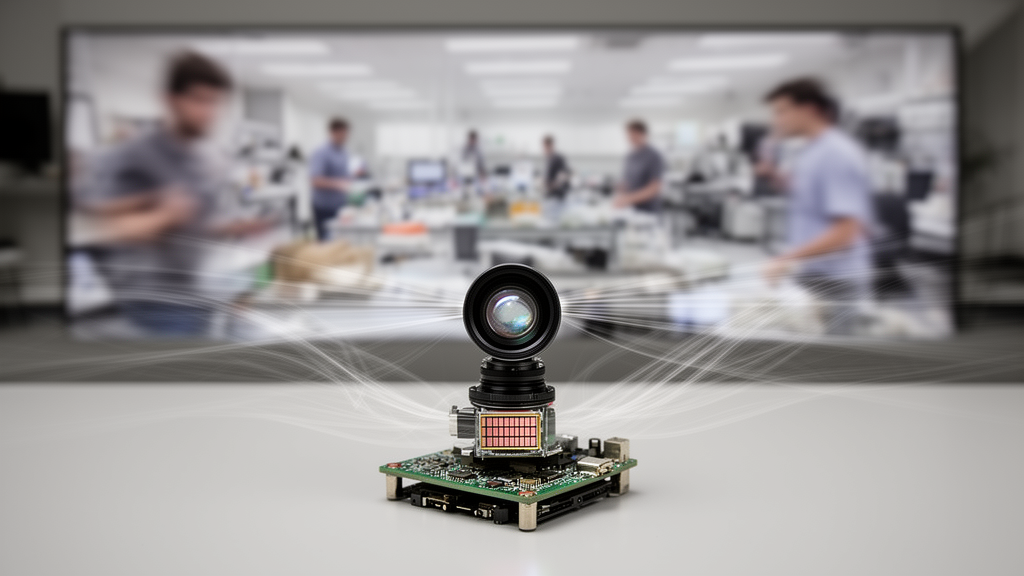
A prototype augmented vision sensor reduced the amount of data generated for machine perception by more than 96% while retaining substantial information for scene interpretation, according to a study in Nature Sensors . The researchers demonstrated a 34 × 34 sensor array that preserved an information entropy of 7.08 and supported accuracy above 90% in high-level inference tasks. The result comes from a hardware design that combines periodically stored, high-fidelity spatial information with asynchronous measurements of fast-changing scene dynamics.
Reliable machine perception must capture fine spatial detail for identifying objects and high temporal resolution for tracking motion. The study frames the simultaneous demand for these forms of visual information as a source of a data burden that can overwhelm computational resources. Its proposed response is to move part of the data-handling task to the sensor itself rather than relying entirely on resource-intensive processing after an image has been recorded.
The augmented sensor periodically captures and stores high-fidelity spatial semantics at a refresh rate of approximately 30 frames per second. At the same time, it asynchronously augments these stored images with event-driven data representing rapid transient changes. That division of labor gives the resulting dataset two complementary components.
The periodically recorded images provide detailed spatial semantics, while the event-driven stream records temporal dynamics at an effective temporal resolution of approximately 10 microseconds. When the two forms are combined, downstream systems receive a high-fidelity account of scene structure together with time-sensitive information about changes. The architecture therefore seeks to represent heterogeneous visual information directly at the sensor frontend, reducing the amount of data that must be transferred and processed in later computational stages.
The authors describe this integration as a means of supporting efficient extraction of information from a mixture of relatively stable spatial content and rapidly changing events. These measurements show that substantial data reduction was achieved in the tested setting without eliminating the information needed by the evaluated inference processes. The researchers present the work as a hardware solution for data-efficient and spatiotemporally precise machine vision, with potential relevance to autonomous agents that must recognize objects and follow motion.
Subject of Research: Prototype augmented vision sensor combining high-fidelity spatial storage with event-driven temporal measurements for data-efficient machine perception
Article Title: Augmented vision sensors for data-efficient and precise spatiotemporal perception
Article References: Ren, Q., Li, Z., Wang, Z., Zhang, C., Ma, S., Zeng, G., Wang, Y., Wang, J., Wu, J., & Chai, Y. (2026). Augmented vision sensors for data-efficient and precise spatiotemporal perception. Nature Sensors. https://doi.org/10.1038/s44460-026-00146-9
Image Credits: AI Generated
DOI: 10.1038/s44460-026-00146-9
Keywords: augmented vision sensors, machine vision, event-driven imaging, data efficiency, spatiotemporal perception, information entropy, high-level inference, autonomous agents, sensor arrays, Augmented, vision, sensors
Cite Scienmag News
Denise Maddox. (October 20, 2026). Prototype augmented vision sensor cuts perception data by over 96%. Scienmag. https://scienmag.com/prototype-augmented-vision-sensor-cuts-perception-data-by-over-96/
Denise Maddox. "Prototype augmented vision sensor cuts perception data by over 96%." Scienmag, 20 October 2026, https://scienmag.com/prototype-augmented-vision-sensor-cuts-perception-data-by-over-96/. Accessed 20 October 2026.
Denise Maddox. "Prototype augmented vision sensor cuts perception data by over 96%." Scienmag. October 20, 2026. https://scienmag.com/prototype-augmented-vision-sensor-cuts-perception-data-by-over-96/


