
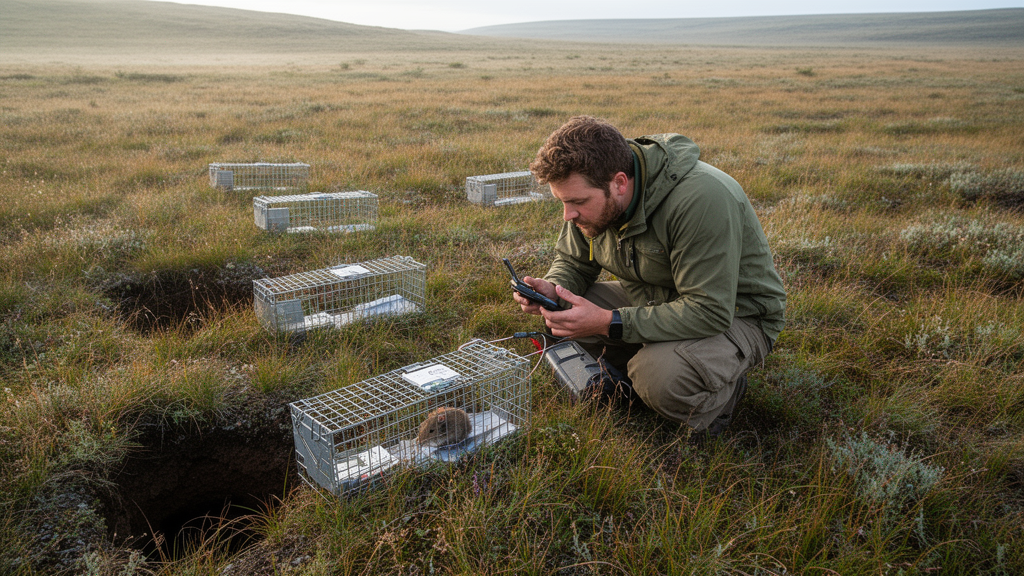
A hierarchical multinomial N-mixture model can estimate how many invasive coypus and muskrats remain after control operations while accounting for animals that are present but never detected. The study combined simulations with two field case studies and released accompanying code and data to support reproducible use of the method. Invasive rodents are difficult to monitor because ordinary counts record captures rather than all animals present.
Some individuals are missed, and standard removal campaigns permanently remove every individual caught. In the multinomial observation model, the sequence of capture counts is treated as a multinomial process. For three sampling occasions, a rodent may be captured in the first occasion, remain uncaptured until the second or third occasion, or never be captured during the campaign.
The number of animals available at the start is modeled as a separate ecological process, allowing the analysis to distinguish abundance from imperfect detection. The model does not estimate demographic survival in the closed-population version; the chance of remaining in the observation sequence represents not being removed. The hierarchical formulation adds flexibility for monitoring programs spread across multiple places or years.
Expected abundance can be modeled with a Poisson or negative-binomial distribution and linked to environmental covariates, while capture probability can vary among sampling occasions. Site random effects allow individual locations to retain local differences while sharing information across the broader network. In Bayesian analyses, abundance, capture probabilities and regression parameters are estimated with Markov chain Monte Carlo, producing posterior means and 95% credible intervals.
The study used the NIMBLE and ubms packages for the case-study implementations, while the simulation study used the unmarked package. Simulations tested 4,800 combinations of ecological and sampling conditions. Expected abundance ranged from 10 to 100 animals, capture probabilities ranged from 0.3 to 0.9, and the number of sampling occasions was three, five or 10.
The number of sites was one, five, 10 or 50, and each scenario was repeated 100 times. Under the assumption of a closed population, estimates generally showed little bias, good precision and satisfactory coverage of 95% confidence intervals. A notable deviation occurred with only one site, but increasing the network to 10 sites significantly reduced that bias, and no bias was observed with 50 sites.
This pattern supported the recommendation to analyze sites jointly rather than separately. Closure was examined in a second set of simulations in which the population could change between sampling occasions. Individuals remained in the population with probability 0.8, and new individuals arrived according to a Poisson process with mean 1.
Deliberately fitting a closed model to these open populations increased relative bias and reduced confidence-interval coverage, particularly when capture probability was low or the numbers of sites and occasions were limited. Immigration enlarged the pool available for capture, while emigration made declines appear to result from removal even when animals had not been trapped. The results show that model flexibility cannot fully compensate for an ecological process that differs materially from the assumptions on which the model is based.
The first field case examined coypus, also called nutria, removed in six cities in the Hérault department of southern France during February, March and April 2022. Operations were conducted by a network of volunteers, and the study used the resulting cage-removal records. Monthly totals varied sharply among cities.
Saint-Nazaire-de-Pezan recorded 169 removals in February, 41 in March and 15 in April, whereas Valergues recorded zero, one and three. Temperature had a negative estimated association with abundance under a Poisson model, with a slope of -0.14 and a 95% credible interval from -0.22 to -0.07. Estimated capture probabilities were 0.43 in February, 0.35 in March and 0.84 in April.
The French data also exposed a limitation of the Poisson assumption, which requires abundance to have equal mean and variance. Posterior site-level estimates were skewed, and a goodness-of-fit test for abundance returned a p-value of 0.04, indicating lack of fit. Replacing the Poisson distribution with a negative binomial accommodated the greater variability, and the abundance-component test then returned a p-value of 0.39.
Under that more flexible model, the estimated temperature slope changed to -0.27, with a 95% credible interval from -1.29 to 0.60, so the earlier association was no longer supported. The analysis was exploratory: it did not comprehensively assess the ecological factors influencing coypu abundance, and the small number of cities limited the scope of the spatial model. The muskrat analysis covered 215 Dutch municipalities represented by 5-by-5-kilometre atlas blocks, using removal records from January, February and March 2014.
A site random effect accommodated spatial variation not explained by temperature. The estimated temperature-abundance slope was -0.48, with a 95% credible interval from -0.70 to -0.26, while the site-effect standard deviation was 1.62, with an interval from 1.46 to 1.79. Capture probabilities were estimated at 0.12 in January, 0.25 in February and 0.60 in March.
The abundance component passed its goodness-of-fit check with a p-value of 0.44, but the observation component did not, with a p-value reported as zero for reasons that remained to be investigated. To examine temporal change, the researchers combined muskrat records from 1987 to 2014, treating each year-and-site combination as a separate unit. The estimated slope of the relationship between temperature and abundance declined over time, at -0.040 with a 95% credible interval from -0.042 to -0.039.
This is consistent with a weakening statistical relationship over time, but the analysis does not establish a causal mechanism for that change. The model can also report a coefficient of variation for each abundance estimate, revealing where uncertainty remains high and where additional sampling could improve precision. Explicit effort data, such as trap density, check frequency and staffing, were unavailable in the case studies, so capture probability was modeled by occasion rather than directly tied to measured effort.
For control programs, the central result is that removal totals can be converted into estimates of the population remaining when detection, spatial variation and population change are represented appropriately. The approach is especially relevant for semi-aquatic rodents, whose burrows can weaken riverbanks, dykes and dams, and for species that may carry zoonotic disease. Future spatial models could use restricted spatial regression to represent neighboring sites and could be adapted to account for stream networks.
Open-population extensions could model survival, recruitment and dispersal more explicitly, while systematic recording of removal effort would support prospective estimates of sampling requirements and statistical power. The study does not establish a universal abundance threshold or prescribe a control strategy; it demonstrates a way to quantify uncertainty and identify where additional monitoring may be needed for management decisions.
Subject of Research: Hierarchical abundance estimation for invasive rodents using removal sampling and N-mixture models
Article Title: Estimating invasive rodent abundance using removal data and hierarchical models
Article References: Gimenez, O. (2025). Estimating invasive rodent abundance using removal data and hierarchical models. NeoBiota, 103, 249-265. https://doi.org/10.3897/neobiota.103.145876
Image Credits: AI Generated
DOI: 10.3897/neobiota.103.145876
Keywords: invasive rodents, coypu, muskrat, abundance estimation, removal sampling, N-mixture models, population closure, Bayesian inference, spatial random effects, species control, Estimating, invasive
Cite Scienmag News
Patricia Pace. (October 20, 2026). Research report: Estimating invasive rodent abundance using removal data and hierarchical models. Scienmag. https://scienmag.com/research-report-estimating-invasive-rodent-abundance-using-removal-data-and-hierarchical-models/
Patricia Pace. "Research report: Estimating invasive rodent abundance using removal data and hierarchical models." Scienmag, 20 October 2026, https://scienmag.com/research-report-estimating-invasive-rodent-abundance-using-removal-data-and-hierarchical-models/. Accessed 20 October 2026.
Patricia Pace. "Research report: Estimating invasive rodent abundance using removal data and hierarchical models." Scienmag. October 20, 2026. https://scienmag.com/research-report-estimating-invasive-rodent-abundance-using-removal-data-and-hierarchical-models/