


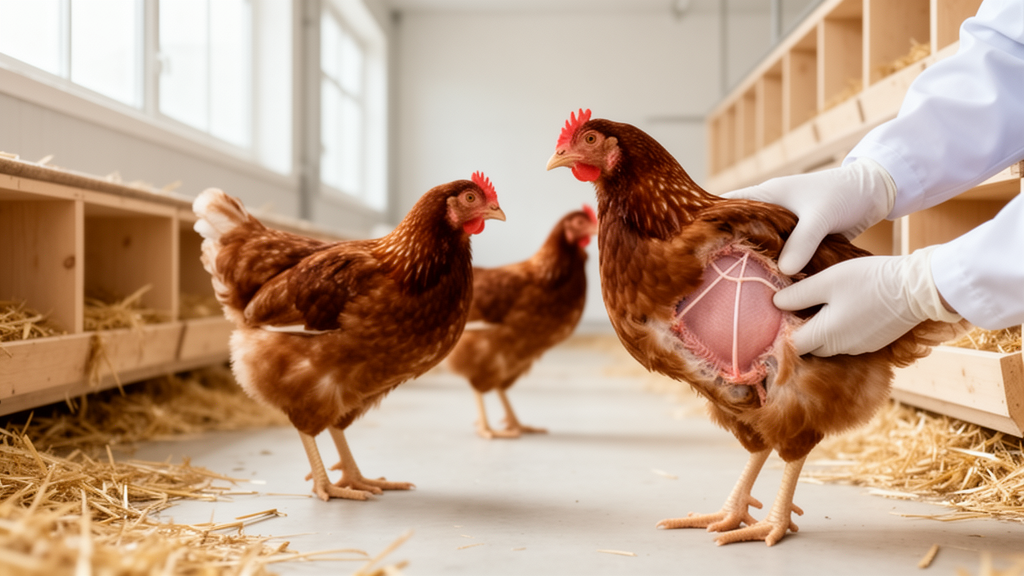
Two high-producing laying-hen hybrids developed keel bone fractures at strikingly higher rates than two traditional breeds in a longitudinal comparison of four chicken genotypes. Across the experiment, radiographs showed fractures in 90.1% of Lohmann Brown Classic hens and 87.5% of Lohmann Sandy hens. By contrast, 9.1% of American Leghorn hens and none of the Rhode Island Red hens were affected.
The exploratory study links the contrast with major differences in laying performance, growth and skeletal development, but it cannot establish that any single genetic or physiological factor directly caused the fractures. The study initially included 12 Rhode Island Red hens, 12 American Leghorns, 12 Lohmann Brown Classic hens and 12 Lohmann Sandy hens, with each group accompanied by two roosters. Eight hens were subsequently lost because of predation, death or medical conditions, leaving small groups for follow-up measurements.
The birds were kept under natural daylight, with access to outdoor enclosures, and were examined radiographically at six points between 16 and 72 weeks of age. Blood was collected at five of those occasions to measure ionized calcium, total plasma calcium, phosphate, 17β-estradiol and follicle-stimulating hormone. Researchers also assessed body weight, keel bone length, ossification, radiographic density, deviations and laying performance.
The design used one group per genotype, limiting the ability to distinguish genotype effects reliably from individual variation or group-specific conditions. No fractures were detected in any genotype at 16 weeks of age. They began appearing among the hybrids from 24 weeks onward, and prevalence rose sharply as the birds aged.
In Lohmann Brown Classic hens, the proportion with fractures reached 50% at 47 weeks, 54.5% at 52 weeks and 90.1% at 72 weeks. Lohmann Sandy reached 66.7% at 47 weeks and 87.5% overall. The American Leghorn result was 9.1%, while Rhode Island Red remained at 0%.
Of 47 radiographs containing fractures, 42 showed damage in the caudal third of the keel, and nine showed damage in the middle section; none involved the cranial third. Eleven radiographs displayed a visible fracture gap, while the other fractures were identified through callus formation associated with healing. The limited number of visible gaps, together with the study’s broader interpretation of the results, is consistent with bone stability being important in addition to high-impact falls or collisions, although the experiment did not directly compare these mechanisms.
Production and development differed substantially among the genotypes. Lohmann Brown Classic first laid an egg at 18 weeks of age and Lohmann Sandy at 19 weeks, compared with 23 weeks for American Leghorn and 30 weeks for Rhode Island Red. During their first laying year, the hybrids averaged 318 eggs per hen for Lohmann Brown Classic and 327 for Lohmann Sandy.
Rhode Island Red averaged 165 eggs and American Leghorn 142. Monthly laying intensity fluctuated more in the traditional breeds, ranging from 27% to 90% in Rhode Island Red and from 0% to 66% in American Leghorn, whereas the hybrids remained within ranges of 61% to 97% for Lohmann Brown Classic and 69% to 95% for Lohmann Sandy. Rhode Island Red hens were also larger: mean body weight across the final two sampling periods was 3,263 grams, versus 2,117 grams for American Leghorn, 2,151 grams for Lohmann Brown Classic and 2,071 grams for Lohmann Sandy.
Their longer growth period, later sexual maturation and changing keel measurements were consistent with slower physical development. Keel bone ossification advanced in all four genotypes between 16 and 33 weeks of age and was complete afterward. At 24 weeks, however, ossification was significantly more advanced in American Leghorn, Lohmann Brown Classic and Lohmann Sandy than in Rhode Island Red.
Because the investigators did not examine the birds exactly when each genotype began laying, the extent of ossification at onset of lay could not be measured directly. Comparisons across ages nevertheless indicated that ossification, and possibly mineralization, was less advanced in the hybrids than in American Leghorns when reproduction began: the hybrids laid their first eggs four and five weeks earlier, respectively, without showing significantly earlier completion of ossification. These observations do not establish that the hybrids entered lay before their skeletons had reached a stage comparable with the traditional breeds; the explicit comparison was with American Leghorns, whose ossification was already more advanced by 24 weeks.
Radiographic density, used as a proxy for bone mineral density, followed different trajectories across age and genotype. It increased between 16 and 47 weeks in Rhode Island Red, American Leghorn and Lohmann Sandy, while Lohmann Brown Classic density rose mainly between 33 and 47 weeks. At 33 weeks, Lohmann Brown Classic hens had significantly lower radiographic density than the other three genotypes.
From 47 weeks onward, Rhode Island Red hens had higher radiographic density than the other groups, although density declined in both Rhode Island Red and American Leghorn between 52 and 72 weeks. These values cannot be interpreted independently of body size and musculature. Heavier birds and thicker surrounding soft tissue can affect the radiographic signal, and the investigators noted that variations in pectoral muscle thickness might also reflect changes in exercise after the groups were moved to smaller outdoor runs at 46 weeks.
Blood measurements associated total calcium more clearly with laying activity than with fracture occurrence. Total plasma calcium increased in all four genotypes around the transition into lay, and birds judged to be in lay had significantly higher concentrations than non-laying birds. At 72 weeks, Lohmann Sandy hens had an average total calcium concentration of 7.52 millimoles per liter, compared with 6.56 for Lohmann Brown Classic, 5.19 for Rhode Island Red and 3.99 for American Leghorn.
The authors considered the higher hybrid values consistent with greater calcium transport associated with eggshell formation, but this was an interpretation rather than a measured causal pathway. Ionized calcium and plasma phosphate were highly variable and did not supply a simple explanation for the fracture pattern. The researchers also emphasized that feed intake, time of day and measurement method can influence these values.
Reproductive hormones also failed to provide a straightforward explanation for the difference in fractures. Plasma 17β-estradiol rose around puberty and the onset of laying in all four genotypes. At 24 weeks, Lohmann Brown Classic and Lohmann Sandy hens had significantly higher concentrations than Rhode Island Reds, but there were no significant genotype differences from 33 weeks onward.
Follicle-stimulating hormone increased significantly in every genotype between 33 and 52 weeks, when natural daylight lengthened from 8 hours 20 minutes to 12 hours 52 minutes. The authors considered seasonal photoperiod change a possible explanation, while warning that absolute hormone concentrations require caution because assays differed among studies. Small group sizes and a lack of individual laying-activity records also limited interpretation.
The experiment therefore identified a strong shared seasonal change in follicle-stimulating hormone, but it did not demonstrate that this change caused fractures or directly controlled laying intensity within the hybrid lines. Keel bone deviations followed a different pattern from fractures. Their prevalence fluctuated substantially, reaching 81.8% in Lohmann Sandy at 52 weeks.
American Leghorn deviations were detected at only one examination, when 8.3% of birds were affected. Among hens with a visible deviation, genotype did not significantly influence the percentage of the lateral keel surface affected. Even the maximum measured value was only 2.04%, and lateral radiographs may fail to reveal transverse deformation or underestimate it.
The study’s relatively generous space, comparatively low perches and early outdoor access may have limited the severity of deviations, although those factors were not tested experimentally. The biological consequences of the observed deviations therefore remain uncertain, and a deviation seen at one examination but not the next could represent either recovery or imperfect repeatability in radiographic detection. The findings reveal a pronounced welfare trade-off but do not prove that early laying, high egg output, hormone levels, calcium metabolism or incomplete ossification directly caused the fractures.
The genotypes differed simultaneously in body size, growth rate, reproductive timing, seasonal laying patterns, bone dimensions and possibly keel shape, making those factors difficult to separate. Seasonal laying pauses in the traditional breeds may also have been relevant: when hens leave lay, medullary bone recedes and structural bone can form, potentially helping maintain skeletal stability. The housing system, individual variation and the exploratory design prevent the results from establishing a single mechanism.
Larger controlled studies would be needed to determine why the high-performing hybrids developed fractures so consistently, whether the pattern reflects selection for multiple production traits rather than egg number alone, and which changes in development or management might reduce keel bone damage.
Subject of Research: Comparative study of keel bone fractures, skeletal development, reproduction and calcium metabolism in four laying-hen genotypes
Article Title: Keel bone damage and associated physiological parameters in traditional chicken breeds and hybrid layers
Article References: Hildebrand, L., Neukirchen, S., Fellmin, M., Mehlhorn, J., Petow, S., Schrader, L., Stracke, J., Weigend, S., & Eusemann-Keller, B. (2026). Keel bone damage and associated physiological parameters in traditional chicken breeds and hybrid layers. Frontiers in Physiology, 17, Article 1973493. https://doi.org/10.3389/fphys.2026.1973493
Image Credits: AI Generated
DOI: 10.3389/fphys.2026.1973493
Keywords: laying hens, keel bone fractures, animal welfare, poultry genetics, egg production, bone development, radiography, calcium metabolism, 17β-estradiol, follicle-stimulating hormone, Keel, bone
Cite Scienmag News
Juliet Wilcox. (October 20, 2026). Hybrid Laying Hens Show Far More Keel Bone Fractures. Scienmag. https://scienmag.com/hybrid-laying-hens-show-far-more-keel-bone-fractures/
Juliet Wilcox. "Hybrid Laying Hens Show Far More Keel Bone Fractures." Scienmag, 20 October 2026, https://scienmag.com/hybrid-laying-hens-show-far-more-keel-bone-fractures/. Accessed 20 October 2026.
Juliet Wilcox. "Hybrid Laying Hens Show Far More Keel Bone Fractures." Scienmag. October 20, 2026. https://scienmag.com/hybrid-laying-hens-show-far-more-keel-bone-fractures/


