


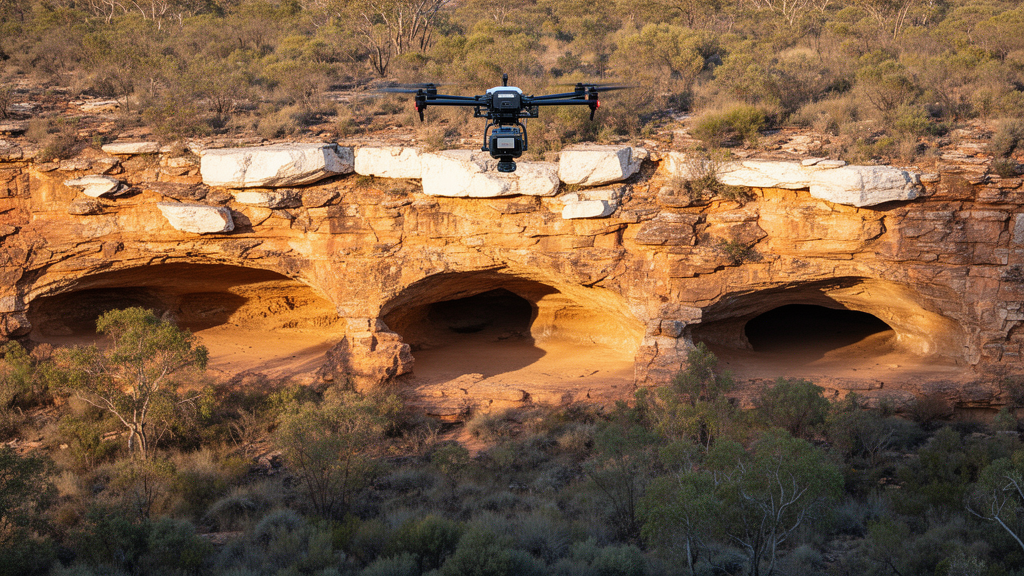
Drone-mounted laser scanning has helped archaeologists locate three previously unregistered Aboriginal rock shelters containing rock art and stone artefacts in Australia’s rugged Blue Mountains. Researchers from the University of Sydney and the Australian Museum, working alongside the Dharug Custodian Aboriginal Corporation, used drone-based LiDAR to identify potential shelters before teams verified them on the ground. The study, published in the peer-reviewed journal Remote Sensing, tested an aerial mapping method for finding cultural sites across landscapes that are difficult, expensive and time-consuming to investigate on foot. The three new finds include rock art featuring red hand stencils, alongside stone artefacts.
The work forms part of the Gulamada Project, which brings scientific knowledge and First Nations cultural knowledge together through an approach described as walking side by side. The Blue Mountains contain more than 200 recorded rock shelters with cultural and archaeological evidence, but researchers estimate that only about 10 percent of the region has been surveyed. Dense vegetation and challenging terrain restrict pedestrian reconnaissance, while conventional ground surveys require substantial time, labour and expense. The drone survey was therefore used to narrow the search for likely shelters, after which researchers entered the landscape to confirm their locations and examine whether they contained cultural material. The approach combined remote sensing with field verification rather than treating features visible in aerial data as archaeological discoveries without further checking.
LiDAR, or Light Detection and Ranging, uses laser pulses to create detailed three-dimensional maps of a landscape. In the project, the system was carried on a DJI M350 drone fitted with a YellowScan Explorer V2 LiDAR sensor. The airborne measurements helped researchers detect features that could be difficult to recognize beneath dense bushland and tree cover, including locations consistent with rock shelters. Once the analysis indicated possible sites, project co-director Dr Amy Mosig Way, a research archaeologist at the University of Sydney and the Australian Museum, led teams of students and volunteers into the field to verify the locations and assess whether the shelters contained cultural material. This staged process was central to the reported results: the drone survey helped direct ground investigation, and the identified shelters were subsequently checked and recorded in person.
The drone-based field surveys confirmed the locations of six rock shelters already listed in the Aboriginal Heritage Information Management System, the official NSW sites register, and identified three previously unregistered shelters containing rock art and stone artefacts. The surveys also produced more accurate coordinates for the six known sites than those recorded in AHIMS. After the aerial analysis highlighted possible locations, Wayne Brennan, an Indigenous rock art expert and project co-director at the University of Sydney, and Erin Wilkins of the Dharug Custodian Aboriginal Corporation led the recording of rock art at the confirmed sites. The newly documented shelters contained visually striking red hand stencils, while stone artefacts were also present. Their discovery expands the record of Aboriginal cultural sites in a region already noted for its natural and cultural significance.
Dr Jacob Bongers, lead author of the drone research and a digital archaeologist at the University of Sydney, said the methodology offers an efficient and accurate way to locate sites in rugged environments that are arduous, expensive and time-consuming to survey. He said its importance lies not only in the speed of aerial coverage but also in expanding the record of Aboriginal cultural sites and offering a method that may be applied in other regions. The Blue Mountains survey demonstrates a practical workflow in which drone observations provide candidates for attention and specialists conduct the subsequent cultural assessment and documentation. For Aboriginal communities, the researchers said, LiDAR can serve as an additional tool alongside existing knowledge and cultural practices for locating, documenting and protecting important heritage places before they are affected by development, erosion, bushfires or other threats.
The project received $248,610 from Round 1 of the Australian Government’s First Nations Heritage Grants program, managed by the Department of Climate Change, Energy, the Environment and Water. The program supports on-Country projects led by First Nations people to identify, record and protect First Nations heritage in existing World and National Heritage-listed places. Gulamada Project co-director Wayne Brennan said the project was designed as a nexus of science and culture and emphasized the importance of listening, learning and working together. The drone research also gave students opportunities to gain hands-on experience in cultural heritage research within a community-centred project. According to Dr Way, those field activities connected the technical survey with direct examination and recording of the shelters, while the collaboration gave the work an explicitly First Nations framework.
Looking beyond the Blue Mountains, the team plans to work with Aboriginal communities to test and adapt LiDAR-assisted surveys in different environments, including the tropical savannahs of western Arnhem Land and the semi-arid landscapes of western New South Wales. Those future studies are intended to determine how the approach performs and where it may be useful in settings unlike the densely vegetated Blue Mountains landscapes. The current findings do not by themselves establish how the method will operate in every environment, nor do they replace the knowledge and cultural practices through which Aboriginal communities understand and manage Country. Instead, the Blue Mountains study provides a documented example of aerial laser mapping assisting a search that was followed by ground verification, archaeological assessment and Indigenous-led recording of rock art.
The immediate achievement is a measured expansion of what is known about Aboriginal cultural heritage in the Blue Mountains. One survey confirmed six registered rock shelters, improved the recorded coordinates of those sites and identified three additional shelters that had not been registered. Those three sites contained both rock art and stone artefacts, showing that the survey extended the formal record rather than merely checking previously known locations. The project also shows how an airborne instrument can help focus limited ground-survey capacity in a region where only an estimated 10 percent has been surveyed. Its broader significance lies in the integration of several stages: drone data identified potential locations, field teams checked them, and trained specialists documented the cultural material once the shelters were confirmed.
For heritage managers, the proposed benefit is a faster and more targeted means of locating Aboriginal cultural sites before they are affected by threats such as development, erosion, bushfires or other changes. The authors caution implicitly through their proposed next steps that broader application must be tested with Aboriginal communities in additional landscapes rather than assumed from the Blue Mountains results. If those community-led trials support the approach, LiDAR-assisted surveying could help document and manage cultural landscapes in other parts of Australia. The method is not a substitute for field expertise, archaeological assessment or Indigenous knowledge. Its demonstrated role is narrower and more concrete: it can assist teams in locating promising shelters, extend the registry of Aboriginal sites and direct subsequent investigation toward areas that conventional ground surveys could otherwise overlook.
Subject of Research: Drone-based LiDAR surveys for Aboriginal rock shelters in Australia’s Blue Mountains
Article Title: Drones help archaeologists find Aboriginal rock art sites hidden in Australia’s rugged Blue Mountains
Article References: Drones help archaeologists find Aboriginal rock art sites hidden in Australia’s rugged Blue Mountains. Original publication (Bibliographic details unavailable.)
Image Credits: AI Generated
DOI: Not provided
Keywords: Aboriginal archaeology, Blue Mountains, drone surveying, LiDAR, rock art, cultural heritage, Dharug Custodian Aboriginal Corporation, Gulamada Project, remote sensing, rock shelters, Drones, help
Cite Scienmag News
Courtney Benton. (October 20, 2026). Drone LiDAR Finds Three Unregistered Aboriginal Rock Shelters. Scienmag. https://scienmag.com/drone-lidar-finds-three-unregistered-aboriginal-rock-shelters/
Courtney Benton. "Drone LiDAR Finds Three Unregistered Aboriginal Rock Shelters." Scienmag, 20 October 2026, https://scienmag.com/drone-lidar-finds-three-unregistered-aboriginal-rock-shelters/. Accessed 20 October 2026.
Courtney Benton. "Drone LiDAR Finds Three Unregistered Aboriginal Rock Shelters." Scienmag. October 20, 2026. https://scienmag.com/drone-lidar-finds-three-unregistered-aboriginal-rock-shelters/


