


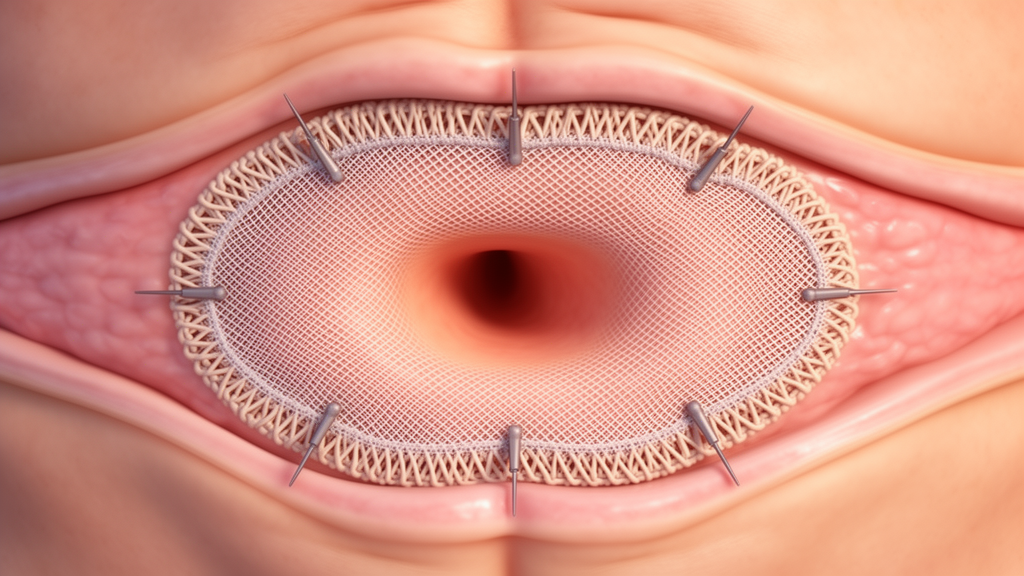
Laparo-endoscopic inguinal hernia repair may be better framed not as a choice between fixing a mesh and leaving it free, but as a test of whether the implant has been matched to the demands of the defect. A translational research programme reported in the Journal of Abdominal Wall Surgery combines pressure-chamber experiments, patient-specific mesh design, a multicentre randomised trial and defect-restricted clinical evaluation. Its central finding is that fixation status alone does not determine stability: mesh geometry, rigidity, shape and deployment interact with the size and type of hernia in a construct the authors call the mesh–defect–technique combination. The results support fixation-free repair in selected cases, including some large medial M3 defects, but they do not establish that every mesh can safely be used without fixation.
The argument begins with evidence that is already more complicated than a simple binary choice. International guidance recommends non-fixation for most transabdominal preperitoneal, or TAPP, and totally extraperitoneal, or TEP, repairs while retaining large medial defects, classified as M3, as a principal exception. Meta-analyses of randomised trials have not shown an overall recurrence advantage from routine fixation across broadly selected laparo-endoscopic populations, and some analyses suggest greater pain among fixed repairs. Registry analyses also associate recurrence or reoperation with the combined effects of defect class, mesh and fixation rather than fixation alone. These findings weaken the assumption that anchors are automatically required, yet they do not by themselves identify the stable element in a successful repair.
That missing element, according to Mateusz Zamkowski and Maciej Śmietański, is the mesh. A flat lightweight sheet, a rigid preformed implant and an anatomically shaped mesh may cover the same anatomical area without behaving equivalently under the forces applied during and after surgery. Medial pressure, folding, the loss of the pneumopreperitoneum and early patient movement can act on the implant. Stability also depends on dissection and parietalisation, sac and cord-lipoma reduction, mesh dimensions and effective overlap, orientation, conformity and the manner in which the operative space is closed or released. A fixed flat mesh may work well, but its success does not prove that the defect required fixation; equally, describing an implant as anatomical or lightweight does not ensure that it can remain stable without anchors.
The programme’s pressure-chamber experiments tested six spatial meshes and one flat macroporous mesh without fixation in the same three-dimensional groin model containing an M3 defect. Under the tested conditions, heavyweight spatial meshes and a lightweight individually designed anatomical mesh retained their positions. By contrast, lightweight implants with insufficient rigidity migrated toward the medial defect, whether they were flat or preformed. Because the defect, anatomical plane and absence of fixation were held constant, the investigators interpreted mesh behaviour as the decisive variable. The model does not establish long-term clinical effectiveness, but it suggests that labels describing weight or shape cannot substitute for direct evaluation of how an implant responds to a particular defect.
Patient-specific engineering offered a possible way to build stability into the implant rather than add anchors afterward. In the Individualized Laparoscopic Anatomical Mesh study, or ILAM, investigators used computed tomography to design an implant intended to provide patient-specific overlap and several contact zones. Its first implantation was uncomplicated, with no recurrence at 12 months. A single case cannot establish effectiveness, and the authors present it as a demonstration of a concept rather than proof of superiority. Even so, it illustrates how shape and geometry can potentially perform a stabilizing role traditionally assigned to tacks, sutures or adhesive.
The MEFISTO multicentre randomised trial, conducted in 12 Polish centres, enrolled 204 patients with M3 inguinal hernias. It compared two complete treatment strategies: a fixation-free approach using a rigid, anatomically shaped three-dimensional mesh, and a flat lightweight mesh secured with tissue adhesive. After 12 months, recurrence was reported in 3.1% of the fixation-free repairs and 2.1% of the adhesive-fixed repairs. The difference met the trial’s non-inferiority criterion, while pain, operating time and surgical complications did not differ significantly. The result shows that an M3 defect can be repaired without fixation when it is treated with the particular mesh and technique tested; it does not isolate the independent effects of mesh geometry and fixation.
That distinction is crucial because MEFISTO was not a same-mesh trial in which identical implants were randomly secured or left free. It compared the strategies surgeons actually use, making it relevant to practice while leaving the mechanical contribution of each component unresolved. The appropriate conclusion is not that all meshes can be left unfixed in all M3 defects. Rather, a large medial defect raises the mechanical demand on the repair without prescribing how that demand must be met. If a surgeon still chooses fixation, the authors argue, the reason should identify the instability being treated, why the selected mesh cannot supply adequate stability and what evidence supports the additional device.
Later results involving the SWING-Mesh sharpened the same point. Pressure-chamber testing across an M3 defect found that the lightweight preformed SWING-Mesh migrated at moderate pressure, while the medium-weight 3DMax MID Anatomical Mesh remained stable through the highest tested pressure. M3 defects were therefore deliberately excluded from the prospective multicentre clinical evaluation of fixation-free SWING-Mesh. Among 294 non-M3 repairs, 86.4% performed by TAPP and 13.6% by TEP, no recurrence was detected at three months. At 12 months, 233 cases were available for assessment and five recurrences were recorded, a rate of 2.15%; 93.1% of assessed patients were pain-free. However, 20.7% loss to follow-up and the absence of a control group limit certainty, and the findings cannot be generalized to the excluded M3 population.
Across these studies, the investigators propose treating the mesh–defect–technique construct as the primary unit of clinical evidence and research. A future comparison would need to specify the mesh by trade name, dimensions, geometry and relevant mechanical properties; classify the European Hernia Society defect; document dissection, parietalisation, deployment and release of the working space; and distinguish TAPP from TEP. Trials should also stratify by defect class, standardise definitions of recurrence and chronic pain, and report longer-term outcomes. Same-mesh randomised trials remain valuable for isolating fixation, while strategy trials are needed to compare the complete combinations used in practice. The authors further suggest that future guidance could replace the M3 fixation exception with a requirement to demonstrate stability, although that is a proposed research direction rather than an existing guideline.
The programme leaves important questions unanswered. Researchers still need to determine which properties best predict in vivo stability, whether pressure-chamber thresholds can predict clinical recurrence and whether fixation-free strategies remain non-inferior beyond five years. It is also unknown whether late recurrences arise through mechanisms that fixation could have prevented, whether the same construct performs differently in TAPP and TEP, and which patient or tissue factors alter the balance. A pressure-chamber model cannot reproduce every biological condition, the 12-month MEFISTO result does not establish the isolated effect of fixation, and the uncontrolled SWING-Mesh cohort was incompletely followed. Within those limits, however, the evidence points to a consequential shift in emphasis: before asking whether a mesh should be fixed, surgeons and researchers can ask whether the implant, its size and its deployment suit the defect. When the construct is stable on its own, fixation may add little; when anchors are used, their purpose should be explicit rather than assumed from defect classification alone.
Subject of Research: Mesh–defect matching and fixation in laparo-endoscopic inguinal hernia repair
Article Title: The fixation paradox: when less is more in laparo-endoscopic inguinal hernia repair
Article References: Zamkowski, M., & Śmietański, M. (2026). The fixation paradox: when less is more in laparo-endoscopic inguinal hernia repair. Journal of Abdominal Wall Surgery, 5, Article 17808. https://doi.org/10.3389/jaws.2026.17808
Image Credits: AI Generated
Keywords: inguinal hernia, hernia mesh, mesh fixation, M3 defects, TAPP, TEP, recurrence, pressure-chamber testing, patient-specific mesh, surgical outcomes, fixation, paradox
Cite Scienmag News
Ophelia Keating. (October 20, 2026). Mesh–Defect Matching May Matter More Than Fixation in Hernia Repair. Scienmag. https://scienmag.com/mesh-defect-matching-may-matter-more-than-fixation-in-hernia-repair/
Ophelia Keating. "Mesh–Defect Matching May Matter More Than Fixation in Hernia Repair." Scienmag, 20 October 2026, https://scienmag.com/mesh-defect-matching-may-matter-more-than-fixation-in-hernia-repair/. Accessed 20 October 2026.
Ophelia Keating. "Mesh–Defect Matching May Matter More Than Fixation in Hernia Repair." Scienmag. October 20, 2026. https://scienmag.com/mesh-defect-matching-may-matter-more-than-fixation-in-hernia-repair/


