


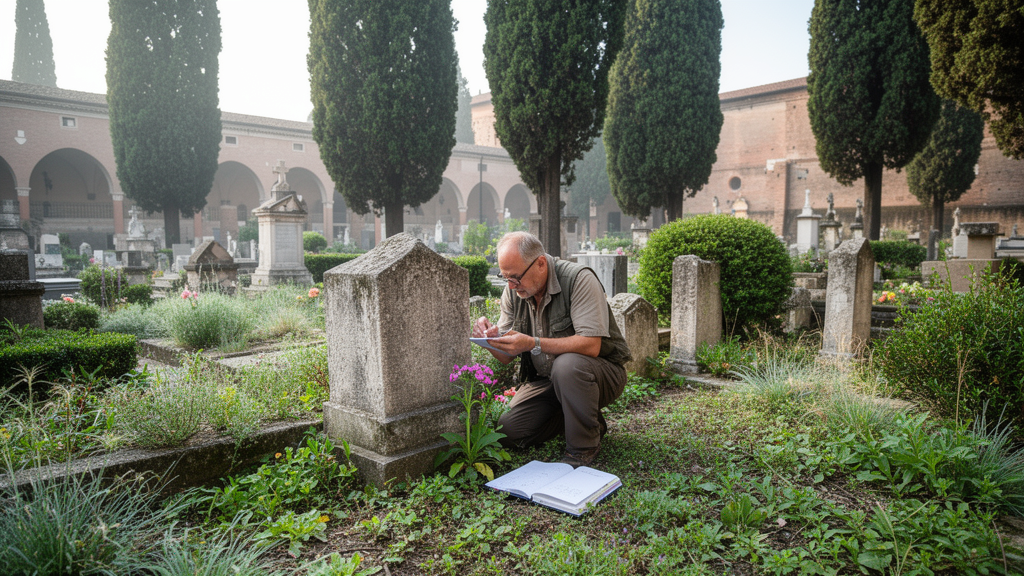
A survey of the spontaneous vascular flora of the Cimitero di San Cataldo in Modena recorded 266 plant species and subspecies across 4.8 hectares of monumental cemetery. Researchers working in the Italian city surveyed the Catholic cemetery’s historic sectors and the adjacent Jewish cemetery from 2019 to 2022, finding four taxa that were new to Italy, Emilia-Romagna or the province of Modena. The results show that a cemetery built as a setting for monuments and burials can also contain a varied community of plants in grasslands, gravel paths, tomb fissures, flowerbeds and other small habitats.
The study was the first systematic investigation of the spontaneous flora of a European historical monumental cemetery, according to the authors. San Cataldo was established as a burial ground outside Modena’s city walls in 1773 and expanded in the nineteenth and twentieth centuries. The Catholic complex contains an elaborate portico, eight rectangular burial sectors, old tombs along its southern perimeter and grasslands associated with an ancient ossuary. The neighboring Jewish cemetery opened in 1903 and occupies a square area divided into six sections. Both cemeteries are about 2 km northwest of the historic city walls and stand on deep, clay-rich, highly calcareous and moderately alkaline soils.
The investigators divided the landscape into four zones: the monumental core of the Catholic cemetery, ancient tombs along the southern wall, grassland around the ossuary and the full Jewish cemetery. Their areas ranged from 2,500 square metres for the perimeter tombs to 33,000 square metres for the monumental core, while the Jewish cemetery covered 10,000 square metres and the ossuary grassland 2,560 square metres. Green areas were mowed an average of seven to eight times per year, with no more than ten mowing events in exceptional years. This recurring management creates moderate disturbance rather than either intensive cultivation or complete abandonment.
Plant observations were made from February through October in each survey year, usually twice per month. The team also incorporated occasional observations made from April 1998 to April 2015 and herbarium specimens held at Modena’s Botanical Garden Herbarium. Investigators recorded spontaneous plants in grasslands, fissures between tombstones and paving stones, sandy deposits beside walls, hedgerows, grave flowerbeds, clay seams, gravel driveways and disturbed backfill. Ornamentally introduced species were included only when they had spread spontaneously. Plants were identified in the field where possible; otherwise, specimens were collected and examined with a stereomicroscope.
The full list represented 66 plant families and 175 genera. Asteraceae was the largest family with 37 taxa, followed by Poaceae with 35, Brassicaceae with 16, Fabaceae with 14, Rosaceae with 13, Caryophyllaceae with 12 and Lamiaceae with 11. Annual species, or therophytes, made up 37.6% of the total flora, followed by hemicryptophytes at 31.6%, phanerophytes at 16.2% and geophytes at 11.7%. Chamaephytes accounted for 2.6% and helophytes for 0.4%. Altogether, 83.8% of the recorded taxa were herbaceous, with the proportion ranging from 80.0% in the southern Catholic cemetery sector to 88.3% in the ossuary grassland.
The richest sector was the Catholic cemetery’s monumental core, where 129 taxa were recorded in 10 distinct growth environments. The southern perimeter area contained 100 taxa in seven environments, while the ancient ossuary grassland supported 61 taxa in four. The Jewish cemetery contained 180 taxa in eight environments. The number of taxa was strongly associated with environmental variety: the Pearson correlation coefficient between taxa and the number of growth environments was 0.709. Conversely, the zones had relatively distinct species compositions. The highest pairwise Jaccard similarity was 0.373 between the monumental core and the Jewish cemetery, indicating that they shared 37.3% of their recorded taxa. Other comparisons ranged from 0.132 to 0.353.
The flora was dominated by widely distributed geographic types. Eurasian species represented 32.0% of the total, Mediterranean species 26.3% and cosmopolitan species 24.8%. The ossuary grassland and Jewish cemetery had a somewhat more Mediterranean and thermophilous character, while the monumental and southern tomb sectors showed a stronger generalist tendency. The researchers linked the differences partly to physical design: the monumental core combines tombs, gravel paths, lawns, hedges and ornamental trees, whereas the ossuary area is dominated by a broad, enclosed grassland. Grave fissures, dry masonry, flowerbed soil and periodically mown turf create distinct microsites within the larger cemetery complex.
Four findings extended the documented floras of their respective geographic levels. The cultivated crabapple hybrid Malus × robusta ‘John Downie’, found in the ossuary grassland, was new to the flora of Italy. The ornamental conifer Calocedrus decurrens, recorded among the old southern tombs, and Salvia haematodes, found in all four surveyed zones, were new to Emilia-Romagna, while Epilobium ciliatum was new to the province of Modena. Three of the four additions were non-native to Italy. The authors also provisionally identified Symphytum bohemicum as a possible first regional record, but said that further investigation was required. They likewise recommended monitoring the crabapple hybrid and studying its possible parentage.
Introduced taxa made up 16.9% of the cemetery’s complete flora: 28 neophytes, nine archaeophytes and eight cryptogenic species. Neophytes represented 62.2% of the introduced list, and 67.8% of the neophytes had invasive behavior somewhere within their introduced range. At the regional level, four were classified as behaviorally invasive: Ailanthus altissima, Erigeron canadensis, Lonicera japonica and Vitis × koberi. Nevertheless, none of the introduced species was frequent or abundant within the surveyed cemetery. Only Erigeron sumatrensis and Euphorbia prostrata occurred relatively commonly, and their populations remained modest, generally numbering five to 10 individuals or fewer. The alien proportion ranged from 9.8% in the ossuary grassland to 22.0% along the southern wall.
Protected plants accounted for 2.6% of the total list. The seven nationally or regionally protected taxa included Allium roseum subsp. roseum, Bellevalia romana, Anacamptis morio, Ilex aquifolium, Orchis purpurea, Spiranthes spiralis and Taxus baccata. Three orchids, including Anacamptis morio, Orchis purpurea and Spiranthes spiralis, are also covered by CITES restrictions. Five of the seven protected taxa occurred spontaneously in the Jewish cemetery. More than 50 individuals of Spiranthes spiralis, an orchid described as rare in northern Italy and the Po Plain, were counted there, alongside about 25 Anacamptis morio plants and populations of Bellevalia romana. The authors identified these occurrences, together with the dry grassland character of the site, as indicators of naturalness and limited disturbance.
The survey found that 176 of the cemetery’s 266 taxa, or 66.2%, were already present in the flora of Modena’s historic center, but the cemetery also supported distinctive assemblages in its different sectors. The authors cautioned that comparisons with other European cemeteries must account for climate, area, environmental variety and national flora, particularly because studies of monumental cemeteries remain limited and Poland has been the most extensively surveyed country. Their results nevertheless identified San Cataldo as a compact site where protected native species, broad-ranging plants and introduced ornamentals can coexist under a regime of regular mowing. They called for comparable surveys at other monumental cemeteries to clarify whether these cultural landscapes consistently preserve unusual native flora or facilitate the spread of non-native plants into surrounding territory.
Subject of Research: Floristic diversity, introduced plants and protected species in Modena’s San Cataldo monumental cemetery
Article Title: Spontaneous vascular flora of the historical monumental cemetery of Modena (N-Italy)
Article References: Buldrini, F., Gianaroli, I., Bosi, G., Alessandrini, A., & Santini, C. (2023). Spontaneous vascular flora of the historical monumental cemetery of Modena (N-Italy). Italian Botanist, 15, 111-136. https://doi.org/10.3897/italianbotanist.15.102589
Image Credits: AI Generated
DOI: 10.3897/italianbotanist.15.102589
Keywords: urban botany, cemetery flora, plant diversity, floristic survey, Modena, San Cataldo Cemetery, non-native plants, protected orchids, urban conservation, monumental landscapes, Spontaneous, vascular
Cite Scienmag News
Margaret Porter. (October 20, 2026). Cemetery survey records 266 plant taxa in Modena’s monumental landscape. Scienmag. https://scienmag.com/cemetery-survey-records-266-plant-taxa-in-modenas-monumental-landscape/
Margaret Porter. "Cemetery survey records 266 plant taxa in Modena’s monumental landscape." Scienmag, 20 October 2026, https://scienmag.com/cemetery-survey-records-266-plant-taxa-in-modenas-monumental-landscape/. Accessed 20 October 2026.
Margaret Porter. "Cemetery survey records 266 plant taxa in Modena’s monumental landscape." Scienmag. October 20, 2026. https://scienmag.com/cemetery-survey-records-266-plant-taxa-in-modenas-monumental-landscape/


