


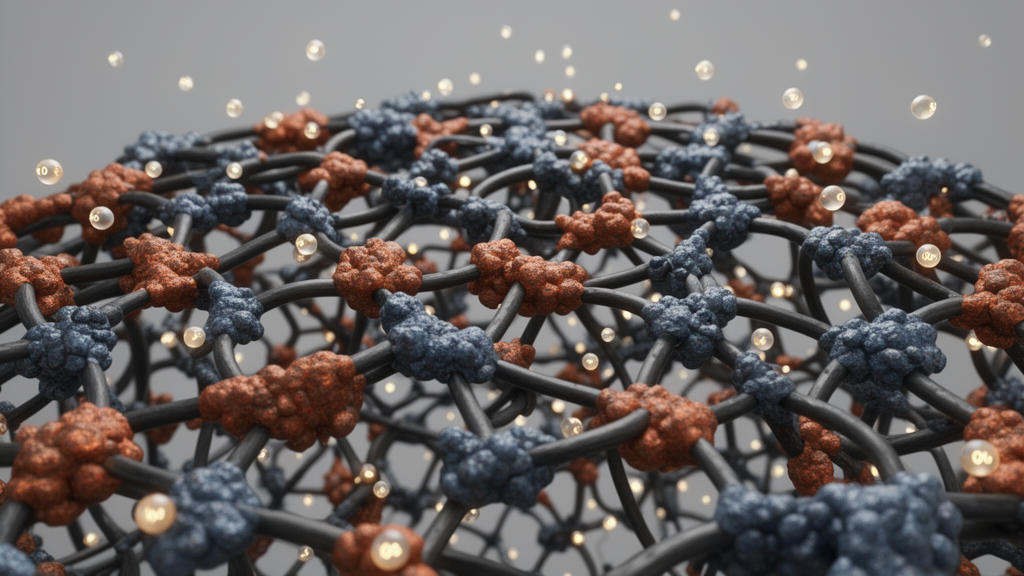
Supercapacitors have long promised a middle path between the instant power of capacitors and the endurance of batteries, but the materials inside them keep forcing a compromise. Electrodes that store a lot of charge tend to degrade quickly, while electrodes that survive millions of cycles rarely store much. A team of researchers at Government College University in Lahore, working with colleagues at the University of the Punjab, now reports a nanocomposite electrode that appears to break that trade-off. Writing in the journal Ionics, Syed Shehzad Hassan, Muhammad Imran and their collaborators describe an equimolar mixture of chromium oxide and zirconium oxide, wired together with acid-treated multi-walled carbon nanotubes, that delivers a specific capacitance of 748 farads per gram at a current density of 1 ampere per gram in a 3 molar potassium hydroxide electrolyte.
That figure is nearly 70 percent higher than the 441 farads per gram achieved by the same biphasic oxide without the carbon nanotube scaffold, and it is only part of the story. When the team assembled a full hybrid device using the composite as the positive electrode, the cell delivered 298 farads per gram at 1 ampere per gram, corresponding to an energy density of 112.68 watt-hours per kilogram at a power density of 821.15 watts per kilogram. For an aqueous, alkaline system, those numbers sit well above what conventional carbon-based supercapacitors, which typically top out around 5 to 10 watt-hours per kilogram, can offer. Just as importantly, the electrode retained 85 percent of its initial capacitance after 5,000 charge-discharge cycles, suggesting the architecture is not a laboratory flash in the pan but a structurally durable design.
The trick, according to the study, lies in combining three complementary functions in a single material. The starting point is a co-precipitation synthesis that produces an equimolar blend of two crystal phases: rhombohedral chromium(III) oxide, Cr2O3, and monoclinic zirconium dioxide, ZrO2. Because the two oxides do not dissolve into one another, the resulting powder is riddled with heterointerfaces, the atomic-scale boundaries where one crystal lattice meets another. These interfaces are electrochemically precious real estate. They provide abundant sites for reversible Faradaic reactions, the surface redox processes in which ions from the electrolyte are temporarily accommodated at the electrode while electrons shuttle through the external circuit, and they can also introduce defects and strain that make the surrounding lattice more reactive.
Chromium oxide alone has attracted attention as a pseudocapacitive material because chromium can cycle between oxidation states during charging and discharging, storing charge through genuine chemical reactions rather than the purely electrostatic adsorption that defines carbon-based double-layer capacitors. Zirconia, by contrast, is chemically robust and contributes structural stability and additional surface sites. Earlier work on Cr2O3-ZrO2 mixtures, notably in catalysis research, had already shown that the two oxides interact productively at their shared boundaries. The Lahore group exploited that chemistry for energy storage, characterizing the coexistence of the two phases with ultraviolet-visible spectroscopy, Fourier-transform infrared spectroscopy, energy-dispersive X-ray analysis and scanning electron microscopy, all of which confirmed a well-mixed biphasic morphology.
But a pseudocapacitive oxide is only as good as its electrical wiring. Transition-metal oxides are notoriously poor electronic conductors, which means that even if the surface sites are plentiful, electrons cannot reach them fast enough to sustain high charge and discharge rates. The second half of the design addresses exactly that bottleneck. The researchers functionalized multi-walled carbon nanotubes with acid treatment, a standard procedure that grafts oxygen-containing groups onto the nanotube walls, making them dispersible in solution and more chemically compatible with the oxide particles. When the oxides were hybridized with these treated nanotubes, the result was an interconnected conductive network threading through the active material, providing highways for electrons while the porous structure kept the electrolyte in close contact with every reactive site.
The electrochemical measurements show how much that wiring matters. Electrochemical impedance spectroscopy, a technique that separates the resistances contributing to a cell’s overall response, revealed substantially reduced charge-transfer resistance in the hybrid electrode compared with the pristine biphasic oxide. In practical terms, that means ions and electrons can meet at the interface more efficiently, so more of the theoretical capacitance is actually accessible at useful current densities. The capacitance of 748 farads per gram at 1 ampere per gram reflects this synergy: the oxides supply the redox activity, the interfaces multiply it, and the nanotubes ensure neither electrons nor ions are left waiting.
The cycling results are equally telling. Degradation in pseudocapacitive electrodes usually comes from volume changes during repeated ion insertion and removal, which pulverize the active material and detach it from the current collector. A composite in which oxide particles are anchored to a flexible, mechanically resilient nanotube network can absorb much of that strain. The 85 percent capacitance retention over 5,000 cycles in a demanding alkaline electrolyte indicates that the heterointerfaces and the carbon scaffold are doing more than boosting initial performance; they are also stabilizing the electrode against the mechanical and chemical wear that kills lesser materials.
The hybrid device results push the work from interesting materials science toward genuine application territory. Energy density of 112.68 watt-hours per kilogram, if it can be reproduced at scale and at the pack level, would put aqueous supercapacitors in the range where they could complement or even replace lithium-ion batteries in applications that demand rapid cycling, long calendar life and tolerance to abuse. Aqueous potassium hydroxide electrolytes are cheap, non-flammable and environmentally benign, a stark contrast to the organic solvents and lithium salts inside most commercial batteries. The trade-off has always been voltage window and energy density, and designs like this one attack that trade-off directly by packing more charge into the electrode material itself.
The study also fits into a broader trend in electrode engineering: rather than searching for a single miracle compound, researchers are increasingly stacking multiple functions into composite architectures. Recent literature reviewed by the team includes biphasic and ternary oxides, MXene hybrids, carbon-nanotube-supported nickel and cobalt systems, and biomass-derived carbons, all attempting the same balancing act between redox activity, conductivity and stability. The Lahore group’s contribution is a particularly clean demonstration of how two inexpensive, abundant oxides with no spectacular properties of their own can become exceptional when forced into intimate contact with each other and with a conductive carbon network. The synthesis route, a facile co-precipitation followed by hybridization, is deliberately simple, which matters enormously for any hope of scaling beyond the laboratory bench.
Challenges remain before such electrodes reach commercial devices. The reported energy density comes from a single-electrode and small-device measurement in idealized conditions, and real-world cells must balance positive and negative electrodes, manage electrolyte volume and survive thousands of cycles at higher mass loadings than laboratory electrodes typically carry. The authors note that no external datasets were generated or analyzed in the study, and the work was carried out without dedicated funding, relying on laboratory resources at Government College University Lahore. Still, the underlying principle, that heterointerface engineering combined with conductive carbon scaffolding can multiply the performance of humble transition-metal oxides, is a recipe other groups can immediately test and refine. If the numbers hold up under scale-up, the chromium-zirconium nanotube composite could become a template for a generation of supercapacitors that finally deliver battery-like energy with capacitor-like speed and durability.
Subject of Research: A biphasic Cr2O3-ZrO2/MWCNT nanocomposite electrode for high-performance supercapacitors
Article Title: Synergistic biphasic Cr₂O₃–ZrO₂/MWCNT nanocomposite: exceptional electrochemical performance for next-generation supercapacitors
Article References: Hassan, S. S., Imran, M., Baig, F., Saleem, A., Akhtar, M. J., Raza, S. M. H., & Rohaan, M. A. (2026). Synergistic biphasic Cr₂O₃–ZrO₂/MWCNT nanocomposite: exceptional electrochemical performance for next-generation supercapacitors. Ionics. https://doi.org/10.1007/s11581-026-07594-w
Image Credits: AI Generated
DOI: 10.1007/s11581-026-07594-w
Keywords: supercapacitors, Cr2O3, ZrO2, multi-walled carbon nanotubes, nanocomposite, pseudocapacitance, heterointerfaces, energy density, cycling stability, electrochemistry, co-precipitation synthesis, aqueous electrolyte
Cite Scienmag News
Denise Maddox. (October 19, 2026). Two Oxides and a Carbon Nanotube Web Push Supercapacitors Toward Record Energy Density. Scienmag. https://scienmag.com/two-oxides-and-a-carbon-nanotube-web-push-supercapacitors-toward-record-energy-density/
Denise Maddox. "Two Oxides and a Carbon Nanotube Web Push Supercapacitors Toward Record Energy Density." Scienmag, 19 October 2026, https://scienmag.com/two-oxides-and-a-carbon-nanotube-web-push-supercapacitors-toward-record-energy-density/. Accessed 19 October 2026.
Denise Maddox. "Two Oxides and a Carbon Nanotube Web Push Supercapacitors Toward Record Energy Density." Scienmag. October 19, 2026. https://scienmag.com/two-oxides-and-a-carbon-nanotube-web-push-supercapacitors-toward-record-energy-density/


