


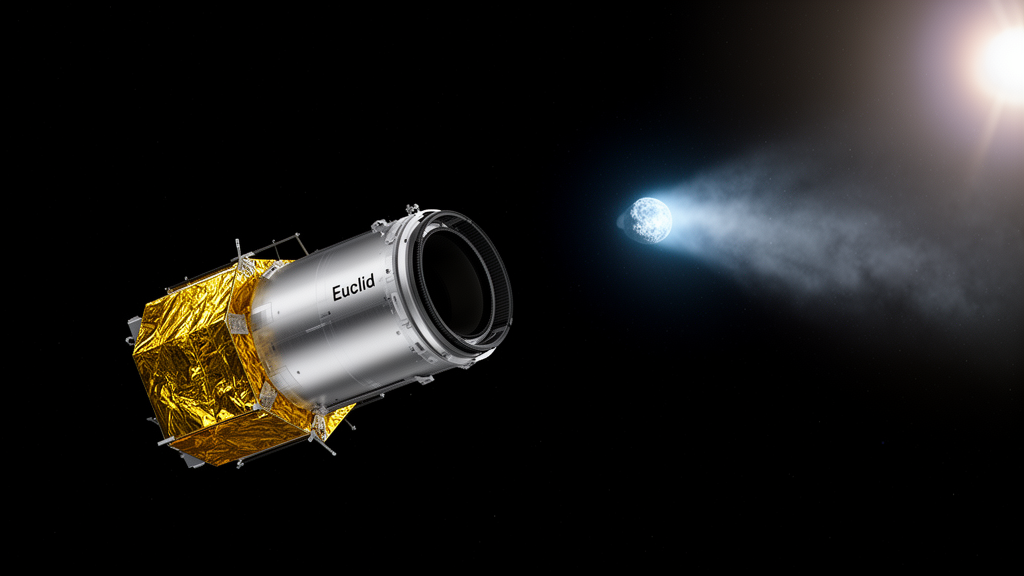
The European Space Agency’s Euclid space telescope, a mission engineered to map billions of distant galaxies in unprecedented detail, has achieved something its designers never specifically planned for: the discovery of a brand-new comet. Spotted in images taken between 16 and 24 September 2026, the object is now officially designated C/2026 S1 (Euclid), and it marks the first previously unknown comet ever found by the dark-matter-hunting observatory. Euclid had photographed comets before, but every one of those was already catalogued. This one was a genuine surprise, a streak of light smeared across deep-sky exposures that no human or database had ever recorded.
The discovery is technically remarkable precisely because Euclid was never built to chase fast-moving Solar System objects. The telescope’s core mission is to take deep, steady images of distant galaxies in order to reveal the hidden influence of dark matter and dark energy on the visible Universe. Over six years it will observe the shapes and motions of billions of galaxies out to 10 billion light-years away. Comets, by contrast, are nearby, fast, and faint, and they move appreciably even during a single long exposure. That Euclid could still catch one, and do so while the comet was still relatively far from the Sun, demonstrates an unexpected capability that could ultimately feed targets to ESA’s future Comet Interceptor mission.
The human story behind the find is equally compelling. Mikko Pöntinen, a PhD student at the University of Helsinki, made the initial discovery using moving object detection software that he developed himself to monitor small Solar System objects in Euclid’s images. In a statement released by ESA, Pöntinen described his excitement at seeing his software flag a streak smeared across several images, the telltale signature of a fast-moving object. By predicting the object’s position, he was able to identify it in other frames, ultimately finding it in five separate image sets. Further inspection revealed something crucial: a fuzzy cloud surrounding the object, the kind of coma produced only by an active body shedding dust and gas as it warms in sunlight.
That coma is the defining feature of a comet. Comets are icy, dusty leftovers from the birth of the Solar System about 4.6 billion years ago, mostly originating in the distant Kuiper Belt and Oort Cloud beyond the orbits of the outer planets. When a comet swings close to the Sun, its ices sublimate directly into gas, creating a glowing, fuzzy atmosphere and often a long tail stretching millions of kilometres. Because comets that originate in our own Solar System have changed very little since they formed, they act as pristine time capsules. Studying them helps scientists understand the raw ingredients and conditions that shaped the planets, including clues about where Earth’s water and the building blocks of life may have come from.
Once the coma was confirmed, the team checked the object against catalogues of known comets and asteroids and found no match. Pöntinen then reported the observations to the International Astronomical Union’s Minor Planet Center, the global clearing house that collects reports from observers worldwide, confirms new discoveries, calculates orbits, and assigns official designations. The report alerted ground-based astronomers who could contribute follow-up observations, and on 8 October the Minor Planet Center formally confirmed the object as a comet. It now carries the name C/2026 S1 (Euclid), a designation that will forever tie the object to the telescope that found it. The comet’s orbital period will be refined once more data has been collected.
The numbers involved are staggering. C/2026 S1 (Euclid) is located approximately 1.3 billion kilometres from Earth, a distance equivalent to roughly the span between the orbits of Jupiter and Saturn. Yet the comet does not lie in the same horizontal plane as the planets. Instead, from the Sun’s perspective it is currently positioned almost straight up above the Solar System, arching over the planetary plane on an orbit that will take thousands of years to complete. Such long-period comets are visitors from the outermost fringes of the Solar System, and each one carries a sample of material untouched since the planets formed.
What makes the discovery even more extraordinary is that Euclid deliberately avoids the asteroid- and comet-rich band of sky along the Solar System’s plane. The reason is practical: dust and glare from Solar System objects would contaminate the sensitive deep-sky imaging that the mission depends on. Finding new Solar System objects in Euclid’s data is therefore particularly challenging by design. Compounding the difficulty, the telescope’s step-and-stare imaging strategy typically visits each section of the sky only once, meaning a comet cannot simply be revisited on demand to confirm its characteristics. The team had to work with whatever frames happened to contain the moving object.
Luck played a role, and the scientists are candid about it. Bruno Altieri, Euclid Archive Scientist and part of the discovery team, noted that very few comets are expected to be discovered by Euclid, calling it a happy coincidence that the combination of the comet’s orbit and Euclid’s scanning over those days captured the object in multiple images. The comet was found in the Euclid Deep Field North, one of the mission’s specially designated deep survey regions, and was captured in five different fields of view over several days, with between two and four exposures per view, for a total of 16 exposures. The image released by ESA, taken on 20 September 2026 with a 560.52 second exposure, shows the comet as a streak because it moved across the sky during the long integration, wrapped in its fuzzy coma of dust and gas.
Tracking Solar System objects, even incidentally, is genuinely important to Euclid’s primary mission. Every moving object, comet trail, or stray patch of extra light in the field of view is noise that must be identified and removed from the precision galaxy mapping that underpins the mission’s cosmological goals. The Solar System Objects Science Working Group of the Euclid Consortium, on whose behalf the discovery was reported, exists precisely to catalogue and subtract these intruders. The discovery team included, alongside Pöntinen, A. A. Nucita, A. Franco, M. Granvik, B. Altieri, S. Kruk, B. Y. Irureta-Goyena and B. Carry, working across the consortium’s network of more than 2000 scientists from 300 institutes in 15 European countries, the USA, Canada and Japan.
Perhaps the most forward-looking aspect of the discovery is what it means for Comet Interceptor, ESA’s planned mission to visit a pristine comet on its first approach to the inner Solar System. While this particular comet is not a suitable candidate for Comet Interceptor, as Euclid Project Scientist Valeria Pettorino explained, the process of discovery and alerting gives the teams a real test case for how the two missions will coordinate in the future. The quick turnaround between identifying and validating the object proves that Euclid can detect new comets while they are still relatively far from the Sun, potentially leading to a suitable target for the interceptor. For now, the Solar System community has a newly confirmed comet to follow up on, and a galaxy mapper has proven it can also be a comet hunter when fortune and software align.
Subject of Research: Tech & Engineering
Article Title: Euclid discovers new comet
Article References: Euclid discovers new comet. Original publication (Bibliographic details unavailable.)
Image Credits: AI Generated
DOI: Not provided
Keywords: Euclid, ESA, comet, C/2026 S1, Minor Planet Center, Comet Interceptor, Solar System, discovers, scientific research
Cite Scienmag News
Grant Pearson. (October 19, 2026). Euclid space telescope discovers its first previously unknown comet. Scienmag. https://scienmag.com/euclid-space-telescope-discovers-its-first-previously-unknown-comet/
Grant Pearson. "Euclid space telescope discovers its first previously unknown comet." Scienmag, 19 October 2026, https://scienmag.com/euclid-space-telescope-discovers-its-first-previously-unknown-comet/. Accessed 19 October 2026.
Grant Pearson. "Euclid space telescope discovers its first previously unknown comet." Scienmag. October 19, 2026. https://scienmag.com/euclid-space-telescope-discovers-its-first-previously-unknown-comet/


