


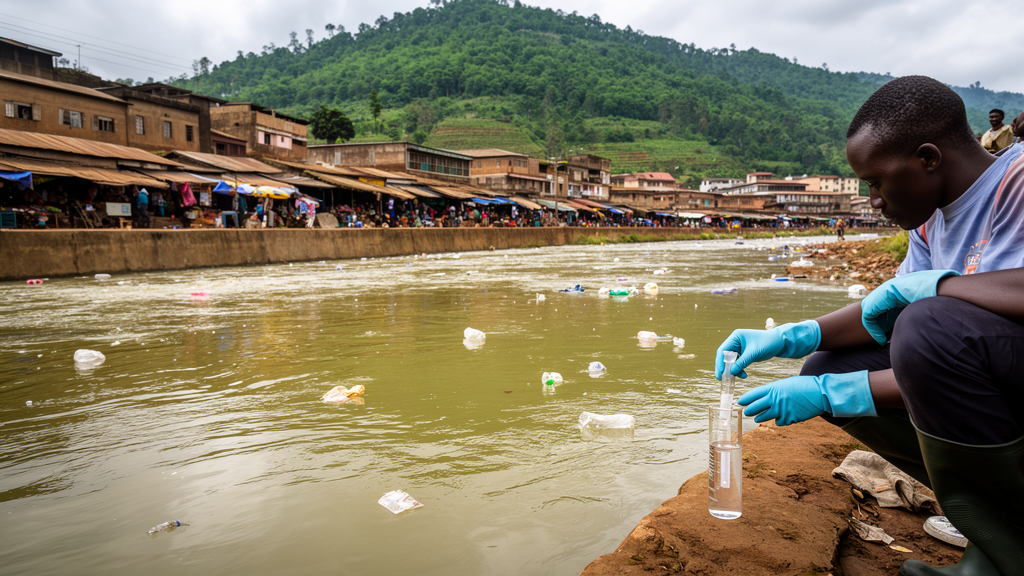
Deep in the heart of Kigali, Rwanda’s busiest commercial district, a river flows quietly past markets, workshops, and informal settlements. The Nyabugogo River has long been known to suffer from visible pollution, including plastic debris, untreated sewage, and sediment from erosion. But a new study has revealed something far less visible: a complex chemical signature of modern life, made up of dozens of pharmaceuticals, pesticides, and plant-derived compounds, flowing through the water in concentrations that vary dramatically depending on the time of day and the surrounding landscape.
Researchers from Umeå University in Sweden and the University of Rwanda conducted the first comprehensive screening of organic contaminants in the Nyabugogo River, analyzing 45 water samples collected from rural, peri-urban, and urban sections of the river and its tributaries. Their findings, published in the journal Environmental Monitoring and Assessment, provide the first baseline data on organic chemical pollution in Rwanda’s rivers and reveal a contamination pattern that closely mirrors the country’s rapid urbanization and its struggles with wastewater management.
The team targeted 158 compounds in total, including 145 pharmaceuticals, nine pesticides, and four polyphenolic compounds, selected based on regional usage patterns. Using solid-phase extraction followed by ultra-high-performance liquid chromatography coupled with tandem mass spectrometry, they detected and quantified 57 pharmaceuticals, five pesticides, and all four polyphenols. The most abundant pharmaceutical was albendazole, an antiparasitic drug used in mass deworming programs across sub-Saharan Africa, with an average concentration of 960 nanograms per liter. The highest pesticide level belonged to metalaxyl, a fungicide widely used in agriculture, at 70 nanograms per liter, while caffeic acid, a plant-derived phenolic compound, topped the polyphenol list at 49 nanograms per liter.
What makes these findings particularly striking is the spatial pattern they reveal. Pharmaceutical concentrations showed a clear rural-to-urban gradient, with consistently low levels in the sparsely populated upstream areas and markedly elevated concentrations as the river passes through Kigali. The difference between rural and urban pharmaceutical levels was statistically significant, reflecting the intense pressure that inadequate sanitation and wastewater infrastructure place on urban waterways. The highest concentrations were recorded at sites N18 through N21, located in the Nyabugogo wetland, an area previously identified as the most polluted section of the river.
The urban contamination spike is not difficult to explain. Kigali lacks a centralized sewer network, and approximately 95 percent of households rely on onsite sanitation systems, with pit latrines accounting for roughly 85 percent of these facilities. These structures can overflow or leak into adjacent channels, sending a steady stream of human waste, and the pharmaceuticals it contains, directly into the river. The Nyabugogo River also receives untreated domestic, institutional, and commercial effluents through multiple drainage channels, as well as industrial discharges from Kigali’s manufacturing sector.
In contrast to pharmaceuticals, pesticide and polyphenol concentrations did not differ significantly across rural, peri-urban, and urban zones. This homogenization suggests that the river functions as a hydrologically integrated system rather than a series of discrete pollution zones. Agricultural runoff in rural and peri-urban areas contributes pesticides that travel far downstream, while urban sources, including the washing of fruits and vegetables at the massive Nyabugogo food market, add their own chemical burden. The researchers suggest that continuous inputs from multiple tributaries and channels, combined with flow dynamics and natural degradation processes, effectively mix and normalize concentrations along the river’s length.
One of the most revealing aspects of the study involved intensive temporal monitoring at a single urban site, N21, located approximately 200 meters from the Nyabugogo Centre. Over five consecutive days, samples were collected at 8 a.m., 1 p.m., and 5 p.m. The results showed that pharmaceutical concentrations were significantly higher in the morning and evening compared to midday, with the average cumulative concentration reaching 7,300 nanograms per liter at 8 a.m., compared to 3,900 nanograms per liter at 1 p.m. and 6,000 nanograms per liter at 5 p.m.
This daily rhythm tells a story about human behavior as much as chemistry. The morning and evening peaks likely reflect patterns of domestic water use, market cleaning activities, and restaurant operations. But they may also reveal something more troubling: the illegal dumping of faecal sludge, which is typically carried out early in the morning or in the evening to minimize the risk of being caught. Informal channels in upstream informal settlements may also accumulate wastewater overnight and release it in a concentrated flush when morning activities begin. These socially mediated disposal practices, combined with structural limitations in Kigali’s sanitation infrastructure, create a predictable yet persistent pattern of contamination.
When the researchers compared concentrations across different days, they found no statistically significant variation for any of the compound classes. This consistency indicates that the contamination sources are what scientists call pseudo-persistent, meaning that pollutants are being released at roughly the same rate at which they are degraded or diluted. Unlike a one-time spill that fades over days or weeks, pseudo-persistent contamination represents a continuous, ongoing input that maintains elevated concentrations in the environment indefinitely. This distinction has important implications for ecological risk, as aquatic organisms are exposed to a constant chemical presence rather than episodic pulses.
The ecological implications of these findings extend well beyond the Nyabugogo River itself. The river is a tributary of the Nyabarongo River, which joins the Akanyaru River to form the Akagera River, ultimately draining 85 percent of Rwanda’s water into the Nile Basin via Lake Victoria. Pharmaceuticals can alter endocrine function, behavior, metabolism, and reproduction in aquatic organisms even at concentrations far below therapeutic doses. Pesticides can impair algae, phytoplankton, and aquatic plants, disrupting the foundation of aquatic food webs. Polyphenols can inhibit microbial growth and induce oxidative stress in aquatic life. When these compounds co-occur, as they clearly do in the Nyabugogo River, they may produce synergistic toxicity that exceeds the sum of their individual effects, contributing to biodiversity decline and ecosystem destabilization.
The researchers acknowledge several limitations in their study. River discharge and flow rates were not measured concurrently with contaminant concentrations, meaning that some of the observed temporal variations could reflect changes in dilution rather than changes in pollutant loading. Additionally, while the spatial distribution of contaminants and surrounding land-use patterns provided strong indications of potential sources, direct source attribution was not possible, as domestic, institutional, commercial, industrial, and agricultural discharges were not individually characterized or quantified.
Nevertheless, the study represents a critical first step in understanding organic chemical contamination in Rwanda’s waterways. The researchers call for improved wastewater and faecal sludge management, enhanced treatment of domestic and industrial effluents, reduced runoff of agricultural and market-related pollutants, and the establishment of regular monitoring programs for organic contaminants. Future research should extend monitoring to both wet and dry seasons, examine sediments and transformation products, and assess the toxicity of contaminant mixtures to aquatic organisms. As Kigali continues to grow and urbanize, the findings provide an essential scientific foundation for protecting not only the Nyabugogo River but also the downstream water systems that connect Rwanda to the broader Nile Basin.
Subject of Research: Occurrence and spatiotemporal variability of pharmaceuticals, pesticides, and polyphenols in the Nyabugogo River, Rwanda
Article Title: Occurrence and concentration variability of pharmaceuticals, pesticides, and polyphenols in Nyabugogo River, Rwanda
Article References: Mukarunyana, B., Nyandwi, E., Kabera, T., Boman, C., & Fick, J. (2026). Occurrence and concentration variability of pharmaceuticals, pesticides, and polyphenols in Nyabugogo River, Rwanda. Environmental Monitoring and Assessment, 198(11), Article 1196. https://doi.org/10.1007/s10661-026-16028-z
Image Credits: AI Generated
DOI: 10.1007/s10661-026-16028-z
Keywords: pharmaceuticals, pesticides, polyphenols, Nyabugogo River, water pollution, Rwanda, Kigali, wastewater management, LC-MS/MS, organic contaminants, urbanization, sanitation
Cite Scienmag News
Violet Maxwell. (October 19, 2026). Rwanda’s Nyabugogo River Carries a Hidden Cocktail of Drugs, Pesticides, and Plant Chemicals. Scienmag. https://scienmag.com/rwandas-nyabugogo-river-carries-a-hidden-cocktail-of-drugs-pesticides-and-plant-chemicals/
Violet Maxwell. "Rwanda’s Nyabugogo River Carries a Hidden Cocktail of Drugs, Pesticides, and Plant Chemicals." Scienmag, 19 October 2026, https://scienmag.com/rwandas-nyabugogo-river-carries-a-hidden-cocktail-of-drugs-pesticides-and-plant-chemicals/. Accessed 19 October 2026.
Violet Maxwell. "Rwanda’s Nyabugogo River Carries a Hidden Cocktail of Drugs, Pesticides, and Plant Chemicals." Scienmag. October 19, 2026. https://scienmag.com/rwandas-nyabugogo-river-carries-a-hidden-cocktail-of-drugs-pesticides-and-plant-chemicals/


