


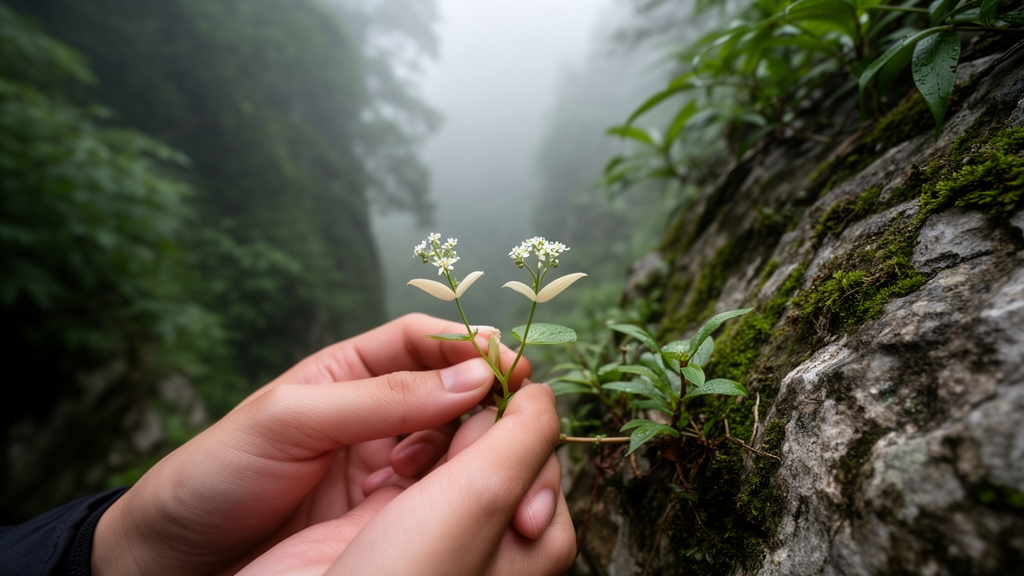
Deep in the subtropical evergreen broad-leaved forests of Jinzhong Mountain in northwest Guangxi, China, botanists have identified a plant unlike any other member of its genus. The species, now formally named Ophiorrhiza bibracteata, was discovered during field surveys conducted in the Guangxi Jinzhong Mountain Black-necked Pheasant National Nature Reserve in Longlin County, at an elevation of roughly 1,715 meters. The find, described and illustrated in the journal PhytoKeys, adds a new branch to one of the most taxonomically challenging genera in the coffee family, Rubiaceae, and highlights how much botanical diversity still remains hidden in the mountain forests of southern China.
The story of the discovery began in November 2025, when researchers encountered an unusual Ophiorrhiza plant carrying flower buds in the forest understory. What immediately caught their attention was a distinctive feature: two large, ovate, persistent bracts enclosing the buds and partially covering the flowers. Bracts are modified leaves associated with the inflorescence, and in most Ophiorrhiza species they are either small, linear, or quickly shed. After consulting the relevant literature, comparing herbarium specimens, and returning to the site in February and March 2026 to collect flowering and fruiting material, the team confirmed that the plant was new to science. The species was named O. bibracteata, from the Latin meaning “two bracts,” a direct reference to the trait that set it apart at first glance.
Ophiorrhiza is a large and notoriously complex genus. Estimates of its size vary widely, from roughly 200 to 300 species in older treatments to 384 accepted names in current checklists. The genus is distributed primarily across the tropical and subtropical regions of Asia, and its members are mostly annual or perennial herbs, with subshrubs being rare. One of the most reliable ways to recognize the genus is by its fruit: obcordate, meaning heart-shaped with the point at the top, flattened capsules that split open along a transverse slit at the apex into two valves. Yet while the genus as a whole is easy to characterize, telling individual species apart can be extremely difficult. Significant morphological variability within species, combined with the fact that the flowers of most species remain poorly documented, has long frustrated taxonomists working on the group.
China is a major center of diversity for Ophiorrhiza. Around 72 species have been documented within its borders, roughly 50 of which are found nowhere else. The bulk of this diversity is concentrated in southern and south-western China, with Guangxi and Yunnan provinces standing out as particular hotspots. The discovery of O. bibracteata in Longlin County, in the northwest of Guangxi Zhuang Autonomous Region, reinforces the picture of this region as an evolutionary cradle for the genus, where isolated mountain forests have allowed distinct lineages to persist and diverge.
So how exactly does the new species differ from its closest relatives? The authors compared O. bibracteata in detail with three allied species: O. mitchelloides, O. nanlingensis, and O. grandibracteolata. Several diagnostic characters emerged. The new species has five to seven pairs of secondary veins on its leaves, compared with three to five pairs in O. mitchelloides and seven to ten pairs in O. grandibracteolata. Its bracts are ovate and 8 to 11 millimeters long, whereas O. mitchelloides has linear bracts of 4 to 8 millimeters and O. nanlingensis has tiny, subulate bracts of only 0.5 to 2.0 millimeters. The calyx lobes of the new species are triangular, 0.8 to 1.0 millimeters long, glabrous, and accompanied by glands between the lobes, a combination not seen in its relatives. Perhaps most tellingly, O. bibracteata bears distylous flowers, meaning the species produces two floral forms that differ in the relative lengths of the style and stamens, while both O. mitchelloides and O. nanlingensis are monostylous, with only a single floral form.
The full description of the plant reveals a delicate creeping herb. O. bibracteata grows to about 20 centimeters tall, with most of its internodes prostrate and rooting at the nodes, a habit that helps it spread across the moist forest floor. The stems are densely pubescent with short brown unicellular trichomes. The leaves are arranged in subequal to unequal pairs, with blades that dry papery to membranous and are broadly elliptic or ovate, measuring 1.5 to 4.5 centimeters long and 1.5 to 3.0 centimeters wide. The upper leaf surfaces are dark green and sparsely scabridulous, while the lower surfaces are yellowish-green with sparse hairs along the veins. The corolla is funnelform, pale pink or white, with a tube 16 to 18 millimeters long and lobes 8 to 12 millimeters long that are narrowly winged on the outside. The capsules are mitriform, or cap-shaped, and slightly puberulent.
The distyly of the new species deserves particular attention. In distylous plants, long-styled flowers have stigmas positioned above the anthers, while short-styled flowers have the reverse arrangement, a mechanism that promotes cross-pollination between different floral forms. In the longistylous flowers of O. bibracteata, the stamens are included near the middle of the corolla tube while the style, 16 to 18 millimeters long, carries the stigma outside the tube. In brevistylous flowers, the stamens are partly exserted with filaments about 3 millimeters long, while the style measures only 6 to 8 millimeters. This reproductive architecture, documented in detail through dissections and line drawings, provides taxonomists with a robust set of characters for distinguishing the species and offers material for future studies of breeding systems in the genus.
Beyond its scientific novelty, the discovery carries practical weight. Species of Ophiorrhiza are widely used in traditional medicine across tropical Asia to treat ailments ranging from snakebites and ulcers to inflammation and skin infections. More significantly for modern pharmacology, the genus is known for producing camptothecin, a potent monoterpene indole alkaloid with established anticancer activity. Species such as O. mungos and O. rugosa have been identified as promising natural sources of this compound. Because the medicinal value of a plant depends on accurate species identification, every newly described Ophiorrhiza represents a potential addition to the pool of medicinally valuable germplasm, and a reminder that conservation and bioprospecting both depend on sound taxonomy.
For now, the conservation status of O. bibracteata remains uncertain. The species is known only from its type locality in Longlin County and nearby sites within the same area, where it grows in moist places under subtropical evergreen broad-leaved forest at around 1,715 to 1,722 meters elevation. It flowers in February and fruits in March. Because the available data are still insufficient to evaluate its rarity or vulnerability, the authors assessed the species as Data Deficient under the IUCN Red List Categories and Criteria, and they emphasize that further collection and monitoring are necessary before any conclusive estimate of its conservation needs can be made.
The authors also note that the discovery underscores the broader need for integrated taxonomic work on the genus. Molecular phylogenetic studies have begun to clarify evolutionary relationships within Ophiorrhiza, and recent work has even led to the transfer of the genera Spiradiclis and Keenania into Ophiorrhiza based on evidence of paraphyly, although the new paper follows the traditional generic delimitation. Comprehensive revisions that combine morphological, molecular, and ecological data are still needed to fully resolve species boundaries. The variation in bract size, shape, and persistence observed across related species may reflect adaptations to environmental factors such as light intensity, humidity, and herbivore pressure, with larger persistent bracts potentially offering better protection for developing flowers and fruits. Future DNA sequencing and phylogenetic analysis of O. bibracteata will help determine whether this creeping mountain herb indeed represents a distinct evolutionary branch, and may reveal how the peculiar twin bracts that gave the species its name fit into the long evolutionary story of one of Asia’s most diverse plant genera.
Subject of Research: Description of a new plant species, Ophiorrhiza bibracteata (Rubiaceae), from Guangxi, China
Article Title: Ophiorrhiza bibracteata ( Rubiaceae ), a new species from Guangxi, China
Article References: Nong, Y., Wei, G.-Y., Wei, H.-Y., Long, L., Liu, Z.-R., Feng, B., & Qin, T. (2026). Ophiorrhiza bibracteata (Rubiaceae), a new species from Guangxi, China. PhytoKeys, 275, 151-161. https://doi.org/10.3897/phytokeys.275.189773
Image Credits: AI Generated
DOI: 10.3897/phytokeys.275.189773
Keywords: Ophiorrhiza bibracteata, Rubiaceae, new species, Guangxi, China, botany, taxonomy, camptothecin, distyly, plant conservation, PhytoKeys, biodiversity
Cite Scienmag News
Margaret Porter. (October 19, 2026). New Snake-Root Plant With Twin Bracts Discovered in China’s Guangxi Mountains. Scienmag. https://scienmag.com/new-snake-root-plant-with-twin-bracts-discovered-in-chinas-guangxi-mountains/
Margaret Porter. "New Snake-Root Plant With Twin Bracts Discovered in China’s Guangxi Mountains." Scienmag, 19 October 2026, https://scienmag.com/new-snake-root-plant-with-twin-bracts-discovered-in-chinas-guangxi-mountains/. Accessed 19 October 2026.
Margaret Porter. "New Snake-Root Plant With Twin Bracts Discovered in China’s Guangxi Mountains." Scienmag. October 19, 2026. https://scienmag.com/new-snake-root-plant-with-twin-bracts-discovered-in-chinas-guangxi-mountains/


