


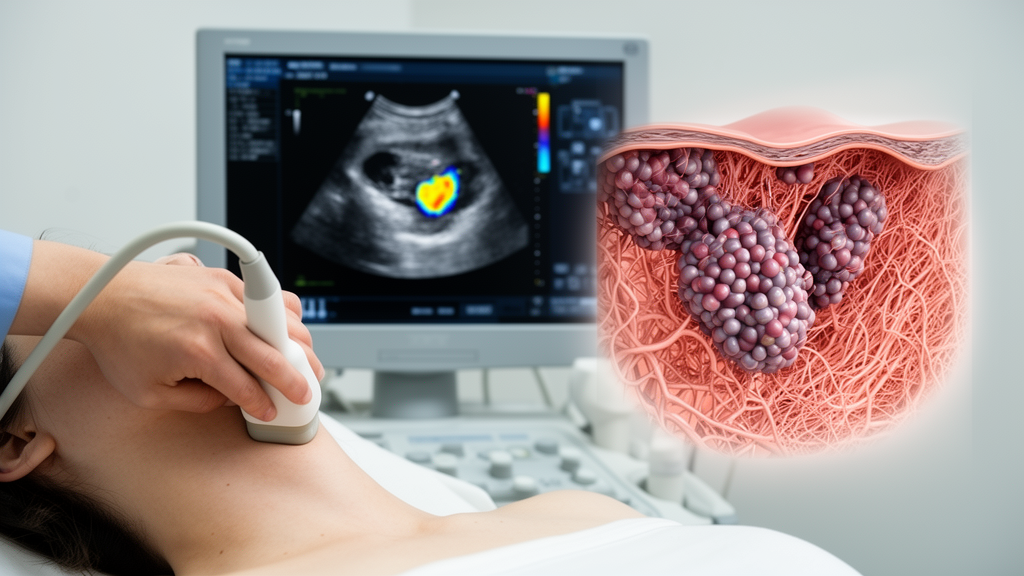
A routine ultrasound scan of the thyroid may soon tell surgeons far more than the size and shape of a nodule. New research from Shanxi Bethune Hospital in Taiyuan, China, suggests that a single number produced by an advanced ultrasound technique can reveal, before any incision is made, whether a papillary thyroid carcinoma harbors a dense population of cancer-associated fibroblasts, the stromal cells widely regarded as engines of tumor aggression. The study, published in Frontiers in Endocrinology, followed 158 patients with pathologically confirmed papillary thyroid carcinoma and found that the maximum elasticity value measured by shear wave elastography, known as Emax, tracked the abundance of these fibroblasts more closely than any other imaging feature the team examined.
Cancer-associated fibroblasts, or CAFs, are not cancer cells themselves. They are recruited and reprogrammed neighbors that form a critical part of the tumor microenvironment, the complex ecosystem of cells, vessels, and scaffold material that surrounds every tumor. In papillary thyroid carcinoma, the most common form of thyroid cancer, high CAFs expression has been linked to extrathyroidal extension, cervical lymph node metastasis, and multifocal disease. In other words, tumors rich in activated fibroblasts tend to behave badly, even though papillary thyroid carcinoma as a whole carries a relatively favorable prognosis. The clinical dilemma is that this biological information has traditionally been locked inside the tumor, accessible only after surgery, when pathologists stain tissue sections for fibroblast markers under a microscope.
The Chinese team, led by Tingting Li of the Department of Ultrasound, set out to break that barrier. Their reasoning rested on a physical principle: activated fibroblasts are prolific builders. They secrete extracellular matrix components such as collagen and release matrix-modifying enzymes that cross-link and remodel the tumor stroma. The result is a tumor that is not just biologically aggressive but mechanically stiffer. If stiffness could be measured quantitatively, it might serve as a non-invasive proxy for fibroblast activation. Shear wave elastography, available on modern ultrasound systems, does exactly that, generating maps of tissue stiffness expressed in kilopascals by tracking how shear waves propagate through tissue.
Between December 2023 and December 2024, the researchers enrolled consecutive patients who underwent thyroid surgery at their hospital. Each participant received conventional ultrasound and shear wave elastography within one month of surgery, using an Aixplorer system with a high-frequency linear probe. A single sonographer with more than a decade of thyroid experience acquired all images, and two blinded sonographers independently evaluated every parameter, with disagreements settled by a third. Conventional features recorded included tumor size, echogenicity, margins, aspect ratio, punctate echogenic foci, suspected extrathyroidal extension, and blood flow graded on the Adler scale from 0 for no flow to 3 for rich flow. Elastography yielded maximum, mean, minimum, and standard deviation elasticity values, averaged over at least three acquisitions per lesion.
The ground truth came from the operating room and the pathology laboratory. After tumor removal, tissue was fixed, embedded, and sectioned at four micrometers, then stained immunohistochemically for two canonical CAFs markers: fibroblast activation protein, or FAP, and alpha-smooth muscle actin, or alpha-SMA. A blinded pathologist scored staining intensity and the proportion of positive stromal cells across five high-magnification fields, multiplying the two scores into an immunoreactivity score, or IRS. Cases were split into low and high expression groups at an IRS cutoff of six, the median value. Reproducibility was excellent, with intra-class correlation coefficients of 0.934 for FAP and 0.939 for alpha-SMA.
The results were striking. Tumors in the high-expression groups were larger, more often suspected of extending beyond the thyroid capsule, and dramatically stiffer. Mean Emax was 50.60 kilopascals in the low FAP group versus 97.01 kilopascals in the high FAP group, with a nearly identical split for alpha-SMA. Elasticity heterogeneity, captured by the standard deviation ESD, also differed sharply between groups. Blood flow grade separated the FAP groups but not the alpha-SMA groups. Notably, the familiar grayscale features that radiologists rely on daily, including echogenicity, margins, aspect ratio, and punctate echogenic foci, showed no significant association with fibroblast expression at all.
Correlation analysis sharpened the picture. The immunoreactivity scores of both markers correlated most strongly with Emax, with Spearman coefficients of 0.555 for FAP and 0.575 for alpha-SMA, both highly significant. Multivariate logistic regression then distilled the independent predictors. For high FAP expression, blood flow grade 2 to 3 roughly doubled the odds, with an odds ratio of 2.513, while each unit increase in Emax raised the odds modestly but significantly. For high alpha-SMA expression, only Emax survived as an independent factor. Receiver operating characteristic analysis gave Emax an area under the curve of 0.799 for FAP and 0.819 for alpha-SMA, performance the authors characterize as good. Adding blood flow grade nudged the FAP area to 0.826, an improvement that fell short of statistical significance.
Why would the stiffest point of a tumor carry more biological information than its appearance in grayscale? The authors propose a mechanistic chain: activated fibroblasts flood the tumor with collagen and remodel the extracellular matrix, raising tissue stiffness, which elastography detects as elevated elasticity values. They are careful to note that this remains a hypothesis, since the study is observational and cannot establish causality. The divergence between the two markers is equally intriguing. Blood flow predicted FAP expression but not alpha-SMA expression, hinting that FAP-positive fibroblasts may be more tightly entwined with tumor angiogenesis than their alpha-SMA-positive counterparts, a reflection of the growing recognition that CAFs are a heterogeneous family of cells with distinct origins and functions.
The clinical implications could be substantial. If a preoperative Emax value flags a fibroblast-rich tumor, surgeons might scrutinize the operative field more vigilantly for capsular invasion and tailor the extent of resection accordingly, easing the chronic tension between under-treatment and over-treatment in papillary thyroid carcinoma. CAFs themselves are increasingly pursued as therapeutic targets, and a non-invasive readout of their activation could eventually help select patients for such therapies. The authors also suggest that combining elastography with serum fibroblast growth factor 21, a hormone recently linked to thyroid cancer aggressiveness, may enable richer risk stratification.
The study has limits the authors acknowledge candidly. It was a single-center retrospective analysis without an a priori sample size calculation, Doppler grading is inherently subjective, no clinical outcome data were available, and two markers cannot capture the full diversity of cancer-associated fibroblasts. Larger, prospective, multi-center cohorts with external validation will be needed before Emax enters routine decision-making. Still, the core message is hard to ignore: a number that takes seconds to acquire on an ordinary ultrasound machine may quietly report on the hidden cellular workforce that makes a thyroid tumor dangerous, turning a picture of anatomy into a glimpse of biology.
Subject of Research: Using shear wave elastography to non-invasively detect cancer-associated fibroblast expression in papillary thyroid carcinoma
Article Title: Ultrasound features for identifying cancer-associated fibroblasts expression in papillary thyroid carcinoma
Article References: Li, T., Xue, J., Li, X., Hao, C., & Zhao, Z. (2026). Ultrasound features for identifying cancer-associated fibroblasts expression in papillary thyroid carcinoma. Frontiers in Endocrinology, 17, Article 1914939. https://doi.org/10.3389/fendo.2026.1914939
Image Credits: AI Generated
DOI: 10.3389/fendo.2026.1914939
Keywords: papillary thyroid carcinoma, cancer-associated fibroblasts, shear wave elastography, ultrasound, tumor microenvironment, Emax, FAP, alpha-SMA, tumor stiffness, extracellular matrix, biomarkers, preoperative assessment
Cite Scienmag News
Nathaniel Bowman. (October 19, 2026). Tumor Stiffness on Ultrasound Reveals Hidden Aggressive Cells in Thyroid Cancer. Scienmag. https://scienmag.com/tumor-stiffness-on-ultrasound-reveals-hidden-aggressive-cells-in-thyroid-cancer/
Nathaniel Bowman. "Tumor Stiffness on Ultrasound Reveals Hidden Aggressive Cells in Thyroid Cancer." Scienmag, 19 October 2026, https://scienmag.com/tumor-stiffness-on-ultrasound-reveals-hidden-aggressive-cells-in-thyroid-cancer/. Accessed 19 October 2026.
Nathaniel Bowman. "Tumor Stiffness on Ultrasound Reveals Hidden Aggressive Cells in Thyroid Cancer." Scienmag. October 19, 2026. https://scienmag.com/tumor-stiffness-on-ultrasound-reveals-hidden-aggressive-cells-in-thyroid-cancer/


