


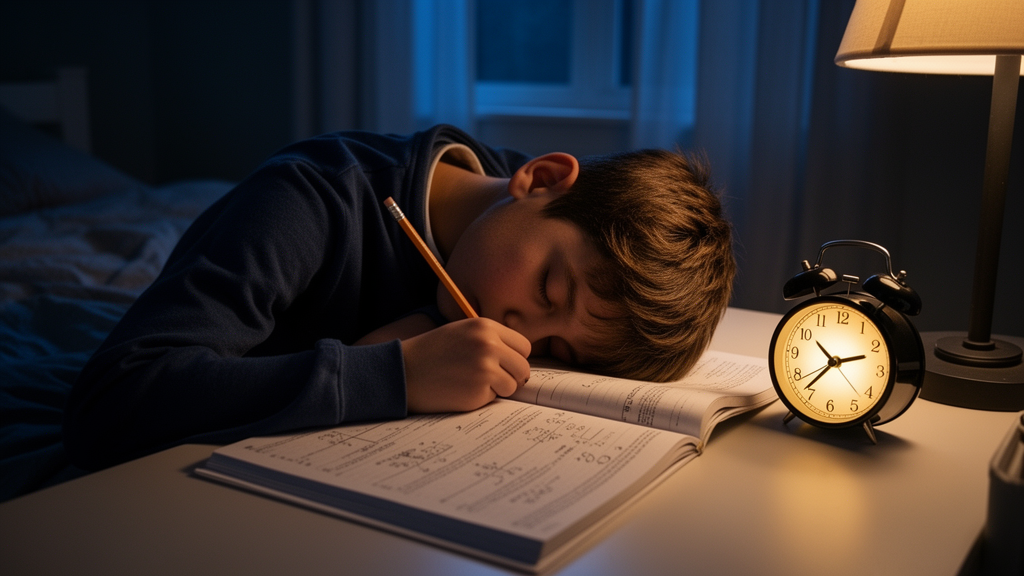
Mathematics anxiety, the tense and often debilitating dread that surges when students face equations, fractions, or a timed test, has been studied by psychologists for nearly seven decades. Yet a new study from researchers at Dayalbagh Educational Institute in Agra, India, brings a fresh computational lens to the problem. Nisha Mahaur, Vasantha Lakshmi Chellapilla, and Sona Ahuja analyzed data from 556 middle school students and applied a suite of machine learning algorithms to predict each child’s level of mathematics anxiety from a small set of cognitive and behavioral variables. Their results, published in SN Social Sciences, suggest that one factor towers above the rest in the models they built: how long the students sleep.
The research team recruited children with an average age of 12.24 years, roughly half of them girls, and measured mathematics anxiety alongside two core cognitive capacities, verbal working memory and visuospatial working memory, as well as a behavioral measure of nightly sleep duration. Working memory, the mind’s limited-capacity workspace for holding and manipulating information in the moment, has long been implicated in arithmetic. Complex calculation demands constant updating and storage of intermediate results, so any factor that erodes that workspace, whether worry or fatigue, can degrade performance and, in a vicious cycle, feed the anxiety itself.
Before turning to algorithms, the researchers examined the raw relationships among their variables using Pearson’s correlation analysis, the standard statistical technique for quantifying the strength and direction of linear associations between two continuous measures. This step confirmed that the candidate predictors were meaningfully linked to mathematics anxiety in the sample, providing the empirical justification for feeding them into predictive models. It also grounded the work in a well-established literature: since Mark Dreger and Lewis Aiken first described ‘number anxiety’ among college students in 1957, and Mark Ashcraft and Elizabeth Kirk demonstrated in 2001 that math anxiety consumes working memory resources and impairs performance, researchers have repeatedly documented the entanglement of worry, cognition, and mathematical achievement.
The heart of the new study, however, is its comparative evaluation of machine learning models. Rather than fitting a single regression equation, the team trained and tested multiple algorithms, each with different assumptions about how the predictors combine to produce an outcome. The performance winner was Support Vector Regression, a technique that finds a function mapping inputs to outputs by fitting a hyperplane within a tolerance margin, allowing flexible nonlinear relationships while penalizing deviations beyond that margin. It achieved an R-squared of 0.551, meaning it accounted for just over 55 percent of the variance in mathematics anxiety scores across the sample.
Close behind came Random Forest, an ensemble method that builds hundreds of decision trees, each trained on a random subset of the data and a random subset of features, and averages their predictions to reduce overfitting. Random Forest reached an R-squared of 0.501. For a psychological construct as multiply determined as anxiety, in which classroom climate, parental attitudes, prior experiences, and personality all plausibly contribute, explaining half or more of the variance from just a handful of cognitive and behavioral measures is a striking result. It suggests that the measured variables capture a substantial share of the signal that drives mathematics anxiety in this age group.
But raw predictive accuracy was only half the story. The researchers turned to SHAP analysis, short for SHapley Additive exPlanations, a technique borrowed from cooperative game theory and popularized in machine learning by Scott Lundberg and Su-In Lee in 2017. SHAP assigns each feature a contribution value for every individual prediction by computing how much the model’s output changes when that feature is included versus excluded, averaged across all possible orderings of features. In effect, it opens the black box, letting researchers see not just that a model predicts well, but which inputs it leans on and how. For educators and psychologists wary of opaque algorithms in educational settings, this interpretability layer matters as much as the accuracy figures.
The SHAP results delivered the study’s most eye-catching finding: sleep duration emerged as the single most influential predictor of mathematics anxiety in the models. Students in the sample who reported roughly six to eight hours of sleep per night tended to show lower predicted mathematics anxiety scores than their peers. The authors are careful to frame this as a pattern observed in their present sample rather than proof of causation, and the correlational design cannot rule out reverse pathways, such as anxious rumination disrupting sleep. Even so, the finding dovetails with a large independent literature linking sleep to adolescent mental health, emotion regulation, and cognition.
That literature is extensive. Meta-analyses have connected shorter and more variable sleep in adolescents to poorer school performance, degraded attention, and elevated emotional reactivity. Experimental work on partial sleep deprivation in teenagers, including the well-known ‘need for sleep’ study conducted in Singapore, has shown that even modest restrictions of nightly sleep measurably impair cognitive performance, mood, and sleepiness ratings. Neuroimaging research has associated sleep variability in adolescence with altered patterns of brain development. Randomized trials of sleep improvement, meanwhile, indicate that better sleep leads to better mental health outcomes. If insufficient sleep erodes the cognitive and emotional resources students bring to a math lesson, the pathway from bedtime to math anxiety becomes biologically plausible.
The study also carries practical implications for schools. Sleep recommendations from the American Academy of Sleep Medicine call for nine to twelve hours per night for children aged six to twelve and eight to ten hours for teenagers, meaning that even the six-to-eight-hour band associated with lower predicted anxiety in this sample sits at or below the recommended range for many middle schoolers. The authors note that earlier interventions targeting sleep patterns have reported reductions in math learning difficulties among elementary students. If predictive models like these can be deployed with routinely collected data, they could help schools flag students at elevated risk of mathematics anxiety early, before avoidance behaviors and declining grades take hold, and pair that screening with low-cost behavioral guidance on sleep hygiene.
There are, of course, caveats. The sample of 556 students from a single educational context in India may not generalize to every population, and the R-squared values, while respectable, leave nearly half the variance unexplained by the measured factors. Sleep duration was self-reported, a measure known to diverge from objectively tracked sleep. And the cross-sectional design means the models capture associations at one point in time, not the developmental dynamics by which anxiety, memory, and sleep reinforce one another across the school years. Still, the study demonstrates that interpretable machine learning can compress a sprawling psychological literature into a compact, actionable model, and it makes a compelling case that the fight against math anxiety may begin not in the classroom, but in the bedroom.
Subject of Research: Predicting mathematics anxiety in middle school students using machine learning models of cognitive and behavioral factors
Article Title: Modeling mathematics anxiety in middle school students: a machine learning approach
Article References: Mahaur, N., Chellapilla, V. L., & Ahuja, S. (2026). Modeling mathematics anxiety in middle school students: a machine learning approach. SN Social Sciences, 6(9), Article 389. https://doi.org/10.1007/s43545-026-01685-1
Image Credits: AI Generated
DOI: 10.1007/s43545-026-01685-1
Keywords: mathematics anxiety, machine learning, sleep duration, working memory, middle school students, support vector regression, random forest, SHAP analysis, predictive modeling, adolescent sleep, educational psychology, numerical cognition
Cite Scienmag News
Glenn Wilkins. (October 19, 2026). Sleep Emerges as the Strongest Predictor of Math Anxiety in Machine Learning Study of Middle Schoolers. Scienmag. https://scienmag.com/sleep-emerges-as-the-strongest-predictor-of-math-anxiety-in-machine-learning-study-of-middle-schoolers/
Glenn Wilkins. "Sleep Emerges as the Strongest Predictor of Math Anxiety in Machine Learning Study of Middle Schoolers." Scienmag, 19 October 2026, https://scienmag.com/sleep-emerges-as-the-strongest-predictor-of-math-anxiety-in-machine-learning-study-of-middle-schoolers/. Accessed 19 October 2026.
Glenn Wilkins. "Sleep Emerges as the Strongest Predictor of Math Anxiety in Machine Learning Study of Middle Schoolers." Scienmag. October 19, 2026. https://scienmag.com/sleep-emerges-as-the-strongest-predictor-of-math-anxiety-in-machine-learning-study-of-middle-schoolers/


