


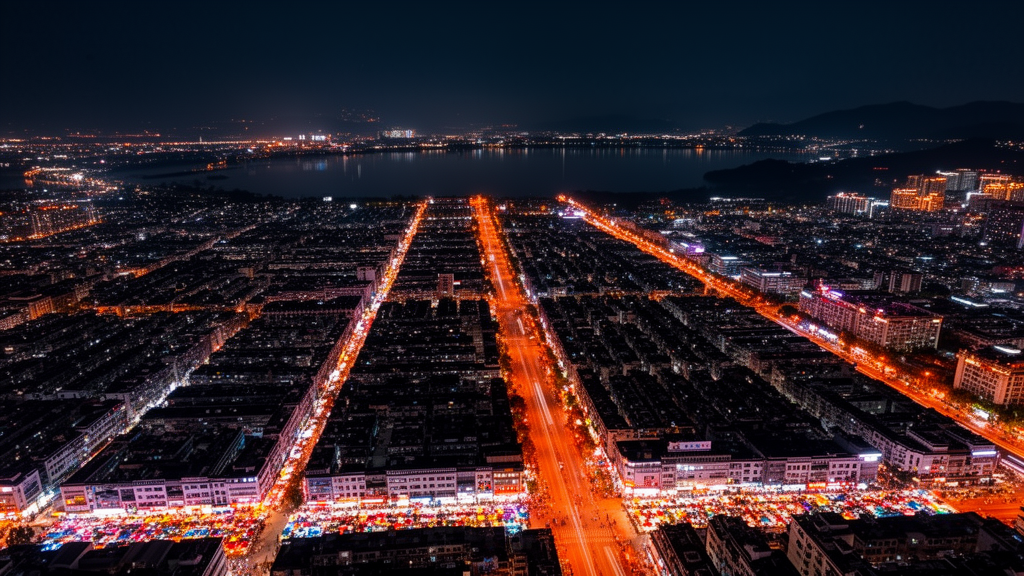
When the sun sets over Kunming, the capital of Yunnan Province in southwestern China, a second city switches on. Street markets glow, shopping plazas hum, and restaurants fill with diners. Now, a team of researchers led by Ruiqu Ma of Yunnan University has mapped this hidden nighttime world in unprecedented detail, revealing a distinctive spatial fingerprint that could reshape how planners think about urban vitality after dark. The study, published in Humanities and Social Sciences Communications, combines satellite imagery, digital point-of-interest data, and traditional questionnaires into a single analytical framework that treats the nighttime economy as both a spatial phenomenon and a behavioral one.
The nighttime economy has become a crucial engine of urban consumption growth and vitality, particularly in rapidly developing cities. Yet, according to the authors, a comprehensive understanding of its spatial organization and consumer behavior patterns has remained limited, especially outside major Western metropolises. To fill this gap, the team proposed a dual-perspective framework integrating spatial analysis with behavioral mechanisms, aiming to capture not just where nighttime activity concentrates but why people choose to spend their evenings in particular places.
Technically, the research drew on multi-source heterogeneous data. Nighttime light imagery from satellites provided a physical proxy for the intensity of human activity after dark, while Points of Interest, or POIs, catalogued the digital footprint of businesses and services across the city. Questionnaire surveys then added the human dimension, recording consumer preferences and demographic characteristics. The team analyzed this data using two complementary statistical models: Geodetector, which quantifies the explanatory power of spatial factors, and Geographically Weighted Regression, or GWR, which allows the influence of each factor to vary across the urban landscape rather than assuming a single city-wide average.
The findings reveal a distinctive spatial pattern the authors describe as large aggregation, small dispersion, and multiple centers. Rather than a single downtown core dominating the city, Kunming’s nighttime economy forms interconnected cores built around commercial shopping plazas, school agglomeration areas, residential clusters, and tourism-leisure zones. Each core functions as a node in a larger network, with smaller pockets of activity dispersed between them. This polycentric structure suggests that nighttime vitality is not the exclusive property of a central business district but emerges wherever the right combination of land uses, services, and accessibility coincide.
What drives these patterns? The analysis identified land-use mix, public service facilities, and transportation accessibility as the primary drivers of nighttime economic intensity. Crucially, the models showed that interaction effects among factors significantly amplified their explanatory power. In other words, no single ingredient creates a thriving nighttime district; it is the combination of mixed land uses, good public services, and easy transport access working together that produces the strongest effect. This interaction insight carries direct implications for urban planning, indicating that piecemeal interventions targeting one factor at a time may underperform compared with integrated strategies.
Perhaps the most striking result, however, is the discrepancy the dual-perspective approach uncovered between spatial patterns and behavioral preferences. While urban spatial quality factors showed limited geographical impact in the statistical models, questionnaire results indicated strong consumer preferences for these very elements. People say they care about spatial quality, aesthetics, and comfort, even when these factors do not strongly predict where nighttime activity actually concentrates. This gap between what the landscape looks like and what consumers want highlights the limits of purely spatial analysis and underscores the value of integrating behavioral data into urban studies.
The behavioral analysis also revealed significant demographic heterogeneity. Women prioritized accessibility and service diversity in their nighttime choices, while younger groups favored functional intensity, seeking districts packed with activities and options. These differences suggest that creating vibrant nighttime economies requires balancing spatial optimization with diverse consumer preferences rather than designing for a single idealized user. A district that works for one demographic group may leave others underserved, and planners who ignore this variation risk producing spaces that feel vibrant on paper but fail to attract the full spectrum of nighttime consumers.
The integrated framework provides empirical evidence for developing nighttime economy strategies that optimize urban spatial configurations while responding to differentiated demographic needs. For developing cities in particular, where nighttime economies are growing rapidly but planning tools often lag behind, the approach offers a replicable template: combine satellite-derived activity measures with digital business footprints and direct consumer surveys, then analyze the results through models that respect spatial variation. The findings underscore that vibrant nighttime economies emerge from the interplay of spatial structure and human preference, and that understanding this interplay demands methods capable of seeing both.
As cities worldwide compete to extend their economic pulse into the night hours, Kunming’s mapped fingerprint offers a reminder that the geography of after-dark vitality is neither random nor uniform. It is shaped by the deliberate arrangement of land uses, services, and transport networks, and by the varied preferences of the people who inhabit those spaces after sunset. Balancing these forces, the authors suggest, is the key to building cities that stay alive long after the daytime economy winds down.
Subject of Research: Mapping the pulse of urban nighttime economy: spatial patterns and behavioral insights in Kunming, China
Article Title: Mapping the pulse of urban nighttime economy: spatial patterns and behavioral insights in Kunming, China
Article References: Ma, R., Ma, Y., Xu, J., Yang, H., Liu, L., Xu, G., Huo, X., & Li, M. (2026). Mapping the pulse of urban nighttime economy: spatial patterns and behavioral insights in Kunming, China. Humanities and Social Sciences Communications. https://doi.org/10.1057/s41599-026-09308-z
Image Credits: AI Generated
DOI: 10.1057/s41599-026-09308-z
Keywords: nighttime economy, urban planning, spatial analysis, Geographically Weighted Regression, Geodetector, Kunming, consumer behavior, urban vitality, land-use mix, polycentric cities, Mapping, pulse
Cite Scienmag News
Courtney Benton. (October 19, 2026). Nighttime economy mapping reveals hidden patterns in Kunming, China. Scienmag. https://scienmag.com/nighttime-economy-mapping-reveals-hidden-patterns-in-kunming-china/
Courtney Benton. "Nighttime economy mapping reveals hidden patterns in Kunming, China." Scienmag, 19 October 2026, https://scienmag.com/nighttime-economy-mapping-reveals-hidden-patterns-in-kunming-china/. Accessed 19 October 2026.
Courtney Benton. "Nighttime economy mapping reveals hidden patterns in Kunming, China." Scienmag. October 19, 2026. https://scienmag.com/nighttime-economy-mapping-reveals-hidden-patterns-in-kunming-china/


