


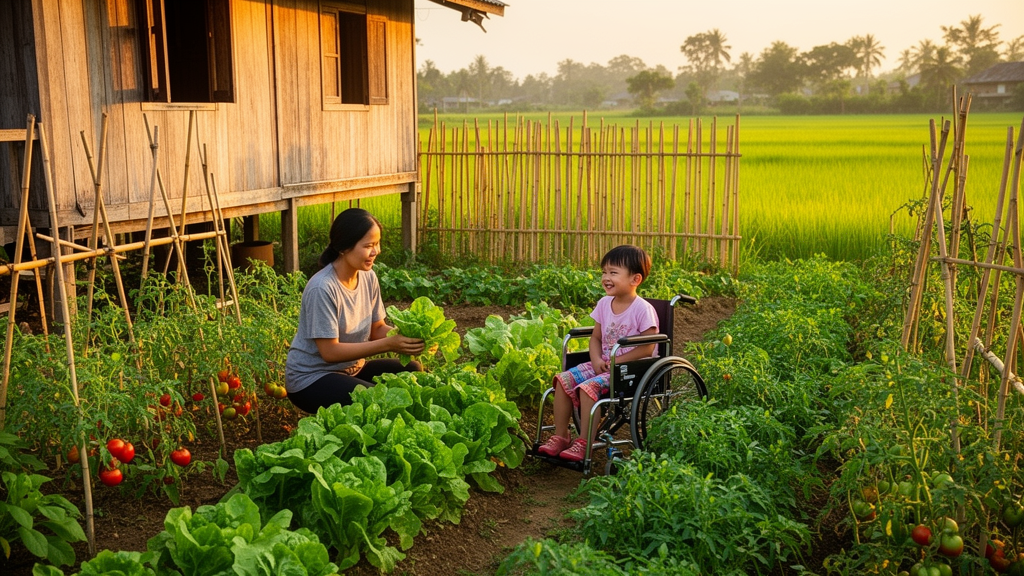
When the COVID-19 pandemic swept through rural Thailand, it did more than disrupt supply chains and close markets. For families in the northeastern province of Nakhon Phanom who are raising children with intellectual disabilities, the crisis acted as what researchers describe as a force multiplier, intensifying structural problems such as unstable incomes, heavy caregiving burdens, and barriers to health and education services. Yet a new qualitative study published in SN Social Sciences suggests that organic farming, practiced as a sustainable livelihood strategy, may offer these families a genuine pathway toward recovery, inclusion, and long-term resilience.
The research team, led by Benjayamas Pilayon of Nakhon Phanom University and Nitikorn Phoosuwan of Thammasat University and Uppsala University, set out to answer a question that has been largely overlooked in the literature on social and care farming: how does organic agriculture specifically, as opposed to conventional or subsistence farming, contribute to disability-inclusive livelihoods in a low-resource, post-pandemic rural setting? To explore this, the researchers adopted a descriptive phenomenological design anchored in the sustainable livelihoods framework, which examines how households construct their livelihoods from available human, natural, financial, social, and physical assets within existing institutional structures.
Between July and December 2023, the team conducted semi-structured, in-depth interviews lasting 60 to 90 minutes with 16 participants in one district of Nakhon Phanom Province. Ten were parents or primary caregivers of children with physician-diagnosed intellectual disabilities who were currently or previously engaged in organic farming; six were key stakeholders, including government health and agricultural officers, private sector representatives, community health workers, and disability support organization staff. Recruitment was facilitated by the Association for Intellectually Disabled Persons of Nakhon Phanom Province and local health volunteers, and interviews continued until informational redundancy was achieved, meaning three successive interviews produced no new codes or subcategories. The researchers explicitly acknowledge that this network-based recruitment may have under-represented families disconnected from disability services, a limitation they flag as potential selection bias.
The analytical pipeline followed a systematic code-to-category progression: researchers independently coded meaningful units from transcripts, grouped them into categories, and developed themes through iterative discussion and consensus. Thirty-seven initial codes were distilled into four main categories: general family conditions, post-COVID-19 consequences, organic farming challenges during the pandemic, and support needs for sustainable career development. A subset of roughly 20 percent of transcripts was coded independently by two researchers spanning clinical and agricultural disciplines, a reflexivity strategy designed to counteract the team’s own professional predisposition to view farming primarily through a therapeutic lens.
The picture that emerged was one of persistent economic fragility. Most families had four to six members, relied on agriculture or contract work, and supplemented their income with disability allowances and the earnings of male household heads. Incomes were consistently insufficient for family expenses, and the pandemic cut family incomes in the province by 1,000 to 3,000 baht per month, roughly 28 to 35 US dollars, a substantial share of rural household budgets. Caregivers frequently paid an even steeper price: as one mother explained, she had to supervise her daughter constantly and could not leave her alone, and as a result she lost her job. The pandemic also severed the informal networks through which these families exchanged knowledge and mutual support, undermining the social fabric that sustains community resilience.
Perhaps the most striking finding concerns the actual reach of organic agriculture. Only two of the ten participating families had achieved certified organic status, growing rice and vegetables while registered with provincial organic farming organizations. The remaining eight households used conventional or partially chemical-reduced methods and expressed an intent, rather than an active transition, toward certification. The authors are candid about what this means for interpretation: the findings on organic agriculture represent a combination of immediate empirical experience from two households and aspirational trajectories from the rest of the sample. This honesty matters, because it tempers the study’s sustainability claims while still pointing to significant untapped potential.
Why does organic farming matter for this population at all? The researchers identify three mechanisms that distinguish it from conventional alternatives. First, it minimizes exposure to toxic agrochemicals for vulnerable children and their caregivers, a meaningful advantage given the health sensitivities of people with intellectual disabilities. Second, it provides flexible, low-intensity labor options that can adapt to varying physical and cognitive abilities. Third, cooperatives and certification processes offer structured, low-risk roles within an organized system. The interviews bore this out: children could participate meaningfully under supervision, watering vegetables and growing crops alongside their parents, though the degree of participation varied with individual capabilities and support needs. This observation challenges traditional assumptions about productivity and employment in agriculture and echoes international research on social and care farming, which has documented benefits for sensory function, physical development, self-esteem, and responsibility.
Barriers, however, remain formidable. Families reported knowledge gaps in organic principles, techniques, and certification processes; technical constraints in pest management and soil health; and crushing production costs, with one participant noting that fertilizers and agricultural treatments had become prohibitively expensive. Market access was perhaps the most binding constraint, with insufficient marketing support and limited connections to value chains preventing families from capturing the economic benefits of organic production. Resource constraints, including limited access to land, seeds, and organic inputs, further hindered any scaling up. Participants were clear about what they wanted: training in modern organic techniques and vegetable cultivation, seeds and equipment from government agencies, allocated community land for organic agriculture, comprehensive welfare coverage, updated databases of intellectually disabled children, and legal frameworks supporting employment for persons with disabilities. Several families also expressed interest in diversified systems such as aquaculture and integrated farming, reflecting a sound instinct for risk diversification.
From these findings, the authors derive three concrete policy interventions rather than broad exhortations. They propose inclusive extension services in which agricultural officers are trained to adapt organic farming instruction for households with intellectually disabled relatives; community social farming cooperatives that pool land, labor, and certification expenses to reduce individual entry barriers; and government procurement programs, such as sourcing organic produce for school lunches or public hospitals, that would guarantee a stable market and mitigate the commercial risks of transitioning to organic methods. These recommendations align with the Sustainable Development Goals on poverty reduction, decent work, and reduced inequalities, and they connect the Thai case to a global context in which approximately 1.3 billion people, 16 percent of humanity, live with disabilities, including some 58.2 million children with developmental or intellectual disabilities.
The study’s limitations are acknowledged with unusual transparency. The small, purposive sample from a single province makes the findings exploratory and context-specific rather than generalizable; the researchers frame them as policy-relevant hypotheses for future larger-scale work. No farm-level economic data, such as yields, incomes, or cost breakdowns, were systematically collected, which limits the ability to evaluate organic agriculture as a financially viable livelihood option. The voices of the disabled children and young adults themselves were mediated entirely through caregivers and stakeholders, and future studies should incorporate developmentally tailored, participatory self-reporting. Interviews were conducted in the local Isan dialect with excerpts back-translated into English, but formal cross-cultural validation was not performed. Even so, the core message stands: sustainable organic farming, embedded in integrated support systems that combine social entrepreneurship, knowledge transfer, and policy intervention, can provide economic opportunity, therapeutic engagement, and social inclusion simultaneously, offering families raising intellectually disabled children not just a livelihood but a foundation for community-level resilience in the wake of a global crisis.
Subject of Research: Post-pandemic experiences of families with intellectually disabled children engaged in organic farming in northeast Thailand
Article Title: Post-COVID-19 experiences of families in organic farming with intellectually disabled children in northeast Thailand: a qualitative study
Article References: Pilayon, B., Praweenwongwuthi, S., Utaisang, A., Panlakphon, P., Hongma, P., Chueaduangpui, K., Saentho, J., & Phoosuwan, N. (2026). Post-COVID-19 experiences of families in organic farming with intellectually disabled children in northeast Thailand: a qualitative study. SN Social Sciences, 6(9), Article 391. https://doi.org/10.1007/s43545-026-01681-5
Image Credits: AI Generated
DOI: 10.1007/s43545-026-01681-5
Keywords: organic farming, intellectual disability, COVID-19 recovery, Thailand, sustainable livelihoods, qualitative research, social farming, community resilience, disability inclusion, rural development, Sustainable Development Goals, caregiving
Cite Scienmag News
Courtney Benton. (October 19, 2026). Organic Farming Offers a Lifeline for Thai Families Raising Disabled Children After COVID-19. Scienmag. https://scienmag.com/organic-farming-offers-a-lifeline-for-thai-families-raising-disabled-children-after-covid-19/
Courtney Benton. "Organic Farming Offers a Lifeline for Thai Families Raising Disabled Children After COVID-19." Scienmag, 19 October 2026, https://scienmag.com/organic-farming-offers-a-lifeline-for-thai-families-raising-disabled-children-after-covid-19/. Accessed 19 October 2026.
Courtney Benton. "Organic Farming Offers a Lifeline for Thai Families Raising Disabled Children After COVID-19." Scienmag. October 19, 2026. https://scienmag.com/organic-farming-offers-a-lifeline-for-thai-families-raising-disabled-children-after-covid-19/


