


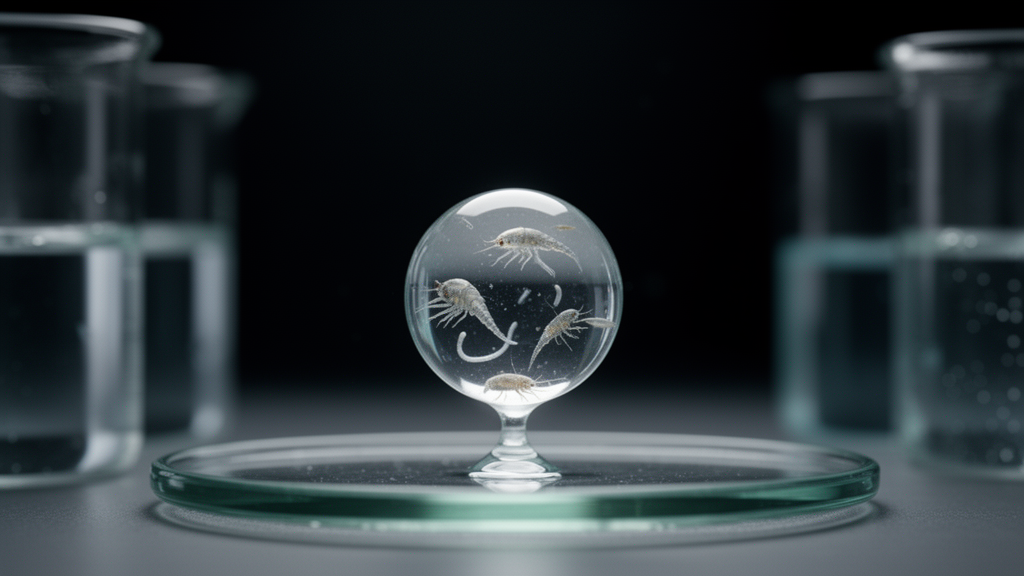
Beneath Switzerland’s rolling hills and alpine valleys, an invisible world of pale, blind crustaceans drifts through the dark water that fills the country’s taps. These obligate groundwater dwellers, known as stygobites, spend their entire lives in aquifers that never see sunlight, and for decades scientists have struggled to answer a deceptively simple question: when should you look for them? A new study published in the journal Subterranean Biology provides one of the most systematic answers yet, and its findings could reshape how nations monitor the biodiversity of the largest freshwater reservoir on Earth.
The research, led by a team studying shallow groundwater aquifers across Switzerland, set out to determine whether the tiny animals living in groundwater show seasonal patterns of occurrence and abundance, and how reliably they can be detected at all. This matters because groundwater ecosystems remain among the least studied habitats on the planet, despite harboring remarkable endemic species, some descended from ancient adaptive radiations. Without baseline knowledge of temporal dynamics, monitoring programs cannot distinguish genuine population trends from mere sampling noise, and groundwater fauna is notably absent from Switzerland’s national biodiversity monitoring programs.
The study relied on an unusually scalable sampling method built around the country’s drinking water infrastructure. Researchers enlisted drinking water providers through a citizen science project, asking them to attach fine filter nets with a mesh size of 0.8 millimeters to the pipe inlets of spring catchment boxes, where groundwater is passively captured before entering the supply system. After one week of filtering, all captured organisms were collected and preserved in 80 percent ethanol. This passive approach turned hundreds of existing water extraction sites into ready-made biological monitoring stations, requiring no drilling, no expensive equipment, and no specialized expertise from the volunteers who installed the nets.
Two datasets formed the backbone of the analysis. The first covered 17 inlets spread across Switzerland, sampled approximately monthly from May 2021 to April 2022, with organisms identified to major taxonomic groups. The researchers split the catch into three categories: groundwater amphipods of the genera Niphargus and Crangonyx, groundwater isopods including the genus Proasellus, and a residual group of other macroinvertebrates consisting mostly of stygophiles and stygoxenes, organisms that visit groundwater only occasionally or accidentally. The second dataset was far denser spatially: 143 inlets in the catchment of the river Töss, each sampled one to ten times in consecutive weeks during spring 2021, with all amphipods identified to species level by sequencing the Folmer fragment of the mitochondrial COI gene.
The statistical treatment was correspondingly rigorous. The team applied Generalized Additive Models with cyclic cubic regression splines to capture seasonality as day of year, thin plate splines for outflow rate and precipitation, and a random effect for each inlet, fitting models with a negative binomial response distribution using restricted maximum likelihood. Crucially, they ran two versions of the model, one standardizing abundance per volume of water filtered and one per duration of sampling, because the choice of offset can fundamentally alter what a monitoring program concludes. Detection rates in the weekly dataset were calculated from capture histories at each inlet, and the researchers then tested how those estimates changed as the minimum number of sampling occasions per site increased.
The headline result is striking in its simplicity: obligate groundwater amphipods and isopods showed no significant seasonal pattern in abundance, while the other macroinvertebrates peaked sharply in July, a pattern driven largely by larvae of mayflies, stoneflies, and caddisflies, the so-called EPT taxa whose life cycles are tied to surface waters. In other words, the true groundwater specialists are temporally consistent, whereas the surface visitors wax and wane with the seasons. Precipitation showed no significant effect on any group, though the authors caution that its influence may be confounded with seasonality or masked by aquifer-specific time lags determined by local geology. Outflow rate mattered only when abundances were standardized per megaliter, with predicted densities highest at low flows, a possible dilution effect suggesting that organism density is largely independent of discharge.
Temporal autocorrelation added another layer of insight. Presence-absence of groundwater amphipods was significantly correlated across samples up to three months apart, and isopods up to ten months, consistent with the slow life histories and limited mobility of stygobites. For monitoring design, this means that samples clustered within a short window are not independent: a string of false absences in quick succession could badly skew an assessment. The authors recommend spreading sampling occasions evenly throughout the year rather than concentrating them, and they note that extending filter periods from one week to several could raise capture rates, though at the cost of specimen decomposition that hampers both morphological and molecular identification.
The detection rate analysis revealed a sobering picture for anyone hoping to confirm the presence or absence of groundwater amphipods with a quick survey. In the Töss catchment, amphipods appeared at 55 percent of the 143 inlets, but nine species were identified and five of them occurred at only one to three sites each, a pattern typical of groundwater communities dominated by rare, narrowly distributed species. Among the four widespread species, detection rates varied enormously between inlets, ranging from 0.1 to 1.0 for amphipods combined. Niphargus fontanus and N. tonywhitteni stabilized around mean detection rates of roughly 0.37 and 0.3 once six or more samples per inlet were available, but N. auerbachi never stabilized, and Crangonyx cf. subterraneus converged toward the study’s lower detection limit of 0.1, implying its true detectability is even lower.
These numbers translate directly into sampling requirements. Using the lowest mean detection rate for amphipods combined, about 0.38, the researchers calculated that a minimum of 6.3 samples would be needed to infer absence with 95 percent probability at an average site. But because detection varies so much between inlets, a site with a detection rate of 0.1 would demand 29 samples to reach the same confidence. The authors also acknowledge that by analyzing only sites where species were present, without modeling the occurrence process, they likely overestimated true detection rates, meaning the real sampling burden could be heavier still. They stress that these estimates are region-specific and may not transfer to mountainous areas or other regions with different amphipod communities.
The study’s practical recommendations are clear: standardize sampling effort by filtering duration rather than discharge volume, space sampling occasions evenly across the year, and design region-specific strategies that account for the heterogeneity in detection among species and sites. Scaling such monitoring to national levels remains a challenge, but the authors see promise in combining approaches, pairing citizen science filternet sampling with environmental DNA metabarcoding, which integrates biodiversity over larger spatial and temporal scales even though it has so far proven less effective than direct filtration at detecting groundwater amphipods. As biodiversity decline extends into the planet’s hidden aquifers, this research makes the case that conserving subterranean life begins with knowing when, where, and how hard to look.
Subject of Research: Temporal consistency and spatial variability in the detection of macroinvertebrates from shallow groundwater aquifers
Article Title: Temporal consistency and spatial variability in detection: implications for monitoring of macroinvertebrates from shallow groundwater aquifers
Article References: Knüsel, M., Alther, R., Couton, M., & Altermatt, F. (2024). Temporal consistency and spatial variability in detection: implications for monitoring of macroinvertebrates from shallow groundwater aquifers. Subterranean Biology, 49, 139-161. https://doi.org/10.3897/subtbiol.49.132515
Image Credits: AI Generated
DOI: 10.3897/subtbiol.49.132515
Keywords: groundwater, stygobites, amphipods, biodiversity monitoring, detection probability, citizen science, aquifers, seasonality, Niphargus, macroinvertebrates, Switzerland, Subterranean Biology
Cite Scienmag News
Drew Townsend. (October 19, 2026). Hidden Life in Drinking Water: Groundwater Creatures Defy the Seasons, Study Finds. Scienmag. https://scienmag.com/hidden-life-in-drinking-water-groundwater-creatures-defy-the-seasons-study-finds/
Drew Townsend. "Hidden Life in Drinking Water: Groundwater Creatures Defy the Seasons, Study Finds." Scienmag, 19 October 2026, https://scienmag.com/hidden-life-in-drinking-water-groundwater-creatures-defy-the-seasons-study-finds/. Accessed 19 October 2026.
Drew Townsend. "Hidden Life in Drinking Water: Groundwater Creatures Defy the Seasons, Study Finds." Scienmag. October 19, 2026. https://scienmag.com/hidden-life-in-drinking-water-groundwater-creatures-defy-the-seasons-study-finds/


