


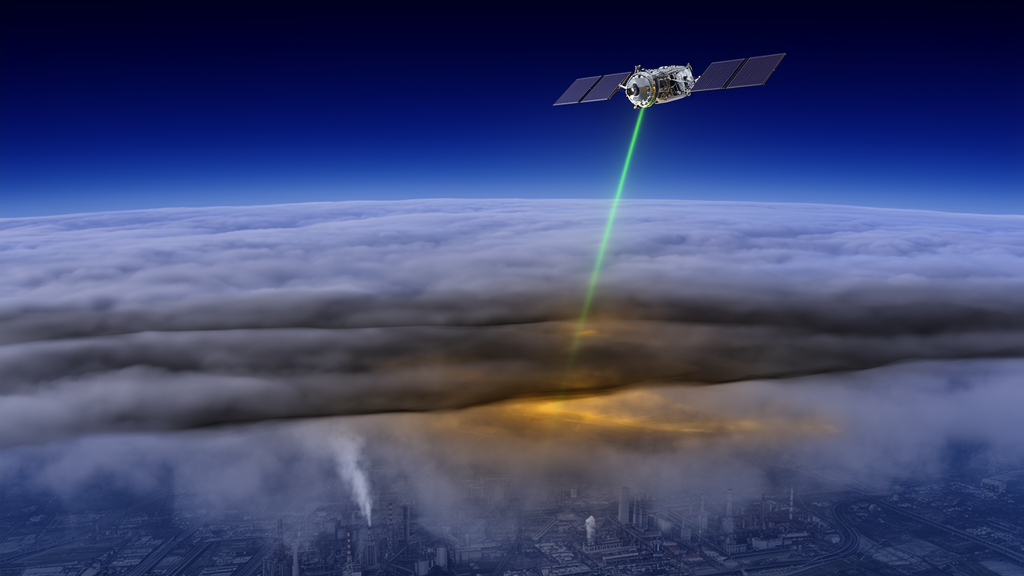
High above the smokestacks and traffic of South and East Asia, thin layers of black carbon drift through the free troposphere, absorbing sunlight and warming the air around them. These hidden plumes have long eluded chemical transport models, which routinely place soot near the surface where it was emitted and miss its lofted journey upward. A new study published in Atmospheric Chemistry and Physics by Yueming Cheng of the Institute of Atmospheric Physics in Beijing, Tie Dai, and an international team of collaborators spanning China and Japan, presents a way to find them. By feeding satellite lidar measurements of individual particle types directly into a numerical weather model, the researchers built a three-dimensional map of pollution that finally captures where absorbing and scattering particles really reside in the sky.
The stakes of getting aerosol altitude right are surprisingly high. Aerosols shape Earth’s energy budget by scattering and absorbing shortwave radiation, and the vertical profile of those particles dictates at what altitude solar energy is deposited. Over dark surfaces, absorbing aerosols high in the atmosphere intercept more incoming sunlight than those near the ground, producing stronger warming aloft; over bright surfaces, they interact chiefly with reflected radiation, amplifying lower-atmospheric heating. Previous research cited by the team shows that the radiative heating induced by black carbon in the stratosphere can exceed its near-surface effect by more than an order of magnitude. Even small errors in the ratio of scattering to absorbing species matter enormously: a mere three percent variation in the scattering-to-extinction ratio can perturb the radiative effect by fifty percent, and multi-component mixing can shift regional estimates by as much as one hundred percent.
The core problem with traditional data assimilation is that it is nearly blind to composition and height. Most systems assimilate column-integrated aerosol optical thickness or surface mass concentrations, neither of which carries information about where particles sit or what they are made of. When the assimilation system has no vertical observations to work with, it is forced to distribute its corrections according to the model’s own background profile, leaving structural errors untouched. Worse, when only total extinction is constrained, increments are typically spread proportionally across species, rigidly coupling the analysis to the model’s flawed assumptions. The system can then misallocate mass, for example boosting scattering sulfates to compensate for an underestimation of absorbing black carbon, a physically meaningless fix that leaves absorption biases intact.
Cheng and colleagues tackled this under-constrained problem head-on by developing a component-resolved data assimilation system built on the local ensemble transform Kalman filter, or LETKF, embedded within the WRF-Chem model. The framework assimilates synergistic retrievals that combine measurements from the Cloud-Aerosol Lidar with Orthogonal Polarization, known as CALIOP, aboard the CALIPSO satellite with passive radiance data from MODIS. The retrieval provides vertical profiles of extinction coefficients for four specific components: dust, sea salt, black carbon, and water-soluble aerosols. A new observation operator maps these species-specific observations onto the model’s fourteen simulated aerosol variables, with mass extinction efficiencies dynamically adjusted for ambient relative humidity. This explicit vertical and chemical mapping overcomes the limitations of bulk-mass approaches that treat all particles as interchangeable.
The technical machinery required careful engineering. A twenty-member ensemble is generated by perturbing aerosol emissions with lognormal factors whose uncertainties reflect known emission errors, and a dual localization scheme suppresses spurious correlations that a finite ensemble inevitably introduces. Spatially, a Gaussian function restricts the influence of observations to within seventy-five kilometers horizontally and a single model layer vertically. Chemically, variable localization forces observations of dust, sea salt, and black carbon to update only their corresponding mass concentrations, while water-soluble extinction is allowed to adjust both sulfate and organic carbon, the two species it combines. The team also confronted a stubborn weakness of ensemble methods: when a model completely misses an aerosol event, background spread collapses toward zero and the filter ignores the very observations that could help. Their solution is a background correction scheme that rescales ensemble members in severely biased regions before the standard assimilation step.
The results are striking. The free-running model systematically underestimated every aerosol component, and for black carbon the correlation with CALIOP observations was a dismal 0.10, meaning the simulation essentially failed to capture the observed spatiotemporal variation of soot. After assimilation, correlations improved dramatically: dust rose from 0.33 to 0.79, water-soluble aerosols from 0.41 to 0.79, sea salt from 0.33 to 0.69, and black carbon to 0.59. Most remarkably, the analysis reconstructed an elevated black carbon layer peaking near six kilometers altitude, driven by intense pollution plumes from the Indian subcontinent lofted into the free troposphere. The correlation of the vertical BC profile improved from 0.26 to 0.95. Such persistent free-tropospheric soot layers have historically been documented almost exclusively through sparse balloon and aircraft profiling.
Because comparing the analysis against the observations it ingested constitutes a self-validation, the team turned to independent ground truth. Against the AERONET sun-photometer network, the assimilation run reduced the bias in aerosol optical thickness from minus 0.278 to minus 0.208, cut the root mean square error from 0.521 to 0.488, and improved the correlation from 0.573 to 0.626. At the site level, the assimilation lowered the error at 42 of 59 stations and reduced the absolute bias at 54 of them, including downwind sites far from any CALIOP ground track, evidence that the optimized fields propagate realistically with atmospheric transport. The Japanese AD-Net lidar network told a similar story at the Fukue island station, where the corrected upstream fields reproduced both intense near-surface layers and episodic transport plumes reaching two to four kilometers.
The compositional payoff showed up in the single scattering albedo, a measure of how much light particles scatter versus absorb. Assimilating species-specific extinctions lets the system independently adjust the mass of scattering and absorbing species, correcting local imbalances that bulk assimilation cannot touch. At South and Southeast Asian sites such as Gandhi College, Dhaka University, and Mandalay, where spring biomass burning loads the air with soot, the assimilation substantially raised the underestimated albedo, halving the root mean square error at several stations. Across 36 AERONET sites, bias and error improved at 33 of them, with mean improvement rates of roughly 34 and 30 percent respectively. The team also showed that the conclusions are robust: even when the prescribed observational error baseline was inflated fivefold, the black carbon correlation held at 0.94, because representativeness error dominates the error budget and the flow-dependent covariance carries the structural information.
The climatic consequences of the corrected profiles are perhaps the most compelling part of the study. With elevated black carbon plumes in place, the diagnosed shortwave heating rate shows a pronounced mid-tropospheric warming, reaching a track-averaged maximum of about 0.3 kelvin per day at four to five kilometers. In a latitude-height cross-section from March 2021, local instantaneous heating increases of roughly 3 kelvin per day appeared where soot concentrations surged aloft, while the lower troposphere below actually cooled as the dense absorbing layer acted as a radiative shield, blocking sunlight from reaching lower levels. The authors caution that remaining limitations matter: the model treats particles as externally mixed spheres while the retrieval assumes internal core-shell mixing for black carbon, a discrepancy that likely inflates absorption per unit extinction in the forward model, and the background correction bypasses rigorous uncertainty weighting in about a quarter to a third of updated points. Even so, the message is clear that accurately assessing how pollution heats the atmosphere requires knowing not just how many particles there are, but which ones are up there and how high they have climbed.
Subject of Research: Component-resolved assimilation of CALIOP satellite lidar observations to constrain vertical aerosol composition and radiative heating profiles over East Asia
Article Title: Constraining the vertical profiles of aerosol component and heating rate over east Asia through assimilating CALIOP observations
Article References: Cheng, Y., Dai, T., Goto, D., Yumimoto, K., Nishizawa, T., Kudo, R., Zhao, M., Higurashi, A., Jin, Y., Shimizu, A., Peng, H., Shi, G., & Nakajima, T. (2026). Constraining the vertical profiles of aerosol component and heating rate over east Asia through assimilating CALIOP observations. Atmospheric Chemistry and Physics, 26(20), 14671-14698. https://doi.org/10.5194/acp-26-14671-2026
Image Credits: AI Generated
DOI: 10.5194/acp-26-14671-2026
Keywords: aerosols, data assimilation, CALIOP, black carbon, vertical profiles, WRF-Chem, radiative heating, East Asia, single scattering albedo, LETKF, satellite lidar, atmospheric heating
Cite Scienmag News
Russell Cooper. (October 19, 2026). Satellite Lidar Data Assimilation Reveals Hidden Soot Layers Warming East Asia’s Mid-Troposphere. Scienmag. https://scienmag.com/satellite-lidar-data-assimilation-reveals-hidden-soot-layers-warming-east-asias-mid-troposphere/
Russell Cooper. "Satellite Lidar Data Assimilation Reveals Hidden Soot Layers Warming East Asia’s Mid-Troposphere." Scienmag, 19 October 2026, https://scienmag.com/satellite-lidar-data-assimilation-reveals-hidden-soot-layers-warming-east-asias-mid-troposphere/. Accessed 19 October 2026.
Russell Cooper. "Satellite Lidar Data Assimilation Reveals Hidden Soot Layers Warming East Asia’s Mid-Troposphere." Scienmag. October 19, 2026. https://scienmag.com/satellite-lidar-data-assimilation-reveals-hidden-soot-layers-warming-east-asias-mid-troposphere/


