


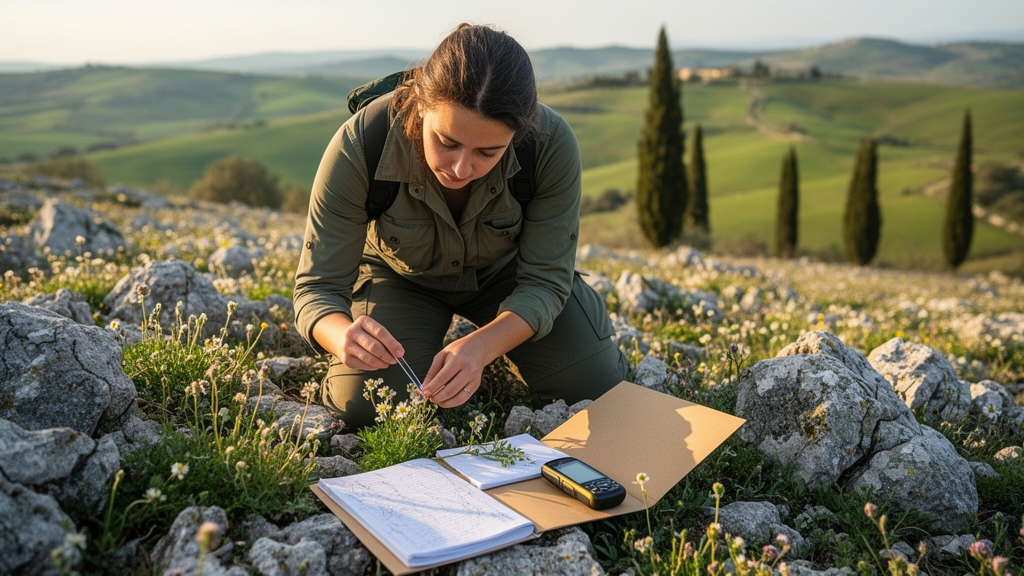
Italy’s botanical map is being redrawn, one herbarium sheet at a time. The sixteenth installment of the Notulae series, published in Italian Botanist, presents a coordinated audit of the country’s native vascular flora, documenting new regional records, long-overdue confirmations, and a handful of exclusions that erase species from regional checklists where the original evidence never held up. The contribution spans the entire peninsula and the major islands, from alpine pastures in Umbria to sandy coastal soils in Puglia, and it illustrates how a modern flora is maintained through continuous, specimen-based verification rather than static lists.
The format of the series is deliberately compact. Each record is submitted electronically, limited to a thousand characters, and must be accompanied by a corresponding herbarium specimen or its scan, deposited in the FI Herbarium in Florence. This discipline matters because distributional claims in botany are only as reliable as the physical evidence behind them. A record without a voucher cannot be re-examined with modern taxonomic tools, and the Notulae framework enforces that every claim of novelty, confirmation, or exclusion is anchored to material that future researchers can retrieve and, if necessary, re-identify.
Among the most striking novelties are three lady’s mantle species newly recorded for Umbria and Molise. Alchemilla effusa was found at Piano Grande near Castelluccio di Norcia on calcareous soil at 1,272 meters, while Alchemilla reniformis turned up on the north-facing pastures of Monte Coscerno at 1,635 meters. Alchemilla marsica, previously unknown in Molise, was detected in Capracotta within a priority semi-natural grassland dominated by Bromopsis erecta and Carex flacca. Lady’s mantles are notoriously difficult taxonomically because of apomixis, the process by which plants produce seeds without sexual recombination, effectively freezing lineages into morphologically distinct microspecies. Records like these therefore depend on careful determination by specialists, with revisions noted in the documentation.
The grasslands of the Ticino valley in Piemonte yielded two significant results. Crassula tillaea, a tiny annual stonecrop previously dismissed from Piemonte as a mistaken record, was found in large populations in pioneer siliceous dry grasslands between an industrial zone and the right bank of the Ticino River, growing alongside Aira caryophyllea and Tuberaria guttata. Sagina alexandrae was confirmed in the same area, within grassland classified as priority Habitat 6210. These findings show how badland and riverine environments can harbor species that older literature either misidentified or overlooked, and how the reclassification of a record from error to confirmed population requires the observation of substantial, reproducing stands rather than a single stray individual.
Coastal and wetland habitats in southern Italy produced several notable confirmations. Euphorbia palustris, the marsh spurge, was rediscovered in a reed thicket within a coastal pine plantation at Chieuti in Puglia, confirming a report by Fiori from 1926 in the Gulf of Taranto area that had never been verified. Melomphis arabica was confirmed in Calabria with a well-established population near San Ferdinando on uncultivated roadside land. In Puglia, Montia arvensis was confirmed in humid therophytic meadows in the Bosco Difesa Grande, and Tragopogon eriospermus was found near Laterza in a meadow dominated by Lolium arundinaceum, confirming a historical report by Tenore for the Tavoliere plain dating to 1831.
Aquatic and segetal species also featured prominently. Najas major, an aquatic macrophyte, was recorded for the first time in Basilicata during monitoring of the submerged vegetation of Lake Pantano near Pignola, where small patches of a Najas-dominated community were detected at depths between 0.6 and 1.3 meters. Vicia pannonica subsp. striata, a Mediterranean segetal element considered alien in northeastern Italy, was newly recorded for Basilicata at the edge of a wheat field. Trigonella infesta, a western Mediterranean species reaching east to the Ionian Islands of Greece, was recorded for the first time in Puglia in the stony dry wasteland of the Gravina di Ginosa, extending its documented peninsular range beyond Basilicata.
Some of the most consequential entries are exclusions rather than additions. Sisymbrium austriacum subsp. austriacum has been removed from the floras of Campania and Molise. The original reports trace back to Tenore in 1831, but Tenore himself doubted the identification, questioning whether his incomplete material represented a variety of Sisymbrium altissimum or even a new species. The only pertinent specimen in Tenore’s herbarium, consisting of a few fruiting scapes apparently collected in Abruzzo, has been re-identified as Sisymbrium orientale. The exclusion demonstrates the self-correcting nature of a voucher-based flora: when the only supporting specimen contradicts a century-old literature claim, the claim must be withdrawn, even when it has been repeated in authoritative works such as Pignatti’s Flora d’Italia.
Historical herbarium material played a decisive role in several other records. Salsola tragus was newly recorded for Lazio not only through fresh fieldwork in the Tarquinia saltworks nature reserve but also through the revision of three specimens collected by B. Anzalone in Rome and Latina provinces between 1966 and 1987, previously filed under the broader name Salsola kali. Similarly, Narcissus tazetta subsp. italicus was confirmed for Sardegna on the basis of new collections in humid meadows and field margins, confirming records from Jerzu material collected in 1884 and 1895 that had never been verified since. Vicia melanops was confirmed for Emilia-Romagna in the Parco dei Gessi Bolognesi, verifying a record by Odoardo Beccari from 1864 for the hills around Bologna.
Even urban environments contributed. Lysimachia loeflingii was confirmed for Puglia in synanthropic vegetation on the campus of the University of Bari, in ruderal areas near construction sites and pedestrian passages, resolving a long-standing doubt about the species’ peninsular presence, since it was otherwise known in Italy only from Sardegna and Sicilia. Hieracium records added regional novelties as well, with Hieracium diaphanoides subsp. pseudumbrosum new for Emilia-Romagna in a mesophilous mixed wood on Monte Fuso, and Hieracium tenuiflorum subsp. tenuiflorum new for Marche at Monte Ascensione, refining a recent genus-level record to the subspecies rank.
The contribution also documents a naturalized regional alien: Viburnum tinus subsp. tinus, found on the hill of Torino near the Colle della Maddalena in a thermophilous downy oak woodland, where it forms a small reproductive population with numerous young seedlings apparently originating from the older plants. Such cases illustrate the boundary between native and alien status in a regional flora, and how establishment evidence, including recruitment, informs that classification. Together with the new records, confirmations, and exclusions, the sixteenth Notulae installment shows that Italy’s native vascular flora remains a living dataset, maintained through fieldwork, herbarium curation, and the willingness to correct the botanical record whenever the evidence demands it.
Subject of Research: Botany
Article Title: Notulae to the Italian native vascular flora: 16
Article References: Bartolucci, F., Domina, G., Adorni, M., Assini, S., Brugellis, I., Buccomino, G., Carruggio, F., Conti, F., Costanzo, E., Del Guacchio, E., Falcinelli, F., Festi, F., Fontanabona, L., Forte, L., Fortini, P., Galasso, G., Genduso, E., Ghillani, L., Gottschlich, G., … Lastrucci, L. (2023). Notulae to the Italian native vascular flora: 16. Italian Botanist, 16, 89-103. https://doi.org/10.3897/italianbotanist.16.114657
Image Credits: AI Generated
DOI: 10.3897/italianbotanist.16.114657
Keywords: Italy, vascular flora, botany, plant records, biodiversity, herbarium, species distribution, Notulae, Italian, native, vascular, flora
Cite Scienmag News
Drew Townsend. (October 19, 2026). New Plant Records Reshape the Map of Italy’s Native Flora. Scienmag. https://scienmag.com/new-plant-records-reshape-the-map-of-italys-native-flora/
Drew Townsend. "New Plant Records Reshape the Map of Italy’s Native Flora." Scienmag, 19 October 2026, https://scienmag.com/new-plant-records-reshape-the-map-of-italys-native-flora/. Accessed 19 October 2026.
Drew Townsend. "New Plant Records Reshape the Map of Italy’s Native Flora." Scienmag. October 19, 2026. https://scienmag.com/new-plant-records-reshape-the-map-of-italys-native-flora/


