


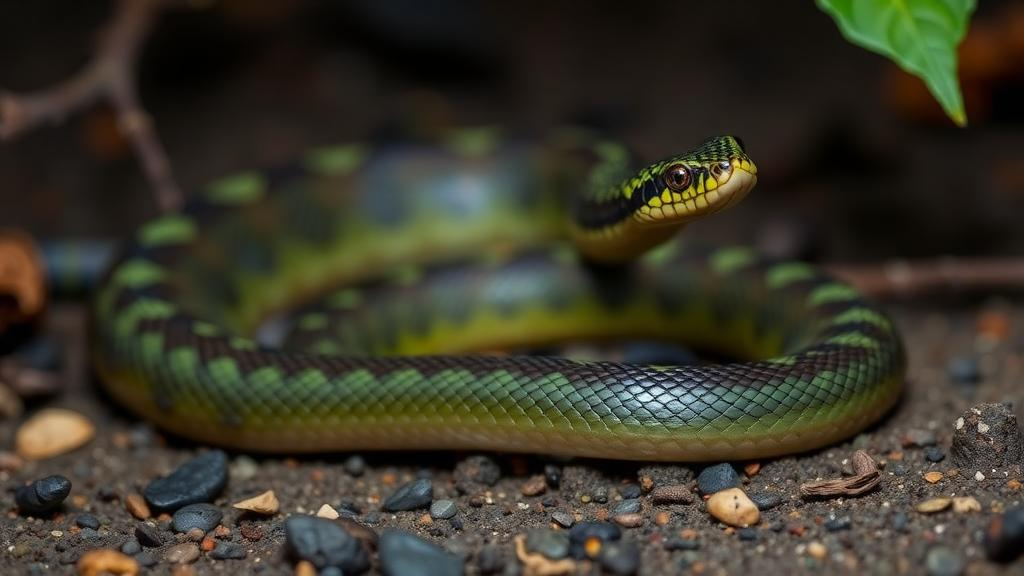
On a small island in Nha Trang Bay, Vietnam, a team of herpetologists has discovered a new species of snake that may be Vietnam’s most endangered reptile. The new species, Colubroelaps adleri, was described based on a single female specimen collected from Hon Tre Island in Khanh Hoa Province. The discovery, published in the journal Herpetozoa, represents only the second known species of the mysterious genus Colubroelaps, colloquially known as lace snakes, and the first record of this enigmatic group from the coastal areas of southern-central Vietnam.
The genus Colubroelaps is one of the most mysterious groups of snakes in Vietnam. It remained unnoticed for over a century of herpetological exploration and was only recently erected in 2009. The genus was originally characterized as a small, very thin colubrid snake with an elapsoid morphotype but no fangs and venomous glands. The body is vermiform and round in cross-section, with a total length up to 500 millimeters. The head is very small, roundish, and short, not distinguished from the body, and covered by large regular shields. The eyes are very small with round pupils, and the dorsal scales are uniform, rhomboid, tile-shaped, and smooth.
However, subsequent examination of the skull morphology using micro-CT X-ray scanning demonstrated that Colubroelaps has hinged teeth more similar to those of the family Sibynophiidae than to colubrids or elapids. This assumption that Colubroelaps was incorrectly assigned to the family Colubridae is now widely accepted. Nevertheless, any phylogenetic data on Colubroelaps are still unavailable, and the researchers take a cautious approach, referring to the taxon as a member of Colubroidea incertae sedis pending further phylogenetic assessment.
Until now, the genus was known only for a single species, Colubroelaps nguyenvansangi, described based on a single adult female collected in 2003 from southern Vietnam. Because of its fossorial lifestyle, this species is quite elusive and difficult to detect in the field. It has only been reported from six localities in southern Vietnam, and its distribution is restricted to the western foothills of the Langbian Plateau, where it is associated with seasonally dry, semi-deciduous, lowland, and mid-elevation tropical forests.
During field surveys on Hon Tre Island in June 2023, researchers Nikolay A. Poyarkov and Andrey M. Bragin encountered a specimen of Colubroelaps that was superficially similar to C. nguyenvansangi in its overall morphological habitus and body coloration. However, closer morphological examination of scalation, pattern, color, and morphometric characteristics demonstrated clear differences in a number of taxonomically important traits. The specimen was collected by hand, photographed in life, and deposited in the herpetological collection of the Zoological Museum of Moscow State University.
The new species, Colubroelaps adleri, can be distinguished from its sister species by a combination of morphological characters. It has a small body size, with a total length of 402 millimeters, and a relatively short tail, with a tail-length-to-total-length ratio of 0.10. The dorsal scales are arranged in 14 rows along the entire body, compared to 16 rows in C. nguyenvansangi. The new species has 234 ventral scales and only 30 subcaudals, all divided, whereas C. nguyenvansangi has 267 to 292 ventrals and 81 to 87 subcaudals. The dorsal coloration is pale brown with a narrow and interrupted dark stripe along the spine, and the body flanks are dark gray lacking the bluish iridescence seen in its sister species. The head is black, with the anterior parts of certain head shields dirty yellowish-brown with dark-brown spots.
The species epithet adleri is a patronymic honoring Dr. Kraig Adler, Professor Emeritus at Cornell University, in recognition of his outstanding support to the international herpetological community and his remarkable scientific contribution to Asian herpetology. The researchers suggest the common name Adler’s lace snake in English.
Currently, Colubroelaps adleri is known only from a single locality in secondary dry maritime evergreen forest on Hon Tre Island, at an elevation of 30 meters above sea level. The only known specimen was collected during the daytime while crossing a road near a garbage dump, approximately 10 meters from a dry maritime mixed low evergreen forest. The presence of a parasitic acanthocephalan worm in the subcutaneous cavity of the specimen may indicate that the new species feeds on insects, as these animals serve as intermediate hosts for such parasites. All other aspects of the ecology of the new species, including diet, preferred microhabitats, reproduction, and predators, remain unknown.
The discovery is significant because it expands the known geographic distribution of the genus Colubroelaps, which is now recorded for the first time from the coastal areas of southern and central Vietnam. The new species appears to be restricted to the unique maritime dry evergreen forests of the southern Vietnamese coasts, in contrast to its sister species, which occurs at elevations of 100 to 930 meters in seasonally dry monsoon semideciduous forests. The researchers suggest that the new species is likely micro-endemic to the small island of Hon Tre and may also inhabit other islands of Nha Trang Bay, though these are much smaller and their forest vegetation has been greatly destroyed.
Unfortunately, the new species is under threat due to the intensifying development of tourist infrastructure on Hon Tre Island. The recent development of resorts and amusement parks, as well as the world’s largest oversea cable car route, has led to an enormous growth in the number of tourists visiting the small island. In 2023, the resort welcomed nearly 10,000 visitors a day. The immense financial returns of tourism development largely outweigh concerns for biodiversity conservation, and urgent measures must be developed at local and central government levels to protect the remaining patches of maritime forests. Due to its uniqueness and rarity, the new species is also likely to become a target for the illegal pet trade. Considering the available information, the researchers recommend that Colubroelaps adleri be classified as Endangered according to the IUCN Red List categories. Given Hon Tre Island’s small size and rapidly growing tourism infrastructure, the new species may actually be Vietnam’s most endangered snake. Further research is urgently required to clarify the extent of its distribution, natural history, and population trends, thereby facilitating the development of adequate conservation actions.
Subject of Research: Herpetology
Article Title: A new endemic insular species of the genus Colubroelaps ( Squamata , Serpentes , Colubroidea ) from Khanh Hoa Province, Vietnam
Article References: Poyarkov, N. A., Bragin, A. M., & Nguyen, T. V. (2024). A new endemic insular species of the genus Colubroelaps (Squamata, Serpentes, Colubroidea) from Khanh Hoa Province, Vietnam. Herpetozoa, 37, 379-390. https://doi.org/10.3897/herpetozoa.37.e137809
Image Credits: AI Generated
DOI: 10.3897/herpetozoa.37.e137809
Keywords: Colubroelaps adleri, new species, Vietnam, Hon Tre Island, lace snake, endangered, herpetology, biodiversity, conservation, Nha Trang Bay, endemic, insular
Cite Scienmag News
Margaret Porter. (October 19, 2026). New endemic snake species discovered on Vietnamese island. Scienmag. https://scienmag.com/new-endemic-snake-species-discovered-on-vietnamese-island/
Margaret Porter. "New endemic snake species discovered on Vietnamese island." Scienmag, 19 October 2026, https://scienmag.com/new-endemic-snake-species-discovered-on-vietnamese-island/. Accessed 19 October 2026.
Margaret Porter. "New endemic snake species discovered on Vietnamese island." Scienmag. October 19, 2026. https://scienmag.com/new-endemic-snake-species-discovered-on-vietnamese-island/


