


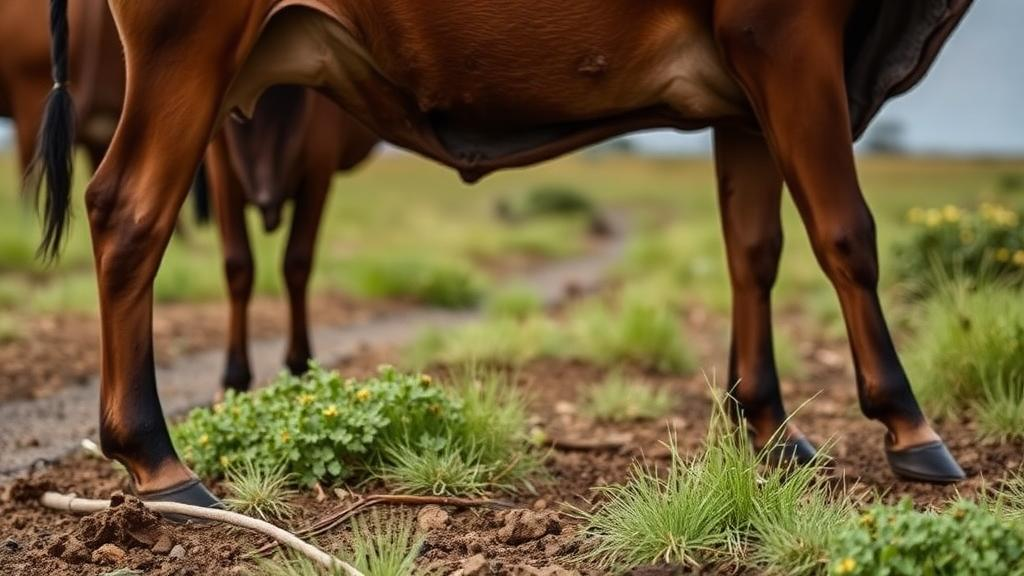
When the rains fail in South Africa’s semi-arid savannas, cattle do something remarkable: they quietly abandon their grass-based diets and turn to a hidden pantry of small flowering plants and tree leaves that most rangeland managers barely register. That is the central finding of a new study published in Metabarcoding and Metagenomics, which used DNA extracted from cattle dung to reconstruct, plant by plant, what livestock actually ate at the end of the dry season in two bioregions of the eastern semi-arid South African savanna. The work, led by researchers analysing faecal samples from 48 individual cattle, offers some of the most detailed molecular evidence yet that forbs — the non-woody flowering herbs that make up the most diverse component of savanna plant communities despite their small above-ground biomass — serve as crucial forage during drought periods.
The research team deployed a dual-locus DNA metabarcoding approach, amplifying two chloroplast gene regions, trnL(UAA) and rbcL, from faecal DNA collected at Welverdiend, a rural communal rangeland village in the Lowveld Bioregion, and at the Syferkuil Experimental Farm of the University of Limpopo in the Central Bushveld Bioregion. Samples were taken in October, directly before the first rains of the new season, when forage from the grass layer is particularly scarce. Approximately 10 grams of fresh faecal material was collected after defecation from each animal without disturbing them, and DNA was isolated using a plant DNA extraction kit. The two barcodes were then amplified and sequenced on an Illumina MiSeq platform, generating millions of sequences that were filtered, curated and matched against custom, study-area-specific plant DNA reference libraries built specifically for these savanna sites.
The choice of barcodes matters enormously in plant metabarcoding. Unlike animals, which have the near-universal COI barcode, plants possess no single marker that works equally well across all taxa. The rbcL region offers highly universal primers and reliable family-level identification, while trnL yields small DNA fragments suited to the degraded, low-copy-number DNA found in faeces. Neither locus has particularly high species-level discrimination, so the researchers evaluated diets to genus level. Crucially, the two markers proved complementary: trnL exhibited higher diversity in family and genus identification at both sites, uniquely recovering families such as Apocynaceae, Asteraceae and Euphorbiaceae, while rbcL exclusively identified Combretaceae and Annonaceae. Only by combining both loci could the team capture a comprehensive account of the cattle diets.
The results revealed a striking seasonal shift in foraging behaviour. At Welverdiend, where cattle forage on communal rangelands, the trnL marker showed Malvaceae — a family dominated by forbs and non-woody shrubs — as the most frequently ingested plant family, with a frequency of occurrence of 92 percent. Ebenaceae, representing woody taxa such as Euclea, and Poaceae, the grasses, followed closely at 84 percent each. Key forb genera in the Welverdiend diets included Malvastrum, Asparagus and Ipomoea, while woody taxa from Fabaceae, Combretaceae, Ebenaceae and Malvaceae — including genera such as Albizia, Combretum, Euclea and Vachellia — made substantial contributions. Grasses such as Setaria and Eragrostis were present but did not dominate individual diets.
At Syferkuil, where rotational grazing is practised on open thorn bush savanna, a different pattern emerged. Grasses dominated both marker datasets, with Poaceae showing a frequency of occurrence of 96 percent in the trnL dataset and 88 percent in the rbcL dataset. Setaria was the most common genus at 88 percent, followed by the woody Vachellia at 58 percent. Yet even here, forbs were actively foraged: Pollichia and Indigofera each recorded a 25 percent frequency of occurrence, and the succulent shrub Adenium appeared in half of the sampled individuals. The forb family Caryophyllaceae emerged as one of the most frequently utilised families in the trnL dataset, and in one sample it was the only family detected.
Phylogenetic and diversity analyses reinforced the superiority of the dual-locus strategy. The sum of branch lengths — a measure of phylogenetic distance among detected food items — was higher for trnL than rbcL at both sites, and Shannon index calculations showed the highest diversity of consumed plants at Syferkuil, especially for trnL. Plant species richness differed significantly between bioregions and markers. The researchers note that the differing success of the two barcodes is partly explained by the completeness of the reference libraries: the Combretaceae family, for instance, was represented by 12 unique species in the combined reference libraries, of which only three were barcoded with trnL, while rbcL covered all 12 — explaining why trnL systematically missed this family.
The study also exposed gaps in existing plant DNA reference databases for South African savannas. A substantial number of sequence variants remained unassigned after comparison with the custom libraries and could not be matched to any plant species in NCBI’s non-redundant nucleotide database, indicating the presence of unknown or poorly characterised plant species in the region. The rbcL reference library consisted of 1,238 sequences representing 318 genera and 562 species, while the trnL library held 921 sequences representing 270 genera and 461 species. The authors argue that expanded, multi-barcode reference records from South African savannas are needed not only to improve dietary reconstructions but to support the wider field of plant metabarcoding in the region.
The ecological implications extend beyond livestock nutrition. African savannas cover almost half the continent, and the replacement of functionally diverse native herbivore communities by single-species livestock has substantially altered savanna vegetation structure. Traditional rangeland management has focused on grass biomass productivity, with limited recognition of the role of forbs. Yet previous studies of bison showed that under nutritional pressure these grazers increased their intake of shrubs and forbs to access higher protein content — a pattern the new cattle data now confirm for African livestock. With drought events projected to increase in frequency and intensity, understanding alternative indigenous forage items is key to future ecosystem management in dryland rangelands.
The researchers caution that the method has inherent limitations. PCR bias may selectively amplify certain taxa, leading to over- or underrepresentation of specific plants, and faecal samples represent a snapshot of what an individual consumed immediately before sampling rather than long-term dietary habits. They recommend incorporating multiple sampling points over time and integrating dietary observations or tracking methods alongside genetic analyses for a more holistic understanding of foraging behaviour.
Nevertheless, the findings carry a clear message for rangeland managers facing a drier future: conserving the diversity of not only grasses but also shrubs and forbs in grazing areas supports the flexible foraging strategies cattle need to survive periods of scarcity. The study underscores that cattle possess a remarkable dietary adaptability, shifting from grass-based forage to higher inclusions of forbs and woody taxa during the dry season to maintain nutritional balance despite changing environmental conditions. Recognising these shifts, the authors argue, can guide adaptive management practices — from rotational grazing to supplemental feeding — that ensure the sustainable use of semi-arid landscapes while sustaining livestock productivity in communities that depend on it.
Subject of Research: A DNA metabarcoding study of cattle dung from two South African savanna sites reveals that livestock shift from grass-based diets to forbs and woody taxa during the dry season, highlighting the hidden dietary importance of small flowering herbs and the value of a dual-locus trnL and rbcL approach with site-specific reference libraries.
Article Title: Application of a dual-locus metabarcoding approach for a more comprehensive account of cattle dietary items in a semi-arid African savanna with special reference to forbs
Article References: Botha, D., Barnard, S., Du Plessis, M., Allam, M., Behn, K., Ismail, A., Linstädter, A., Mokoka, M. V., Mnisi, Z. T. H., & Siebert, F. (2024). Application of a dual-locus metabarcoding approach for a more comprehensive account of cattle dietary items in a semi-arid African savanna with special reference to forbs. Metabarcoding and Metagenomics, 8, Article e127959. https://doi.org/10.3897/mbmg.8.127959
Image Credits: AI Generated
Keywords: DNA metabarcoding, cattle diets, forbs, semi-arid savanna, South Africa, drought, rangeland management, trnL, rbcL, livestock, Application, dual-locus
Cite Scienmag News
William Thompson. (October 19, 2026). DNA from dung reveals cattle quietly switch from grass to forbs when the savanna dries out. Scienmag. https://scienmag.com/dna-from-dung-reveals-cattle-quietly-switch-from-grass-to-forbs-when-the-savanna-dries-out/
William Thompson. "DNA from dung reveals cattle quietly switch from grass to forbs when the savanna dries out." Scienmag, 19 October 2026, https://scienmag.com/dna-from-dung-reveals-cattle-quietly-switch-from-grass-to-forbs-when-the-savanna-dries-out/. Accessed 19 October 2026.
William Thompson. "DNA from dung reveals cattle quietly switch from grass to forbs when the savanna dries out." Scienmag. October 19, 2026. https://scienmag.com/dna-from-dung-reveals-cattle-quietly-switch-from-grass-to-forbs-when-the-savanna-dries-out/


