


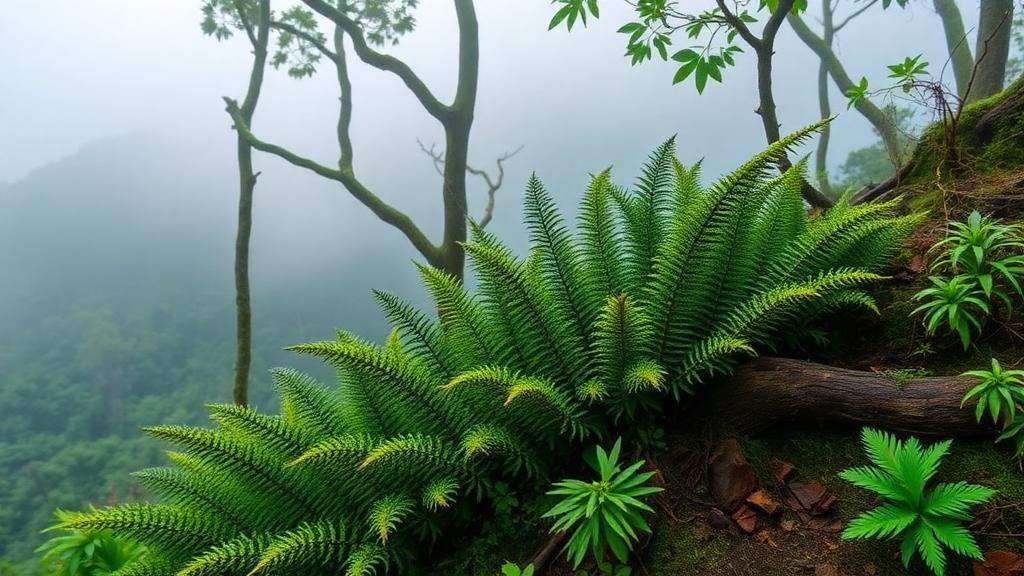
Deep in the moss-draped montane forests of Malaysia’s Cameron Highlands, a fern unseen by scientists for more than three decades has finally been found again. Diplazium velutinum, a rare species endemic to Peninsular Malaysia, was first collected in 1936 by the celebrated botanist R.E. Holttum and formally described in 1937. After a single subsequent record in 1988, the species vanished from scientific documentation, its fate uncertain. Now, floristic surveys conducted in 2018 along the trail to Mount Berinchang have yielded the first documented collection of this elusive plant in over 30 years, along with a wealth of new morphological, anatomical, and ecological data that finally puts this botanical ghost on solid scientific footing.
The rediscovery, published in the journal PhytoKeys, is far more than a simple field sighting. The research team provided a detailed updated morphological description, captured the species’ spore surface ornamentation under field emission scanning electron microscopy for the first time, summarized its molecular phylogenetic placement within the fern family Athyriaceae, and formally designated a lectotype to resolve the plant’s long-ambiguous nomenclatural status. Together, these results confirm that D. velutinum is a distinct species, not a mere montane variant of its lowland relative, and underscore why continued botanical surveys of Malaysia’s shrinking mountain forests matter so much.
The genus Diplazium is the most species-rich lineage in the family Athyriaceae, comprising roughly 300 species worldwide with centers of diversity in tropical and subtropical regions. Molecular phylogenetic studies have robustly supported Diplazium as a monophyletic genus, united by linear sori, continuous grooves running along the rachis and costa, and distinctive stipe scale morphology. In Peninsular Malaysia, 29 species have been recorded, six of which are endemic to the region. D. velutinum is one of these endemics, and until now it was also one of the poorest documented.
Holttum originally described the species from specimens collected in Cameron Highlands, a district in the Main Range of Peninsular Malaysia that harbors the largest remaining area of pristine montane rainforest in the country. The region spans 71,227 hectares, with approximately 74 percent of its land situated above 1,000 meters in elevation. Year-round temperatures average between 17 and 20 degrees Celsius, and annual rainfall exceeds 2,500 millimeters, conditions that create an optimal environment for fern diversity. Holttum himself emphasized the area’s extraordinary pteridophyte richness as early as 1947, and recent studies have continued to yield significant finds, including the first record of the genus Cornopteris for Peninsular Malaysia and new lycophyte species from the same montane zone. Yet these forests have also suffered significant habitat loss from agricultural encroachment and tourism development, lending urgency to every floristic documentation effort.
The 2018 fieldwork took place along the trail to Mount Berinchang, the second-highest peak in Peninsular Malaysia at 2,031 meters. The study site is characterized by upper montane forest with a closed canopy dominated by oaks (Fagaceae), laurels (Lauraceae), and Myrtaceae, with the forest floor blanketed in dense mosses, liverworts, and ferns. Specimens of D. velutinum were collected in October 2018 at an elevation of 1,687 meters and deposited at the Herbarium of Universiti Kebangsaan Malaysia. For morphological comparisons, the team consulted herbarium images from the Royal Botanic Gardens, Kew and the Singapore Botanic Gardens, and physically examined specimens of the closely related D. tomentosum, D. crenatoserratum, and D. prescottianum. Characters including rhizome type, stipe and scale characteristics, lamina dissection, venation pattern, sori arrangement, and indusium morphology were examined under a stereo microscope.
The morphological evidence paints a clear picture of a species distinct from its closest congener. D. velutinum differs from D. tomentosum in its bipinnatifid to tripinnatifid lamina, versus the pinnate to bipinnatifid fronds of the lowland species; in its nearly black stipe scales reaching 10 millimeters long, versus pale brown scales of roughly 4 millimeters; in an indument that covers the entire stipe and the abaxial lamina surface, rather than being restricted to the costa and rachis; and in its restriction to upper montane forest above 1,400 meters. A formal identification key now makes these differences explicit, allowing reliable field separation of all four morphologically similar species in the region through the combined characters of scale length, scale color, lamina dissection, and elevation.
Perhaps the most striking new data come from the spores. All spores of D. velutinum are monolete and bilaterally symmetrical, consistent with other Diplazium species from Peninsular Malaysia. Under the scanning electron microscope, the perispore ornamentation reveals broadly winged-alate folds with irregular gaps between adjacent folds. Viewed from the distal face, the spores display large, thin, sheet-like folds radiating from the spore body, producing a conspicuously stellate to lobate outline in polar view. Oblique lateral views confirmed that these folds are genuinely free-standing, projecting structures that extend well above the spore body surface rather than mere surface relief. The fold margins are strongly lacerate and irregularly dissected, some subdividing into narrow finger-like projections at their distal tips, while the fold faces carry a secondary micro-rugulate texture with sparse globular deposits. This is the first reported scanning electron microscopic examination of D. velutinum spores, filling an important gap in regional pteridological knowledge.
Comparative examination of previously published electron microscope images of D. tomentosum and D. crenatoserratum shows that D. velutinum occupies an intermediate position between the broadly developed wing-like perispore folds of D. tomentosum and the interconnected mesh-like fold pattern of D. crenatoserratum, while remaining distinguishable by its stellate outline. This pattern is congruent with the species’ molecular phylogenetic placement. Analyses of Athyriaceae in Peninsular Malaysia, using five DNA markers spanning four plastid regions and the nuclear ITS region with both maximum likelihood and Bayesian inference methods, place D. velutinum in a well-supported subclade with 94 percent bootstrap support together with D. crenatoserratum and D. tomentosum. A global sectional revision of Diplazium further places these species in section Anisogonium. The molecular data unambiguously reject treating D. velutinum as merely a variety of D. tomentosum, instead suggesting the two species diverged through ecological speciation associated with altitudinal range partitioning along a montane gradient.
The ecological observations reinforce this evolutionary story. At the collection site, D. velutinum grew terrestrially on steep, well-drained slopes in deep shade beneath a closed canopy, associated with ferns such as Athyrium anisopterum, Cornopteris opaca, and various filmy ferns of the family Hymenophyllaceae. Some plants grew beneath wild banana plants along moist, shaded slopes. The microhabitat featured dense bryophyte cover, humus-rich soil under thick decomposing leaf litter, air temperatures of 15 to 18 degrees Celsius, and relative humidity exceeding 90 percent. Holttum suggested in 1937 that D. velutinum represents the montane derivative of the lowland D. tomentosum, an ecological replacement along an elevational gradient, and the new observations support exactly that hypothesis: D. tomentosum typically occurs below 800 meters, while D. velutinum appears restricted to upper montane zones above 1,400 meters, a pattern of elevational partitioning common among closely related fern species on tropical mountains.
The study also settled a lingering nomenclatural question. Holttum originally listed two specimens under a single type heading without designating a holotype, meaning the two collections constitute syntypes and lectotypification was required. The researchers formally designated specimen S.F.N. 31221, held at the Singapore Botanic Gardens Herbarium, as the lectotype, choosing it because it is the more complete and diagnostically informative specimen, was collected from the locality explicitly cited in Holttum’s original description of the species’ streamside habitat in wet and shady mountain forest, and is represented by five sheets across three herbaria, providing exceptional accessibility for future researchers. The rediscovery of D. velutinum more than 30 years after its last record confirms the continued presence of this rare endemic in the montane forests of Cameron Highlands and demonstrates the enduring value of pteridological surveys, while highlighting the scientific significance of protecting these mist-shrouded habitats, where species can slip from view for a generation and still be waiting to be found.
Subject of Research: Rediscovery, lectotypification, and systematic characterization of the rare endemic fern Diplazium velutinum in Peninsular Malaysia
Article Title: Rediscovery and lectotypification of Diplazium velutinum Holttum ( Athyriaceae ), a rare endemic fern from Peninsular Malaysia
Article References: Aliah, N., Nadhirah, N., Maideen, H., Norhazrina, N., Khamis, S., Mohd Yusop, S., Basir, S., Syazwana, N., Zainal Abidin, D. H., & Zainee, N. F. A. (2026). Rediscovery and lectotypification of Diplazium velutinum Holttum (Athyriaceae), a rare endemic fern from Peninsular Malaysia. PhytoKeys, 276, 139-149. https://doi.org/10.3897/phytokeys.276.197738
Image Credits: AI Generated
DOI: 10.3897/phytokeys.276.197738
Keywords: Diplazium velutinum, Athyriaceae, ferns, Cameron Highlands, Peninsular Malaysia, lectotypification, spore ornamentation, molecular phylogenetics, montane forest, endemic species, Mount Berinchang, biodiversity
Cite Scienmag News
Margaret Porter. (October 19, 2026). Rare Malaysian fern lost for 30 years rediscovered on misty mountain trail. Scienmag. https://scienmag.com/rare-malaysian-fern-lost-for-30-years-rediscovered-on-misty-mountain-trail/
Margaret Porter. "Rare Malaysian fern lost for 30 years rediscovered on misty mountain trail." Scienmag, 19 October 2026, https://scienmag.com/rare-malaysian-fern-lost-for-30-years-rediscovered-on-misty-mountain-trail/. Accessed 19 October 2026.
Margaret Porter. "Rare Malaysian fern lost for 30 years rediscovered on misty mountain trail." Scienmag. October 19, 2026. https://scienmag.com/rare-malaysian-fern-lost-for-30-years-rediscovered-on-misty-mountain-trail/


