


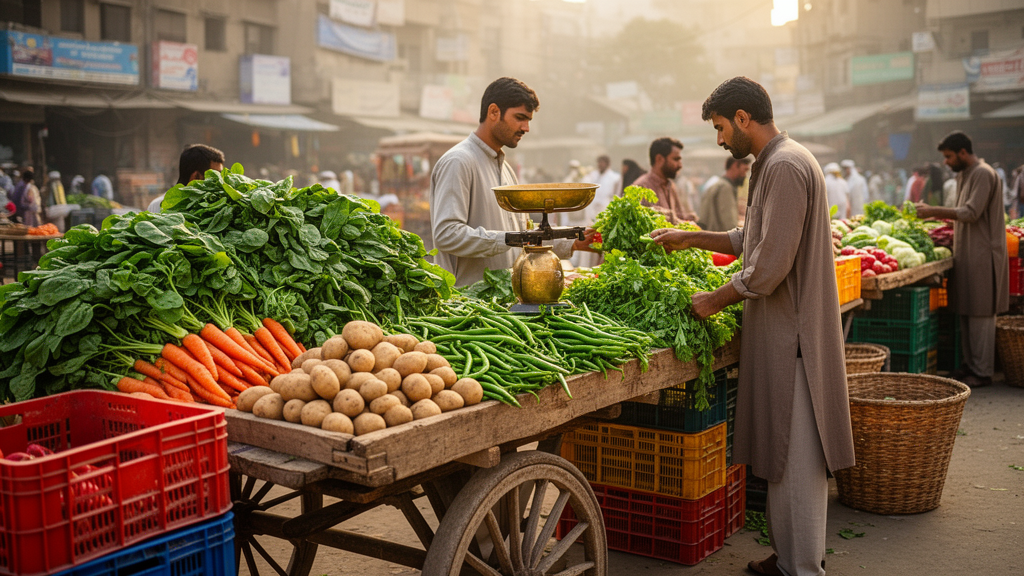
A trip to the vegetable market in Islamabad or Rawalpindi may deliver more than fresh produce. A new study from researchers at Fatima Jinnah Women University, published in Environmental Monitoring and Assessment, reports that nine commonly consumed vegetables bought from major wholesale markets in Pakistan’s twin cities carried measurable burdens of cadmium, chromium, nickel, and copper, with several samples exceeding internationally recognized permissible limits. The findings, drawn from samples collected over two months in 2025, add the Pothohar region of Punjab to a growing list of South Asian locations where the everyday act of eating vegetables carries a quantifiable chemical exposure, and they point to cumulative risks that fall hardest on children.
The research team, led by Aleeza Jalil with Mehwish Jamil Noor as corresponding author, set out to answer a deceptively simple question: how much toxic metal do consumers actually ingest when they eat vegetables purchased from local markets, and does that dose matter for health? To find out, they obtained nine vegetable species from wholesale markets in Islamabad and Rawalpindi, cities that together anchor the Pothohar plateau and supply a large urban population. The vegetables were analyzed using Flame Atomic Absorption Spectrophotometry, a well-established analytical technique in which a sample is ashed, dissolved, and aspirated into a flame that excites metal atoms; the wavelength and intensity of the light those atoms absorb reveal which metals are present and at what concentration. This method allowed the team to quantify four target metals: cadmium, chromium, nickel, and copper.
The numbers the spectrophotometer returned were striking. Cadmium ranged from 0.103 milligrams per kilogram in spearmint, Mentha spicata, sampled in Islamabad, to 2.28 milligrams per kilogram in potato, Solanum tuberosum, from Rawalpindi. Chromium varied from 0.09 milligrams per kilogram in Islamabad samples to a high of 7.52 milligrams per kilogram in coriander, Coriandrum sativum, purchased in Rawalpindi. Nickel spanned from 1.24 milligrams per kilogram in coriander from Islamabad to 21.18 milligrams per kilogram in bitter gourd, Momordica charantia, from Rawalpindi. Copper, the least toxic of the four but still problematic in excess, ranged from 1.37 milligrams per kilogram in bitter gourd from Rawalpindi to 24.98 milligrams per kilogram in tomato, Solanum lycopersicum, from Islamabad. Several vegetables, the authors report, exceeded permissible limits particularly for cadmium, chromium, and nickel.
What makes these figures concerning is the toxicology of the metals themselves. Cadmium, ranked among the highest on the United States Agency for Toxic Substances and Disease Registry’s substance priority list, accumulates in the kidneys and skeleton over decades and is classified as a human carcinogen; there is no beneficial biological role for it in the human body. Chromium, depending on its oxidation state, can range from an essential trace nutrient to the highly toxic hexavalent form that damages DNA. Nickel exposure is associated with dermatitis, respiratory irritation, and carcinogenic outcomes in certain compounds. Copper, in contrast, is an essential micronutrient required for enzyme function, but chronic overexposure damages the liver and gastrointestinal tract. Because plants take up these metals from soil and irrigation water and concentrate them in edible tissues, vegetables act as a direct conduit from contaminated growing environments to the human dinner plate.
The Pothohar region’s contamination profile has plausible sources rooted in its rapid urbanization. Rawalpindi and Islamabad host dense traffic corridors and industrial activity, and earlier work by some of the same research community has documented air pollution in the twin cities linked to heavy transportation and industry. Atmospheric deposition of metal particles onto leafy surfaces, irrigation with contaminated water, and application of fertilizers or sewage-derived amendments to peri-urban fields are all recognized pathways by which metals enter vegetable crops. Leafy herbs such as coriander and mint are particularly efficient accumulators because their large surface areas intercept airborne particles, while their fine root systems mine the soil intensively. The fact that some of the highest concentrations in this study appeared in coriander and bitter gourd from Rawalpindi is consistent with that pattern, although the study’s market-based design means it captures the produce supply as a whole rather than tracing individual farms.
To translate concentrations into health consequences, the team deployed the standard battery of dietary risk metrics used by environmental health agencies worldwide. The Estimated Daily Intake, or EDI, multiplies the measured metal concentration by the amount of vegetable a typical person eats each day, divided by body weight, yielding a dose in milligrams per kilogram of body weight per day. The Target Hazard Quotient, or THQ, compares that dose against a reference dose, the level below which regulatory agencies assume no appreciable harm over a lifetime of exposure. A THQ below one is considered acceptable; values above one signal potential non-carcinogenic risk. Summing the THQs across metals and vegetables produces the Hazard Index, or HI, which captures the cumulative burden of exposure to a mixture of metals. Finally, the Target Cancer Risk, or TCR, estimates the incremental lifetime probability of developing cancer from carcinogenic metals such as cadmium and chromium.
The results of this risk calculus reveal an important nuance. When each metal was evaluated on its own through the Estimated Daily Intake, exposures remained within acceptable limits, suggesting that no single vegetable delivers a dangerous dose of any one metal in a typical serving. But the cumulative indices told a different story. The Hazard Index and the Target Cancer Risk both suggested potential non-carcinogenic and carcinogenic risks, especially among children. The reason is arithmetic: children eat more food per kilogram of body weight than adults, so the same metal concentration in a vegetable translates into a higher dose for a smaller body. Their developing organs and longer remaining lifetimes further amplify both non-carcinogenic effects and lifetime cancer probability. A diet built around multiple contaminated vegetables, consumed daily over years, quietly stacks exposures that individually look tolerable but collectively cross thresholds.
This distinction between individual and cumulative risk is where the study’s significance lies, and it echoes a broader shift in how food safety is being assessed globally. Recent probabilistic assessments of dietary heavy metal exposure in China, Bangladesh, India, and Nigeria have converged on the same conclusion: single-metal, single-food evaluations systematically underestimate real-world risk because diets are diverse and contaminants co-occur. A companion systematic review by members of the same team, also published in Environmental Monitoring and Assessment, documented the global trend of rising heavy metal concentrations in vegetables and the spread of health risk assessment frameworks to quantify them. The Pothohar findings slot into that international picture while adding locally specific data from a region where such measurements had been sparse.
The authors frame their results as a call for action on three fronts. First, continuous monitoring of food quality is needed, since market surveillance of vegetables for metal contamination is not currently routine in Pakistan, and contaminated produce can move through wholesale channels without detection. Second, agricultural practices require improved regulation, including controls on irrigation water quality, fertilizer composition, and the siting of vegetable plots near roads and industry, because preventing uptake at the source is far more effective than testing finished produce. Third, public awareness must increase, so that consumers understand which vegetables and which markets carry higher burdens and how washing, peeling, and dietary diversification can modestly reduce exposure. The research was funded by Fatima Jinnah Women University under grant ORIC/FJWU/2025/308 as part of a project evaluating heavy metal dietary exposure and health risks from vegetable consumption in the twin cities.
For the millions of people who shop in the bazaars of Rawalpindi and Islamabad, the study does not mean vegetables should be abandoned; plant foods remain central to nutrition and disease prevention, and the authors themselves emphasize food safety rather than dietary avoidance. What it does mean is that the safety of those foods depends on environmental conditions far upstream of the market stall, in the soil, water, and air of the farms that supply them. As urbanization intensifies across South Asia and demand for fresh produce grows, the invisible chemistry of contamination will increasingly determine public health outcomes. Studies like this one, which convert parts-per-million measurements into concrete risk estimates for adults and children, provide the evidence base that regulators, farmers, and consumers need to act before cumulative exposure becomes cumulative harm.
Subject of Research: Heavy metal contamination of market vegetables and associated dietary health risks in the Pothohar region of Punjab, Pakistan
Article Title: Dietary exposure and health risks associated with selected vegetables from Pothohar Region of Punjab, Pakistan
Article References: Jalil, A., Noor, M. J., Bukhari, A. L., Shaban, A., & Iram, S. (2026). Dietary exposure and health risks associated with selected vegetables from Pothohar Region of Punjab, Pakistan. Environmental Monitoring and Assessment, 198(9), Article 1020. https://doi.org/10.1007/s10661-026-15848-3
Image Credits: AI Generated
DOI: 10.1007/s10661-026-15848-3
Keywords: heavy metals, cadmium, chromium, nickel, copper, vegetables, food safety, dietary exposure, health risk assessment, Pakistan, Pothohar region, Environmental Monitoring and Assessment
Cite Scienmag News
Russell Cooper. (October 19, 2026). Toxic Metals Lurk in Everyday Vegetables Sold in Pakistan’s Twin Cities, Study Warns. Scienmag. https://scienmag.com/toxic-metals-lurk-in-everyday-vegetables-sold-in-pakistans-twin-cities-study-warns/
Russell Cooper. "Toxic Metals Lurk in Everyday Vegetables Sold in Pakistan’s Twin Cities, Study Warns." Scienmag, 19 October 2026, https://scienmag.com/toxic-metals-lurk-in-everyday-vegetables-sold-in-pakistans-twin-cities-study-warns/. Accessed 19 October 2026.
Russell Cooper. "Toxic Metals Lurk in Everyday Vegetables Sold in Pakistan’s Twin Cities, Study Warns." Scienmag. October 19, 2026. https://scienmag.com/toxic-metals-lurk-in-everyday-vegetables-sold-in-pakistans-twin-cities-study-warns/


