


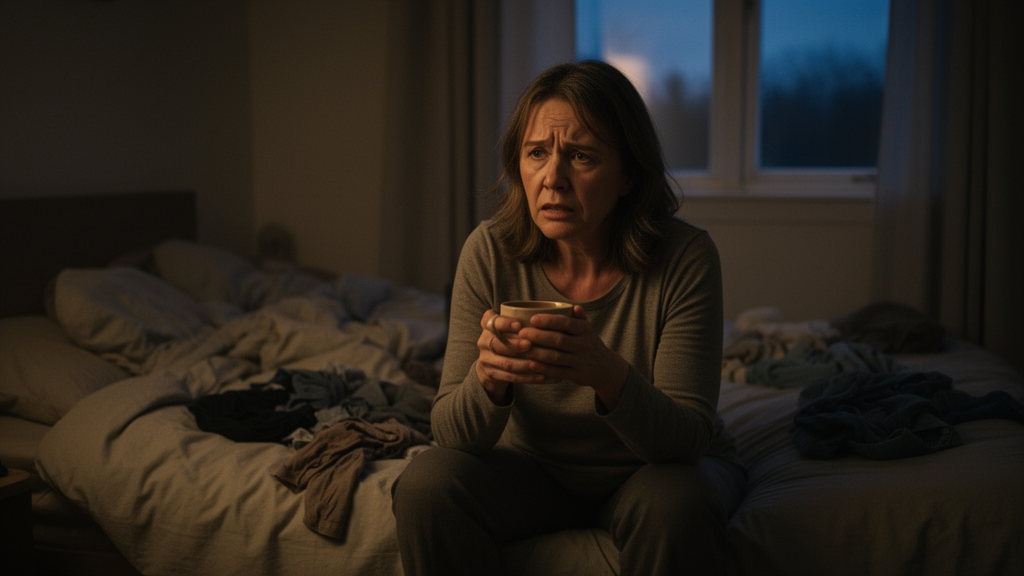
Anxiety has long been treated as a problem that lives inside the mind, but a new study of more than a thousand psychiatric inpatients in southern China suggests it is also shaped by something far more ordinary: how well people can get through the basic routines of daily life. The research, published in BMC Psychiatry, combined network analysis with path analysis to map how limitations in activities of daily living, mania symptoms, and anxiety interact in patients with mental disorders. Its central finding is striking. Difficulty with everyday tasks such as dressing, bathing, and eating does not merely accompany anxiety; it predicts it, feeds it indirectly through mania symptoms, and is itself amplified by mania in a feedback loop that varies by age and gender.
The team, led by Zukang Gong of the Fifth People’s Hospital of Nanning together with colleagues from Guangxi Medical University and the Nanning Center for Disease Control and Prevention, surveyed 1,050 patients at a mental health hospital in a southern province of China. Each participant completed three standardized instruments: the Self-Rating Anxiety Scale to measure anxiety severity, the Mania Scale to capture elevated mood, irritability, and increased activity, and the Activities of Daily Living Disability Scale to quantify how much help patients needed with self-care and routine functioning. Ethical approval came from the Medical Ethics Committees of Guangxi Medical University and the Fifth People’s Hospital of Nanning, and all participants gave informed consent in line with the Declaration of Helsinki.
What makes the study methodologically interesting is its departure from the traditional epidemiological habit of treating symptoms as isolated variables. Instead, the researchers used network analysis, a statistical framework borrowed in part from complexity science, in which each symptom or functional impairment is a node and the statistical associations between them are edges. In such a network, some nodes act as hubs with many strong connections, while others sit at the periphery. The analysis revealed a dense web of interactions linking daily living limitations, mania, and anxiety, with limitations in activities of daily living emerging as a particularly influential node. It was both a strong direct predictor of anxiety and a bridge through which other symptoms exerted their effects, a role the authors describe as mediating within the network structure.
Network analysis, however, describes correlations; it cannot by itself establish the direction of influence. To probe that question, the team turned to path analysis, a form of structural equation modeling that tests whether data are consistent with hypothesized causal chains. Two indirect routes stood out. In the first, daily living limitations increased anxiety by first intensifying mania symptoms, with the indirect component of this effect accounting for 33.2 percent of the total effect. In the second, mania symptoms worsened anxiety partly by eroding patients’ capacity to manage daily tasks, a pathway responsible for 16.2 percent of the total effect. In plain terms, roughly one third of the way that functional impairment translates into anxious distress runs through heightened manic states, and about one sixth of the way mania breeds anxiety runs through lost independence.
These bidirectional pathways paint a picture of a self-reinforcing cycle that clinicians will recognize from the ward. A patient who struggles to wash, dress, or feed independently may experience frustration, agitation, and restless energy that resemble or trigger manic symptoms. Those manic states, characterized by impulsivity and disorganized behavior, can in turn make it harder to maintain basic routines, deepening the functional impairment. Anxiety thrives in this environment, fed both directly by the loss of autonomy and indirectly by the escalating mood instability. The synergy implied by the study’s title is precisely this: neither daily living limitations nor mania alone tells the full story of anxiety risk, but together they form a loop in which each aggravates the other.
The study also found that the strength of these pathways is not uniform across the patient population. Gender and age acted as moderating variables, meaning the indirect effects linking daily living limitations, mania, and anxiety differed in magnitude depending on who the patient was. The authors do not report that one single pathway dominates in every subgroup; rather, their conclusion emphasizes that the three constructs are interrelated and exhibit differential path mechanisms across gender and age. That heterogeneity matters for practice. A screening strategy that treats all psychiatric patients as equivalent with respect to anxiety risk may miss those whose vulnerability is concentrated in a particular pathway, such as younger patients whose mania-driven route to anxiety is especially strong, or older patients for whom functional decline plays a larger role.
For the researchers, the motivation was a gap in the literature. Mental disorders have become a global public health challenge with a continuously expanding patient population, yet most studies of anxiety risk have focused on the general population, leaving psychiatric patients comparatively understudied. That gap is consequential because anxiety in people already living with mental disorders is associated with worse prognosis, greater functional decline, and higher service use. By focusing specifically on a hospitalized psychiatric sample and by modeling symptoms as an interacting system rather than a list of independent predictors, the study offers a more realistic account of how distress accumulates in this vulnerable group.
The clinical implications follow directly from the structure of the findings. If a substantial share of anxiety risk flows through functional impairment and mania, then interventions that preserve or restore daily living skills could do double duty, easing anxiety both directly and by dampening the manic symptoms that mediate part of the effect. Occupational therapy, structured daily routines, and rehabilitation programs aimed at self-care might therefore be reframed not merely as supportive care but as anxiety prevention. Conversely, aggressive management of manic symptoms could protect patients’ functional independence and, through it, reduce anxious distress. The moderating roles of gender and age suggest that these interventions should be tailored rather than uniform, with assessments that identify which pathway is most active for each individual patient.
As with any cross-sectional survey, caution is warranted in interpreting the directionality. Path analysis tests whether observed data are consistent with a proposed causal architecture, but it cannot prove causation in the way a randomized experiment can, and the mediation percentages describe statistical decomposition rather than measured biological mechanisms. The sample came from a single hospital in one province of China, which raises fair questions about generalizability to other settings and cultures. The study also relied on self-report scales, which, while validated and widely used, are subject to reporting biases that may vary with symptom state. The authors themselves frame the work as evidence that the three constructs are interrelated and warrant joint attention, a claim the data support robustly, rather than as a definitive causal verdict.
Even with those caveats, the study adds a compelling piece to a growing body of research that treats psychopathology as a network of mutually reinforcing symptoms rather than a collection of separate disorders. Its quantitative decomposition of the anxiety risk into direct and indirect components, and its demonstration that the balance of those components shifts with demographic characteristics, gives clinicians and researchers a concrete target: break the loop between lost daily function and mania, and anxiety may lose much of its fuel. For a patient population that has long been underserved by research designed around healthier populations, that reframing is a practical step toward care that addresses the whole system a patient lives in, not just the diagnosis on the chart.
Subject of Research: Synergistic effects of daily living limitations and mania symptoms on anxiety risk in patients with mental disorders
Article Title: Anxiety risk from the synergistic effect of activities of daily living limitations and mania symptoms in mental disorder patients: evidence from network and path analysis
Article References: Gong, Z., Liu, S., Xu, B., Qin, S., Lan, L., Long, J., Chen, B., Shen, B., Huang, X., Liang, T., Liao, F., Su, L., & Lin, W. (2026). Anxiety risk from the synergistic effect of activities of daily living limitations and mania symptoms in mental disorder patients: evidence from network and path analysis. BMC Psychiatry. https://doi.org/10.1186/s12888-026-08600-1
Image Credits: AI Generated
DOI: 10.1186/s12888-026-08600-1
Keywords: anxiety, mania, activities of daily living, mental disorders, network analysis, path analysis, psychiatry, mediation effect, functional impairment, gender differences, age differences, BMC Psychiatry
Cite Scienmag News
Glenn Wilkins. (October 19, 2026). Daily Living Struggles and Mania Team Up to Drive Anxiety in Psychiatric Patients. Scienmag. https://scienmag.com/daily-living-struggles-and-mania-team-up-to-drive-anxiety-in-psychiatric-patients/
Glenn Wilkins. "Daily Living Struggles and Mania Team Up to Drive Anxiety in Psychiatric Patients." Scienmag, 19 October 2026, https://scienmag.com/daily-living-struggles-and-mania-team-up-to-drive-anxiety-in-psychiatric-patients/. Accessed 19 October 2026.
Glenn Wilkins. "Daily Living Struggles and Mania Team Up to Drive Anxiety in Psychiatric Patients." Scienmag. October 19, 2026. https://scienmag.com/daily-living-struggles-and-mania-team-up-to-drive-anxiety-in-psychiatric-patients/


