


When a patient’s heart stops, the first minutes belong to the nurse or midwife standing at the bedside. Cardiopulmonary resuscitation is one of the most time-critical interventions in modern medicine, and its effectiveness depends on a chain of actions, from recognizing cardiac arrest and calling for help to delivering chest compressions of the right depth and rate and operating a defibrillator correctly. A new cross-sectional study from a tertiary hospital in Ghana, published in BMC Nursing, offers a strikingly detailed picture of how prepared frontline nurses and midwives actually are, and the results reveal a paradox that has implications far beyond one institution.
The research team, led by Rita Opoku-Danso of the Department of Adult Health at the University of Cape Coast’s School of Nursing and Midwifery, set out to measure three distinct dimensions of CPR competence: theoretical knowledge, observed practical skills, and self-reported readiness. Of 331 eligible staff working in critical and emergency care units, 271 participated, an impressive response rate of 81.9 percent. The design was analytical and cross-sectional, meaning the researchers captured a snapshot of competence at a single point in time and then used statistical modeling to identify which factors were associated with readiness.
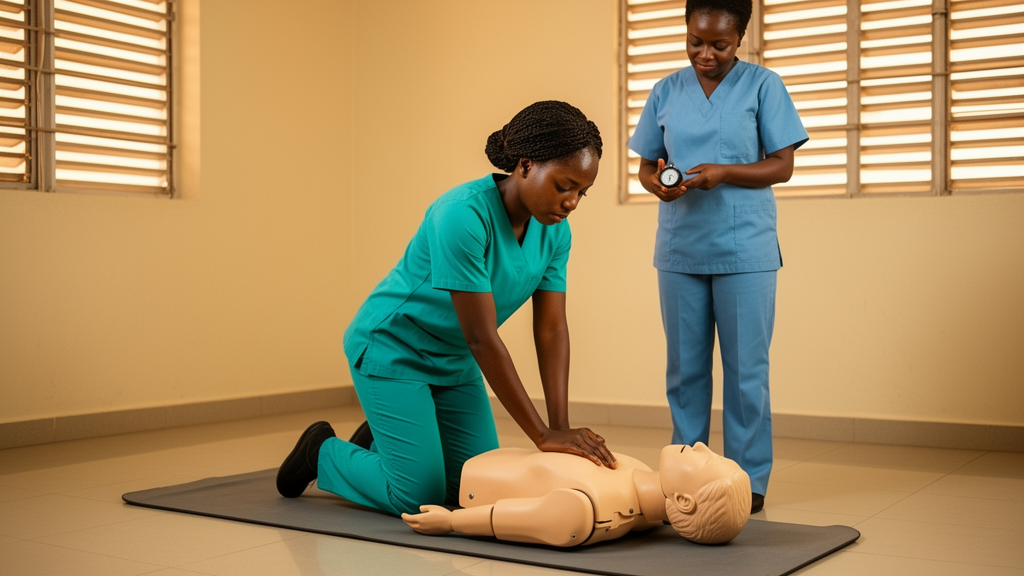
The measurement strategy is what makes this study technically interesting. Knowledge was assessed with a structured test, the kind of written examination that has long been the default tool for evaluating clinical competence. Skills, by contrast, were observed directly on a manikin using a 12-item checklist, forcing each participant to physically demonstrate the sequence of resuscitation steps rather than merely describe them. Self-reported readiness was captured with an 11-item Likert scale, a psychometric instrument that asks respondents to rate their own confidence and preparedness on a graded continuum. Each instrument therefore probes a different layer of competence, and the study’s central finding emerges from how poorly those layers align.
The headline numbers are sobering. A staggering 94.8 percent of respondents had low CPR knowledge, meaning that nearly every nurse and midwife tested failed to reach an adequate score on the written assessment. Yet when the same professionals were observed performing CPR on a manikin, 65.7 percent demonstrated adequate skills. And when asked how ready they felt to perform resuscitation in a real emergency, 90.0 percent reported moderate readiness. In other words, the workforce that would respond to a cardiac arrest knows the least about the theory, performs the procedure reasonably well in practice, and feels moderately confident about doing it under pressure.
This dissociation between knowledge and performance is not unique to Ghana, but its magnitude here is remarkable. The authors suggest that the pattern likely reflects how nurses and midwives learn and retain resuscitation skills. Practical, repeated exposure to emergency scenarios, even on simulation equipment, appears to build procedural memory that outlasts the theoretical content covered in classroom sessions or occasional refresher courses. Chest compressions, airway management, and the choreography of a resuscitation attempt are motor skills reinforced by doing, while knowledge of compression depths, drug dosages, and algorithm sequences decays rapidly without regular reinforcement.
The statistical core of the study lies in its binomial logistic regression analysis, which modeled the odds of reporting moderate readiness as a function of knowledge, observed skills, and demographic and training variables. The strongest signal came from observed skills: nurses and midwives who demonstrated adequate CPR skills had dramatically higher odds of reporting moderate readiness, with an adjusted odds ratio of 12.84 and a 95 percent confidence interval spanning 4.09 to 40.36, a result significant at p less than .001. This means that hands-on competence, as measured on the manikin, was the dominant predictor of how ready clinicians felt, dwarfing every other factor the researchers examined.
More puzzling is the finding on knowledge. Compared with staff who had low knowledge, those with moderate knowledge actually showed lower odds of reporting moderate readiness, with an adjusted odds ratio of 0.11 and a confidence interval of 0.03 to 0.46, significant at p equal to .003. The authors themselves urge caution in interpreting this counterintuitive result. One plausible explanation is a version of the Dunning-Kruger dynamic in reverse: clinicians who know more about the complexity of resuscitation may also be more aware of what they do not know, and therefore rate their readiness more conservatively. Those with minimal theoretical grounding may feel unqualified to doubt themselves. Alternatively, the small number of participants in the moderate knowledge category may have made this estimate unstable.
Equally important is what did not predict readiness. Demographic characteristics such as age, professional cadre, and years of experience, along with prior training variables, were not significant predictors in the regression model. This null result carries a practical message: simply having attended a training course at some point in the past, or having accumulated years on the ward, does not guarantee that a nurse or midwife feels, or is, prepared to resuscitate a patient. Readiness appears to track current, demonstrated competence rather than credentials or tenure.
For hospital administrators and nursing educators, the study’s recommendations follow directly from its architecture. The authors call for regular simulation-based training paired with competency assessment that combines knowledge testing with observed practical performance. The logic is precise: because observed skills were so strongly associated with readiness, and because knowledge was so deficient, programs that rely on either written tests or practical demonstrations alone will miss half the picture. Simulation-based approaches, in which teams rehearse resuscitation scenarios on manikins under realistic time pressure, are increasingly recognized as the gold standard for maintaining emergency competence, and this study provides context-specific evidence for that approach in a West African tertiary setting.
The broader significance of the research extends to health systems across low- and middle-income countries, where evidence on CPR competence among nurses and midwives has been limited. Cardiac arrests on hospital wards are common, and the quality of the initial response, delivered overwhelmingly by nursing staff, shapes survival outcomes before physicians and advanced teams arrive. A workforce with strong observed skills but weak theoretical knowledge may perform adequately in routine scenarios yet falter when atypical situations demand algorithmic reasoning, such as recognizing reversible causes of arrest or adjusting to pediatric protocols. Closing that gap requires sustained investment in recurring, assessed training rather than one-off certification. The Ghanaian study, with its unusually high response rate and its triangulation of knowledge, skills, and self-assessment, offers a replicable template for measuring that readiness wherever nurses and midwives stand first in line when a heart stops.
Subject of Research: CPR readiness among nurses and midwives in Ghana
Article Title: Association of knowledge and observed skills with self-reported readiness of nurses and midwives to perform cardiopulmonary resuscitation in a tertiary hospital in Ghana: a cross-sectional study
Article References: Opoku-Danso, R., Bockor, M. A., Quayson, E., Boahemaa, J., Odoom, E., & Owusu, G. (2026). Association of knowledge and observed skills with self-reported readiness of nurses and midwives to perform cardiopulmonary resuscitation in a tertiary hospital in Ghana: a cross-sectional study. BMC Nursing, 25(1), Article 903. https://doi.org/10.1186/s12912-026-05327-y
Image Credits: AI Generated
DOI: 10.1186/s12912-026-05327-y
Keywords: cardiopulmonary resuscitation, nurses, midwives, Ghana, CPR knowledge, observed skills, readiness, simulation-based training, cross-sectional study, tertiary hospital, BMC Nursing, emergency care
Cite Scienmag News
Ophelia Keating. (October 18, 2026). Nurses in Ghana Show Strong CPR Skills but Weak Knowledge, Study Finds. Scienmag. https://scienmag.com/nurses-in-ghana-show-strong-cpr-skills-but-weak-knowledge-study-finds/
Ophelia Keating. "Nurses in Ghana Show Strong CPR Skills but Weak Knowledge, Study Finds." Scienmag, 18 October 2026, https://scienmag.com/nurses-in-ghana-show-strong-cpr-skills-but-weak-knowledge-study-finds/. Accessed 18 October 2026.
Ophelia Keating. "Nurses in Ghana Show Strong CPR Skills but Weak Knowledge, Study Finds." Scienmag. October 18, 2026. https://scienmag.com/nurses-in-ghana-show-strong-cpr-skills-but-weak-knowledge-study-finds/


