


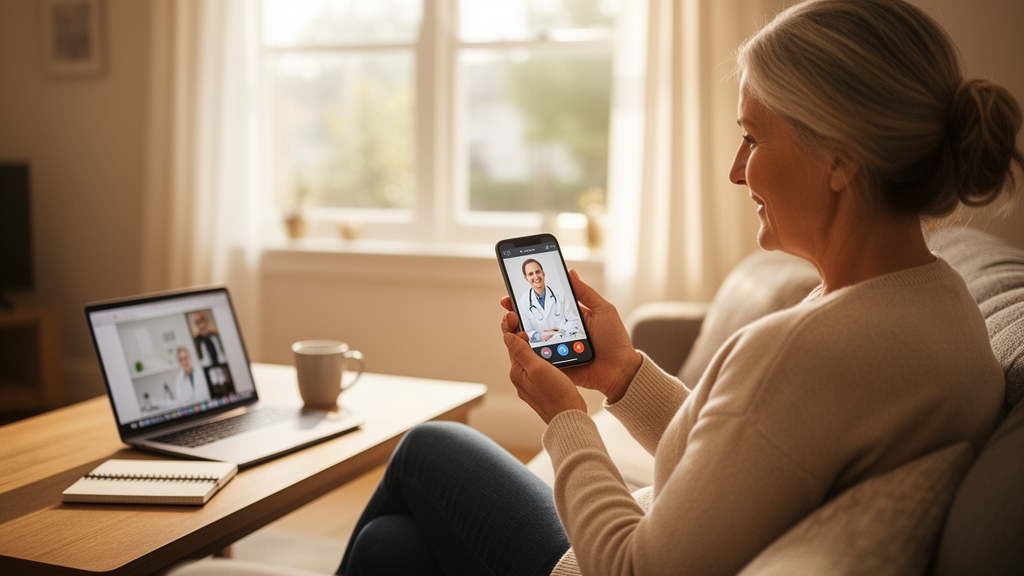
When the COVID-19 pandemic forced clinics to close their doors, American medicine went home. Video calls replaced waiting rooms, telephone consults replaced hallway conversations, and telehealth went from an afterthought to a central pillar of care delivery. Almost overnight, researchers, policymakers, and health systems began asking the same urgent question: was this sudden transformation a temporary emergency measure, or a permanent restructuring of how patients and doctors connect? Years after the acute phase of the pandemic subsided, the answer matters for everything from broadband policy to insurance reimbursement rules, because the infrastructural and financial decisions made now will determine who can access virtual care for decades to come.
A new nationally representative study published in the Journal of General Internal Medicine offers one of the clearest post-pandemic baselines yet. Drawing on the Health Information National Trends Survey, or HINTS, a team of researchers led by Cancan Zhang of Beth Israel Deaconess Medical Center and Harvard Medical School compared telehealth use among US adults in 2022 and 2024, tracking not only how common virtual visits had become but whether the disparities in use that surfaced during the pandemic were fading, persisting, or hardening into structural inequities. The analysis pooled 11,386 respondents across the two survey waves, with a mean age of about 48.6 years and a slight female majority of 51.1 percent.
The headline finding is a modest retreat rather than a collapse. Unadjusted telehealth use fell from 39.0 percent of adults in 2022 to 34.9 percent in 2024, meaning that roughly one in three American adults still reported at least one video or telephone medical visit in the previous year. That decline, the researchers found, was driven substantially by women, who had been among the heaviest users of virtual care during the pandemic and who pulled back more sharply as in-person options returned. The overall trajectory suggests that telehealth has not reverted to its marginal pre-pandemic status but has instead settled at a plateau considerably above baseline, embedding itself as a routine option rather than a crisis workaround.
Perhaps more revealing than the volume numbers is the composition of those visits. The proportion of telehealth encounters conducted by video remained essentially stable at around 71.1 percent between the two survey years, indicating that the telephone versus video split has stabilized into a durable equilibrium. There was one striking exception: among uninsured individuals, the share of visits conducted by video increased considerably, a shift the study identified as one of the few dimensions on which the insurance-related gap in virtual care actually narrowed over time. The technical and logistical hurdles that once made video visits disproportionately difficult for people without steady coverage appear to be easing, at least at the margins.
Methodologically, the study is notable for the care it takes with the messy realities of survey data. The researchers used repeated cross-sectional logistic regression models, adjusting for sociodemographic, clinical, and access-related variables, and crucially testing interactions with survey year to determine whether each factor’s association with telehealth use changed between 2022 and 2024. This design allowed them to distinguish between disparities that merely persisted and disparities that were actively widening or closing. Confidence intervals were estimated with techniques suited to complex survey proportions, and the models interpreted log odds with attention to the well-known pitfalls of translating logistic coefficients into probability statements, following best practices for logit model interpretation.
The results paint a consistent picture of who uses telehealth. Overall use was associated with age, internet use, higher income, and residence in large metropolitan areas. Among those who did use telehealth, opting for video rather than telephone visits was additionally linked to living in the Northeast and to having depression, a clinical association that may reflect both the suitability of video formats for mental health care and the greater comfort of certain patient populations with screen-based communication. These patterns echo earlier national findings that telehealth adoption concentrates among patients who already enjoy advantages in connectivity, income, and geography, raising the uncomfortable possibility that virtual care can amplify existing inequities even as it removes barriers like transportation and time off work.
Here is where the study delivers its most consequential news: most of these associations did not differ by survey year. The digital divides identified during the pandemic, in other words, were not transient artifacts of an emergency but durable features of the telehealth landscape. Older adults, people with lower incomes, those who do not use the internet, and residents of smaller metropolitan and rural areas remained less likely to use telehealth in 2024 just as they had in 2022. The two bright spots were the narrowing of gender differences in overall use and the narrowing of insurance differences in video use, suggesting that the composition of telehealth users is converging in some dimensions while remaining stubbornly stratified in others.
The quality signals are equally important for what they say about the future of virtual care. Despite roughly 20 percent of telehealth users reporting technical problems during their visits, more than 75 percent rated the care they received as comparable to in-person care. That combination of friction and satisfaction is telling: patients are willing to tolerate dropped calls, audio delays, and fumbled screen-sharing because the underlying experience of being seen and heard by a clinician still comes through. Prior research supports this optimism, with randomized trials of telehealth in settings ranging from early palliative care for advanced lung cancer to longitudinal primary care demonstrating that virtual visits can sustain clinical relationships and outcomes comparable to traditional care, even as questions linger about follow-up patterns and diagnostic limits.
The study arrives at a pivotal policy moment. Federal and state telehealth flexibilities, from expanded Medicare reimbursement to cross-state licensure accommodations, were extended repeatedly after the pandemic emergency expired, and some expire or require renewal on rolling schedules that the Centers for Medicare and Medicaid Services continues to update. The new findings supply evidence for those debates in two directions at once. On one hand, the persistence of a substantial user base, the stable quality ratings, and the growing video uptake among the uninsured argue that broad access to telehealth should continue as a permanent feature of American health care. On the other hand, the durability of income, age, connectivity, and geographic gaps suggests that simply keeping the doors open is not enough; without deliberate investment in broadband access, device availability, digital literacy support, and technology navigator programs like those emerging in safety-net systems, virtual care will remain a two-tier service that works best for those who need it least.
The researchers’ conclusion is restrained but pointed: because perceived quality is high, broad access to telehealth should continue, paired with concerted efforts to reduce the structural and technological barriers that keep telehealth’s benefits unevenly distributed. The pandemic proved that American health care could reinvent its delivery model in a matter of weeks. The slower, harder task now under way is ensuring that the version of telehealth that survives is one that serves not just the connected, insured, urban majority but the full breadth of the population the health system exists to care for.
Subject of Research: Trends in telehealth use and associated sociodemographic disparities among US adults from 2022 to 2024
Article Title: Trends in Telehealth Use and Changes in Associated Disparities: 2022–2024 HINTS
Article References: Zhang, C., Zhang, A. D., Grobman, B., Morooka, H., Janszky, I., Mukamal, K. J., & Schonberg, M. A. (2026). Trends in Telehealth Use and Changes in Associated Disparities: 2022–2024 HINTS. Journal of General Internal Medicine. https://doi.org/10.1007/s11606-026-10765-0
Image Credits: AI Generated
DOI: 10.1007/s11606-026-10765-0
Keywords: telehealth, telemedicine, health disparities, HINTS survey, digital divide, video visits, health insurance, COVID-19 pandemic, health policy, patient satisfaction, Journal of General Internal Medicine, survey research
Cite Scienmag News
Kristina Jarvis. (October 18, 2026). Telehealth Use Is Settling Into Its Post-Pandemic Rhythm, National Survey Shows. Scienmag. https://scienmag.com/telehealth-use-is-settling-into-its-post-pandemic-rhythm-national-survey-shows/
Kristina Jarvis. "Telehealth Use Is Settling Into Its Post-Pandemic Rhythm, National Survey Shows." Scienmag, 18 October 2026, https://scienmag.com/telehealth-use-is-settling-into-its-post-pandemic-rhythm-national-survey-shows/. Accessed 18 October 2026.
Kristina Jarvis. "Telehealth Use Is Settling Into Its Post-Pandemic Rhythm, National Survey Shows." Scienmag. October 18, 2026. https://scienmag.com/telehealth-use-is-settling-into-its-post-pandemic-rhythm-national-survey-shows/


