


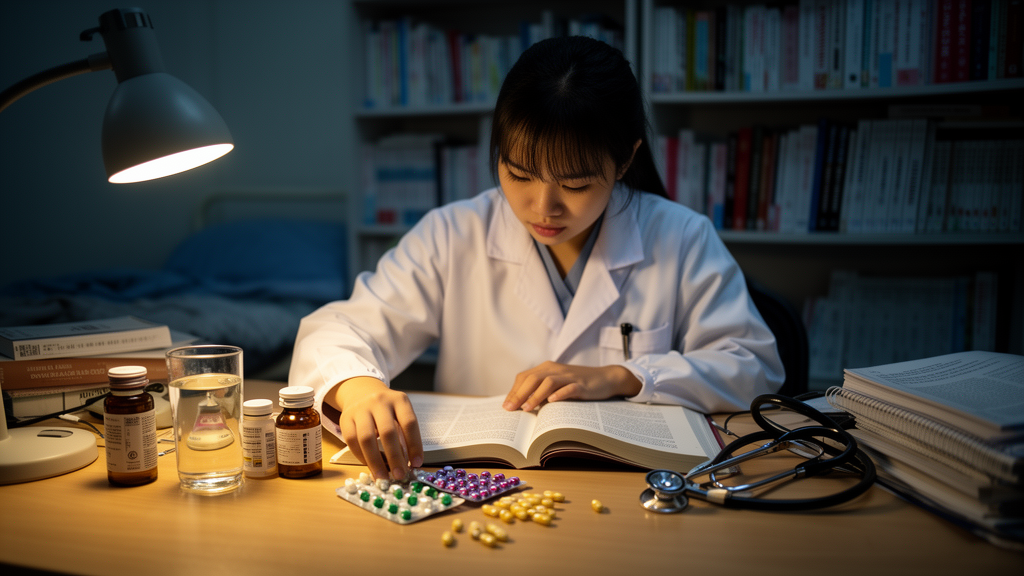
Future pharmacists and nurses in southern Vietnam are graduating with strong pharmacological knowledge—and more than half of them are still treating themselves with medicines without professional supervision. A new cross-sectional study at Binh Duong Medical College, published in the journal Pharmacia, followed 363 final-year associate-degree pharmacy and nursing students through the end of 2025 and found that 53.3 percent had self-medicated within the previous six months. The most striking result, however, was not the prevalence itself but what predicted it: knowledge of drug risks played almost no role in whether students reached for the medicine cabinet, while their attitudes and the discipline they were training in did.
The World Health Organization defines self-medication as the selection and use of medicines by individuals to treat symptoms they have recognized themselves, or the intermittent reuse of a prescribed drug for a chronic condition, all without professional oversight. When practiced responsibly for minor ailments, it can relieve pressure on overstretched health systems and support personal autonomy. But irresponsible self-medication carries serious consequences: misdiagnosis, delayed treatment of serious disease, adverse drug reactions, and—perhaps most dangerously—the acceleration of antimicrobial resistance, which the WHO ranks among the gravest threats to global health. A 2022 systematic review cited in the study put the worldwide prevalence of self-medication at up to 67 percent, with Southeast Asia topping the table at 74 percent, and prior research has found rates approaching 97 percent among health sciences students, far above the general population.
Vietnam presents a particularly fertile environment for the practice. Roughly half the population bought at least one medicine or supplement in the preceding three months according to recent national data, and antibiotics can reportedly be purchased without a prescription at 97 percent of community pharmacies. Earlier Vietnamese studies among university-level health students reported six-month self-medication rates ranging from 32 percent among pharmacy students to 52.7 percent among health sciences students who relied on personal experience. Yet the country’s associate-degree pharmacy and nursing students—the backbone of the primary healthcare workforce in rural and provincial facilities—had never been systematically compared within a single institution.
The research team, working from November to December 2025, surveyed essentially the entire final-year cohort: 365 eligible students, of whom 363 provided valid responses, a 99.5 percent response rate. The sample comprised 223 pharmacy students and 140 nursing students, nearly all aged 20 to 25 and predominantly female. The questionnaire, adapted from a validated instrument developed in Penang, Malaysia, went through a rigorous six-stage translation and cross-cultural adaptation process, including independent forward and back translation, expert committee review, pretesting, and a pilot with 30 separate students. Reliability was high: the knowledge section scored 0.85 on the Kuder–Richardson 20 coefficient and the attitude scale reached a Cronbach’s alpha of 0.92, both comfortably above the conventional 0.70 threshold.
The instrument measured four domains. Ten binary items assessed knowledge of drug interactions, contraindications, and safe-use principles, scored against the modified Bloom’s cutoff in which 80 percent or higher counts as good. Ten five-point Likert items gauged attitudes, operationalized as the propensity to self-medicate—so a higher score signals a stronger inclination toward the behavior, not a safer mindset. Nine further items captured actual practice over the preceding six months, including where students obtained medicines, what they treated, and why. Statistical analysis combined chi-squared and Mann–Whitney U tests with multivariable logistic regression, controlling for multicollinearity and verified for calibration with the Hosmer–Lemeshow test.
The knowledge results were broadly reassuring. Overall, 80.1 percent of students demonstrated good knowledge, with pharmacy students outperforming nursing students, 84.3 percent to 73.2 percent. Pharmacy students scored significantly higher on drug–alcohol interactions, drug–food interactions, and contraindications in children, reflecting the deeper pharmacology content of their curriculum. But a troubling detail lurked in the data: 61.7 percent of all students admitted having previously discontinued a medicine without consulting a healthcare professional—a habit with direct relevance to antimicrobial resistance and treatment failure, and one that was equally common in both disciplines.
Attitudes told a different story. Nearly 80 percent of students showed a moderate propensity toward self-medication, and 12.3 percent showed a high propensity. Nursing students were 5.5 times more likely than pharmacy students to fall into the high-propensity category, 24.6 percent versus 4.5 percent, despite scoring similarly on knowledge. Encouragingly, most students rejected the notion that professional training is unnecessary for safe self-medication, and majorities declined to recommend self-medication to others or to claim they could self-treat many diseases simply because of their health sciences background. Married students also expressed more caution than their single peers.
Practice data revealed what the researchers call a pharmacy–nursing paradox. Pharmacy students, armed with better knowledge and more cautious attitudes, nonetheless self-medicated more often: 61.0 percent versus 40.0 percent among nursing students. They cited emergency situations more frequently as a justification and self-treated gastrointestinal complaints—abdominal pain, diarrhea, constipation—at substantially higher rates. Nursing students, by contrast, leaned on prior treatment experience and the internet for information, and showed a striking reliance on unconventional supply channels: 46.2 percent of nursing students who self-medicated obtained medicines online, and 26.9 percent bought them at supermarkets, compared with 5.1 percent and 1.5 percent respectively among pharmacy students. The authors flag this as a pharmaceutical-law literacy gap, particularly urgent given Vietnam’s new e-commerce provisions under Law No. 44/2024/QH15.
The multivariable regression, fitted on 299 complete cases, distilled the picture into three independent predictors of self-medication. Being a nursing student roughly halved the odds compared with pharmacy students, an adjusted odds ratio of 0.43. Each one-point increase in the attitude score—greater propensity toward self-medication—raised the odds by 5 percent. And students with a grade point average between 2.00 and 2.49 faced nearly four times the odds of self-medicating compared with those in the excellent range, a finding that remained stable across sensitivity analyses including a Firth penalized-likelihood model. Knowledge score, notably, was not significant in any model, and the weak bivariate correlation between knowledge and attitudes dissolved after adjustment. The authors interpret this through the lens of the Theory of Planned Behavior: attitudes and internalized professional norms, not factual recall, drive behavior. Nursing training, with its emphasis on following medical orders, may itself act as a protective barrier, while pharmacological depth may breed a subtle overconfidence among pharmacy students—a hypothesis the cross-sectional design cannot confirm.
The implications reach beyond one college. Because knowledge alone demonstrably fails to shape safe behavior, the authors argue that health professional curricula should embed attitude-oriented interventions that stress the limits of professional competence and the clinical risks of unsupervised medication use, including arbitrary discontinuation. Nursing programs need explicit content on pharmaceutical law and online medicine purchasing; regulators, meanwhile, should strengthen Good Pharmacy Practice inspections and publish lists of licensed e-pharmacies. The study also positions cumulative GPA as a potentially modifiable risk marker worth screening for targeted support. Its limitations are real—single-institution scope, self-reported data vulnerable to recall and social desirability bias, and no capacity for causal inference—but the message is hard to dismiss. In a region where antibiotics sit behind no prescription counter, the people who will soon staff the front line of primary care are learning, before graduation, that knowing the risks of self-medication and acting on them are two very different skills.
Subject of Research: Self-medication knowledge, attitudes, and practices among Vietnamese healthcare college students
Article Title: Knowledge, attitudes, and practices regarding self-medication among healthcare college students in Vietnam: a cross-sectional study
Article References: Vo-Ho, T.-D., Vo, H. B. T., Huynh, H. V., Le, P.-Y. T., Nguyen, N.-N. T., & Vo, T. Q. (2026). Knowledge, attitudes, and practices regarding self-medication among healthcare college students in Vietnam: a cross-sectional study. Pharmacia, 73, Article e204360. https://doi.org/10.3897/pharmacia.73.e204360
Image Credits: AI Generated
DOI: 10.3897/pharmacia.73.e204360
Keywords: self-medication, Vietnam, pharmacy students, nursing students, knowledge attitudes practices, antimicrobial resistance, cross-sectional study, health sciences education, over-the-counter medicines, pharmacology training, Binh Duong Medical College, drug safety
Cite Scienmag News
Louis Brooks. (October 18, 2026). Knowing Is Not Enough: Vietnamese Healthcare Students Keep Self-Medicating Despite the Risks. Scienmag. https://scienmag.com/knowing-is-not-enough-vietnamese-healthcare-students-keep-self-medicating-despite-the-risks/
Louis Brooks. "Knowing Is Not Enough: Vietnamese Healthcare Students Keep Self-Medicating Despite the Risks." Scienmag, 18 October 2026, https://scienmag.com/knowing-is-not-enough-vietnamese-healthcare-students-keep-self-medicating-despite-the-risks/. Accessed 18 October 2026.
Louis Brooks. "Knowing Is Not Enough: Vietnamese Healthcare Students Keep Self-Medicating Despite the Risks." Scienmag. October 18, 2026. https://scienmag.com/knowing-is-not-enough-vietnamese-healthcare-students-keep-self-medicating-despite-the-risks/


