


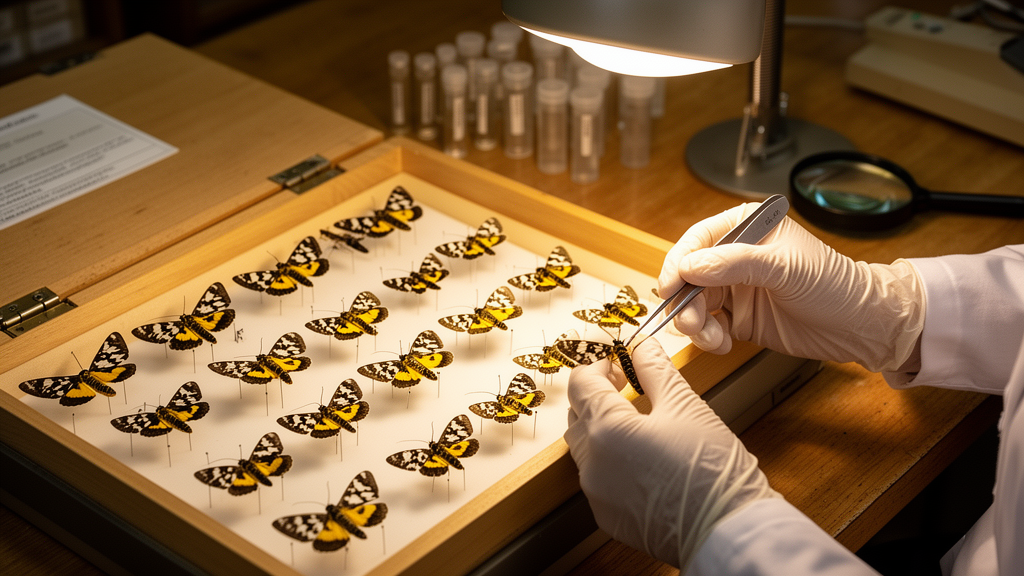
Deep inside the Lepidoptera collection of the Museum of Nature Hamburg – Zoology, a set of drawers holds some of the most visually arresting insects ever pinned: the pericopine tiger moths, a Neotropical branch of the subfamily Arctiinae whose wings blaze with orange, red, yellow and glassy translucent patterns. A newly published illustrated catalogue in the journal Evolutionary Systematics has now photographed and documented these museum specimens, most of them collected between 1930 and 1970, and in doing so has thrown light on one of the most taxonomically tangled groups of moths in the Americas. The work is far more than a picture book. It is a revisionary resource that updates scientific names, maps geographic ranges, records larval host plants, documents differences between males and females, and connects each species to the mimetic rings in which it participates.
The pericopine moths belong to the tribe Arctiini, one of four groupings currently recognized within Arctiinae, alongside Lithosiini, Syntomini and Amerilini. The subfamily as a whole encompasses more than 11,000 species, roughly six percent of the world’s lepidopteran diversity, and the Neotropics are estimated to harbor at least thirty percent of all lepidopteran species. Yet the taxonomic history of these moths remained obscured for centuries, mainly because distinct lineages with high morphological resemblance were squeezed into classification systems that produced unnatural groupings. Several authors even erected artificial groups to accommodate species that did not fit pre-existing categories, compounding the confusion. Modern analyses have cleaned up the higher classification, but at the species level the pericopines remain a focal group for revisionary work, precisely because their collections rarely yield large specimen counts and most species are poorly represented in museums.
One of the most striking biological themes running through the catalogue is chemistry. Tiger moth caterpillars carry primary and secondary setae that provide physical and chemical protection against predation, and their strong association with larval host plants is mediated by plant secondary compounds. Larvae of Arctiini forage on host plants that include members of the families Asteraceae, Boraginaceae, Apocynaceae and Fabaceae, all known for the presence of pyrrolizidine alkaloids. These alkaloids are sequestered by the insects and retained through metamorphosis, appearing in the chorion of eggs, the integument of adults, the hemolymph, the larvae and the larval setae, or released as secretions through thoracic glands. The compounds are transferred from immature stages to adults, biparentally to eggs, and from males to females during courtship. This chemical armor confers unpalatability, which synergistically complements visual color signals in a display of aposematism, and even ultrasonic sound, as deterrents against predation.
The catalogue’s species accounts reveal how this chemical ecology intertwines with mimicry. Calodesma maculifrons, for instance, has highly distinctive wing patterns with an orange background, yellow post-discal maculae and parallel yellow stripes on black, and moths from other families share the same patterns, including species of Pyralidae, Tortricidae, Geometridae, Zygaenidae, Crambidae and Notodontidae, as well as some Central American butterflies in the genus Mesene, suggesting a mimicry ring. Chetone phaeba, known from a Peruvian female, carries a coloration resembling the Heliconius butterflies Heliconius erato emma, Heliconius melpomene aglaope, Heliconius demeter demeter and Heliconius xanthocles melittus, together with the nymphalid Castilia perilla. Netoche histrio exhibits tiger-pattern imitation coloring resembling Heliconius and Eresia butterflies, tiger-patterned Ithomiini and the riodinid Stalachtis calliope, all occurring in the Amazon. These convergent wing patterns are the visible face of a shared chemical defense, warning predators of a bad taste that the moths themselves may have borrowed from their host plants.
Sexual dimorphism emerges as the second great source of taxonomic chaos in the group. Many pericopine species show extreme differences between males and females, and the catalogue documents case after case in which the two sexes were described as different species. In Dysschema amphissa, males have a white wing pattern with brown obscured regions while females display an orange pattern similar to other Dysschema species involved in mimetic rings with Heliconiinae and Ithomiini butterflies. For some species, such as Dysschema amphissa and Euchlaenidia trancisa, males are sampled with light traps during the night while the females have a diurnal habit and are apparently rare or difficult to find. This variation in flight period between the sexes, associated with their sexual dimorphism, resulted in descriptions based on only one sex, and not rarely females and males were described as different species, contributing to the taxonomic disorder that the new catalogue helps to untangle.
The genus Dysschema dominates the Hamburg collection, and its species accounts illustrate both the problems and the solutions of modern revisionary work. Dysschema sacrifica, a relatively common and widespread South American species extending from the Cerrado and open Atlantic Forest into Bolivia, Uruguay, Paraguay and north-central Argentina, turns out to be highly polyphagous, with larval records in Amarantaceae, Asteraceae, Myrtaceae, Nyctaginaceae and Urticaceae. Remarkably, it was introduced in South Africa as a biological control agent against the invasive weed Chromolaena odorata. Dysschema picta shows males with a wing pattern similar to glasswing butterflies while females have wing polychromatism and a black, yellow and orange tiger pattern; immatures were reared in Mikania hirsutissima, Senecio brasiliensis and Vernonia polyanthes, all Asteraceae, and the documented female polychromatism resulted in the establishment of synonyms. Dysschema terminata, whose pairing of sexes was confirmed by collections at the Boracéia Biological Station in São Paulo, has males that are polychromatic on the hindwings, with a red submarginal band that is quite evident or gradually reduced until its complete absence.
Genitalia and other anatomical details provide the technical backbone for separating such lookalike species. Dysschema boisduvalii males are distinguished from related species such as D. centenaria and D. inominatum by spiniform projections at the base of the valva, whereas females are distinguished by having the opening of the ostium in the middle of the seventh sternite and an enlarged ductus bursae. Dysschema centenaria, whose immatures were reared in Eryngium paniculatum and E. eburneum, allowing the association between males and females, is externally distinguished from D. boisduvalii by white or yellow scales dorsally on the apex of the forewings, yellow spots on the hindwing base and a brown abdomen ventrally, with differences in the morphology of female and male genitalia corroborating the status of distinct species. Dysschema marginalis, by contrast, has genitalia that do not exhibit discernible distinctions across species, indicating that it constitutes a cryptic species complex with D. lycaste. Dysschema tricolora even possesses asymmetric structures in both male and female genitalia, which is unusual for the genus.
The catalogue also engages directly with molecular systematics and its pitfalls. Eucyane dejanira was previously allocated in the genus Hypocrita and subsequently moved to Eucyane based on a maximum likelihood analysis using the CO1 gene. The authors caution that this taxonomic decision shall be taken with care, because while CO1 is effective for species-level identification, its high mutation rate can make it challenging to compare sequences across very diverse taxa, since similar nucleotide changes may occur independently in different lineages, leading to misleading phylogenetic relationships. Moreover, the taxonomic coverage of that analysis was narrow. Recent phylogenetic work has shown that the genus Hypocrita is polyphyletic, consisting of two unrelated groups, one phylogenetically close to Netoche and the other close to the genera Ephestris and Thirgis. A wider taxonomic sampling and the use of nuclear genes are needed to clarify the relationships and taxonomic validity of the genera Eucyane, Hypocrita, Chetone and Netoche, mainly because the evolution of color pattern within these genera was driven by mimicry relationships.
Not every species in the collection is a showstopper, and the catalogue is candid about the knowledge gaps that remain. Hyalurga fenestra, Hyalurga fenestrata, Hypocrita fenestraria and Hypocrita plagifera are species for which available information is limited to the original description and inclusion in faunal survey lists, despite their prevalence in collections and broad distributions spanning the Amazon and Atlantic Forest biomes. Composia credula, distributed mainly in Central America with records on the islands of Puerto Rico, Jamaica, Cuba and the Dominican Republic, is another species about which scant information can be found in the literature. By contrast, Gnophaela vermiculata, a North American species without sexual dimorphism, has well-documented immature stages reared in Mertensia virginica, and adults are recorded to contain pyrrolizidine alkaloids, a chemical signature that ties this northern moth into the same defensive syndrome as its tropical relatives.
The broader significance of the Hamburg catalogue lies in what taxonomic catalogues do for biodiversity knowledge as a whole. By offering updated and standardized use of scientific names, together with data on geographic distribution, ecological relationships, host plant use and participation in mimetic rings, such inventories assist in closing knowledge gaps and enable a biological system to be convincingly described in detail and with clear nomenclature. The pericopines, with their incredible diversity of wing patterns that attract butterfly collectors, are a focal group for museomics studies, particularly for the rare or under-sampled species whose low representation in collections makes them nearly invisible to conventional research. Every photographed specimen, every synonym resolved and every host plant record added brings the hidden diversity of the Neotropics a step closer to being discovered, named and understood before it disappears.
Subject of Research: Illustrated catalogue of Pericopina (Lepidoptera, Erebidae, Arctiinae) in the Museum of Nature Hamburg – Zoology
Article Title: Illustrated catalogue of Pericopina ( Lepidoptera , Erebidae , Arctiinae ) in the Museum of Nature Hamburg – Zoology
Article References: Moraes, S. D. S., Freitas, A. V. L., & Silva-Brandão, K. L. (2025). Illustrated catalogue of Pericopina (Lepidoptera, Erebidae, Arctiinae) in the Museum of Nature Hamburg – Zoology. Evolutionary Systematics, 9(1), 123-134. https://doi.org/10.3897/evolsyst.9.150930
Image Credits: AI Generated
DOI: 10.3897/evolsyst.9.150930
Keywords: Illustrated, catalogue, Pericopina, Lepidoptera, Erebidae, Arctiinae, Museum, Nature, Hamburg, Zoology, scientific research
Cite Scienmag News
Drew Townsend. (October 18, 2026). Illustrated catalogue of Pericopina (Lepidoptera, Erebidae, Arctiinae) in the Museum of Nature Hamburg – Zoology. Scienmag. https://scienmag.com/illustrated-catalogue-of-pericopina-lepidoptera-erebidae-arctiinae-in-the-museum-of-nature-hamburg-zoology/
Drew Townsend. "Illustrated catalogue of Pericopina (Lepidoptera, Erebidae, Arctiinae) in the Museum of Nature Hamburg – Zoology." Scienmag, 18 October 2026, https://scienmag.com/illustrated-catalogue-of-pericopina-lepidoptera-erebidae-arctiinae-in-the-museum-of-nature-hamburg-zoology/. Accessed 18 October 2026.
Drew Townsend. "Illustrated catalogue of Pericopina (Lepidoptera, Erebidae, Arctiinae) in the Museum of Nature Hamburg – Zoology." Scienmag. October 18, 2026. https://scienmag.com/illustrated-catalogue-of-pericopina-lepidoptera-erebidae-arctiinae-in-the-museum-of-nature-hamburg-zoology/


