


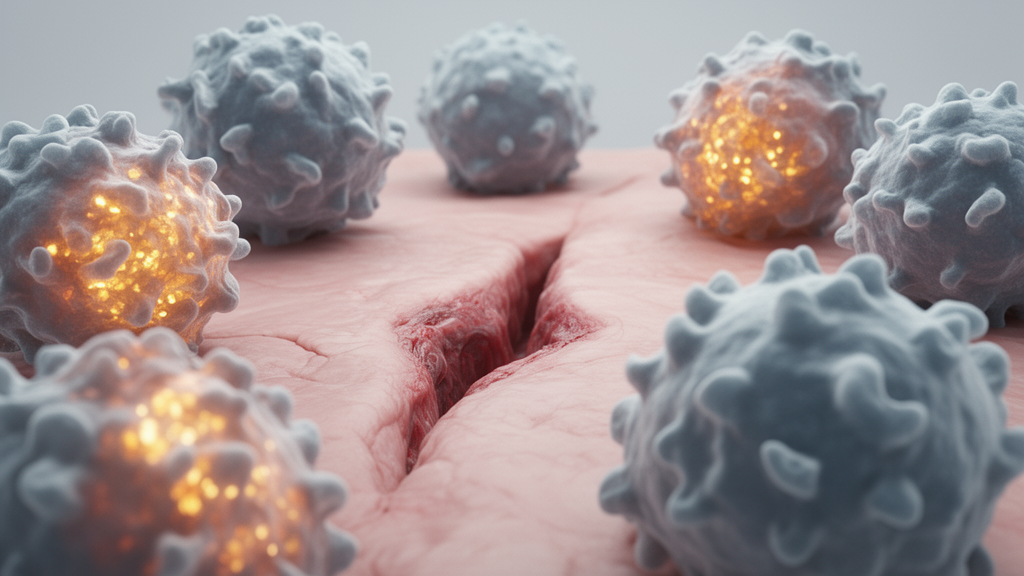
Diabetic wounds are among the most stubborn failures of modern medicine. High blood sugar quietly sabotages every stage of tissue repair, and one of the deepest casualties is the immune cell that should be orchestrating the healing response. Now a team of researchers from Tongji Hospital of Huazhong University of Science and Technology, Union Hospital, Wuhan University, Qingdao University, and the University Medical Center Groningen has identified a single metabolic enzyme inside macrophages as a decisive checkpoint controlling whether new blood vessels can regenerate in diabetic tissue. The work, published in Nature Communications, also demonstrates a nanozyme-integrated hydrogel patch that restores the enzyme’s function and markedly accelerates wound closure in a diabetic pig model, one of the most clinically demanding large-animal systems available.
The enzyme at the center of the story is transketolase, or TKT, a thiamine-dependent component of the pentose phosphate pathway. In macrophages, the immune cells that flood a wound and coordinate inflammation, vascular growth, and tissue remodeling, TKT acts as a metabolic gatekeeper. The researchers found that when TKT is lost specifically in macrophages, the cells shift into an abnormal catabolic state: they burn through amino acids and fatty acids at an accelerated rate, generate excessive reactive oxygen species, and lose the ability to support the proliferation and differentiation of endothelial cells, the building blocks of new blood vessels. Without functional macrophage metabolism, angiogenesis collapses, and the wound stalls in a chronic, non-healing state.
The mechanistic chain the team traced begins with hyperglycemia itself. Persistently elevated glucose suppresses TKT expression in macrophages, which allows advanced glycation end products, or AGEs, to accumulate and activate their receptor RAGE, setting off a signaling cascade that further reprograms macrophage metabolism toward dysfunction. The researchers describe this as a pathological TKT-AGEs-RAGE axis, a self-reinforcing loop in which high sugar disables the enzyme, the disabled enzyme permits glycemic damage signaling, and that signaling locks the macrophage into a dysfunctional metabolic identity. In practical terms, the macrophage stops behaving like a vascular architect and starts behaving like a bystander, releasing oxidative stress that damages the very endothelial cells it should be nurturing.
What makes this discovery technically significant is the specificity of the metabolic reprogramming. Macrophage metabolism has long been recognized as a target in chronic wounds, but the field has lacked a precise molecular handle. By demonstrating that macrophage-specific TKT loss is sufficient to disrupt amino acid and fatty acid catabolism, elevate reactive oxygen species, and impair endothelial cell proliferation and differentiation, the team established a causal chain rather than a correlation. The pentose phosphate pathway, through which TKT channels metabolic flux, is central to producing NADPH, the reducing equivalent that cells use to maintain antioxidant defenses and biosynthetic capacity. When TKT drops, that reducing power falls, oxidative stress rises, and the macrophage’s secretory profile shifts away from supporting vascular growth.
On the therapeutic side, the researchers engineered a nanozyme-integrated hydrogel patch designed to selectively increase TKT levels in macrophages at the wound site. Nanozymes are synthetic nanomaterials that mimic enzymatic activity, and in this system they are embedded within a hydrogel matrix that can be applied directly to the wound bed. The patch rebalances macrophage metabolism, reduces oxidative stress, and rescues the angiogenic capacity that diabetes had stripped away. Because the delivery is localized, the approach concentrates its effect where it is needed and avoids systemic exposure, a critical consideration for any therapy intended for chronic wound management in patients already managing a complex metabolic disease.
The preclinical evidence is notable for the animal model chosen. Rather than relying solely on rodents, the team validated the nano-system in a diabetic pig model, a large-animal system whose skin structure, vascular anatomy, and wound healing dynamics resemble human physiology far more closely than mouse models do. In that model, localized delivery of the nanozyme hydrogel patch markedly accelerated wound closure and vascular repair. Large-animal validation is a demanding benchmark, and pig models of diabetic wounds are widely regarded as one of the most translationally relevant preclinical systems for skin regeneration research, which strengthens the case that the observed effects could carry into clinical settings.
The implications reach beyond diabetic wounds alone. Macrophage metabolic reprogramming is increasingly recognized as a central theme in immunology, influencing everything from tumor-associated inflammation to fibrosis and tissue engineering. By identifying TKT as a macrophage-specific metabolic checkpoint that governs vascular regeneration, the study adds a concrete molecular target to a field that has often operated with broad metabolic categories. The finding suggests that restoring a single enzymatic node within the pentose phosphate pathway could be sufficient to flip macrophages from a dysfunctional state back into a vascular-supportive one, a level of precision that broad metabolic interventions have struggled to achieve.
The study also highlights the growing role of biomaterials in translating metabolic biology into therapies. The collaboration brought together orthopedic surgeons, rehabilitation specialists, anesthesiologists, computer scientists, and biomaterials researchers from institutions in China and the Netherlands, reflecting the interdisciplinary nature of modern regenerative medicine. The nanozyme hydrogel patch represents a class of smart biomaterials that do not merely deliver drugs but actively modulate cellular metabolism at the wound site, an approach that blurs the line between tissue engineering and metabolic therapy. As biomaterials become more sophisticated, the ability to reprogram immune cell metabolism locally could become a standard strategy in chronic wound care.
Diabetic foot ulcers and chronic non-healing wounds affect hundreds of millions of people worldwide and are a leading cause of amputation, infection, and reduced quality of life. Current clinical options, from debridement to growth factor therapies and advanced dressings, often fall short because they do not address the underlying immune metabolic dysfunction that keeps the wound in a chronic state. The TKT-centered approach offers a different logic: rather than adding growth factors from the outside, it restores the internal metabolic machinery that allows macrophages to support vascular growth on their own. If the nanozyme hydrogel strategy can be safely translated to human patients, it could shift the clinical management of diabetic wounds from symptomatic treatment toward genuine metabolic rescue.
The research, led by Yuan Xiong, Li Lu, and Qipeng Wu as co-first authors, with Bobin Mi, Hélder A. Santos, and Mohammad-Ali Shahbazi as corresponding authors, was supported by the National Natural Science Foundation of China, the Hubei Provincial Health Commission, the Fundamental Research Funds for the Central Universities, the Key Research and Development Program of Hubei Province, UMCG Research Funds, and a start-up fund from Tongji Hospital. The article is open access under a Creative Commons license, and the team has released source data and supplementary materials alongside the publication. As the field moves toward clinical evaluation of metabolic checkpoint restoration in chronic wounds, the macrophage transketolase pathway stands out as a target worth watching closely.
Subject of Research: Health sciences
Article Title: Metabolic reprogramming of macrophage-specific transketolase orchestrates angiogenesis in diabetic wounds
Article References: Xiong, Y., Lu, L., Wu, Q., Wang, H., Hu, H., Zhao, H., Santos, H. A., Shahbazi, M.-A., & Mi, B. (2026). Metabolic reprogramming of macrophage-specific transketolase orchestrates angiogenesis in diabetic wounds. Nature Communications. https://doi.org/10.1038/s41467-026-78765-6
Image Credits: AI Generated
DOI: 10.1038/s41467-026-78765-6
Keywords: diabetic wounds, macrophages, transketolase, angiogenesis, metabolic reprogramming, nanozyme, hydrogel, AGEs-RAGE, oxidative stress, wound healing, Metabolic, reprogramming
Cite Scienmag News
Ophelia Keating. (October 18, 2026). Macrophage Metabolic Switch Could Heal Diabetic Wounds. Scienmag. https://scienmag.com/macrophage-metabolic-switch-could-heal-diabetic-wounds/
Ophelia Keating. "Macrophage Metabolic Switch Could Heal Diabetic Wounds." Scienmag, 18 October 2026, https://scienmag.com/macrophage-metabolic-switch-could-heal-diabetic-wounds/. Accessed 18 October 2026.
Ophelia Keating. "Macrophage Metabolic Switch Could Heal Diabetic Wounds." Scienmag. October 18, 2026. https://scienmag.com/macrophage-metabolic-switch-could-heal-diabetic-wounds/


