


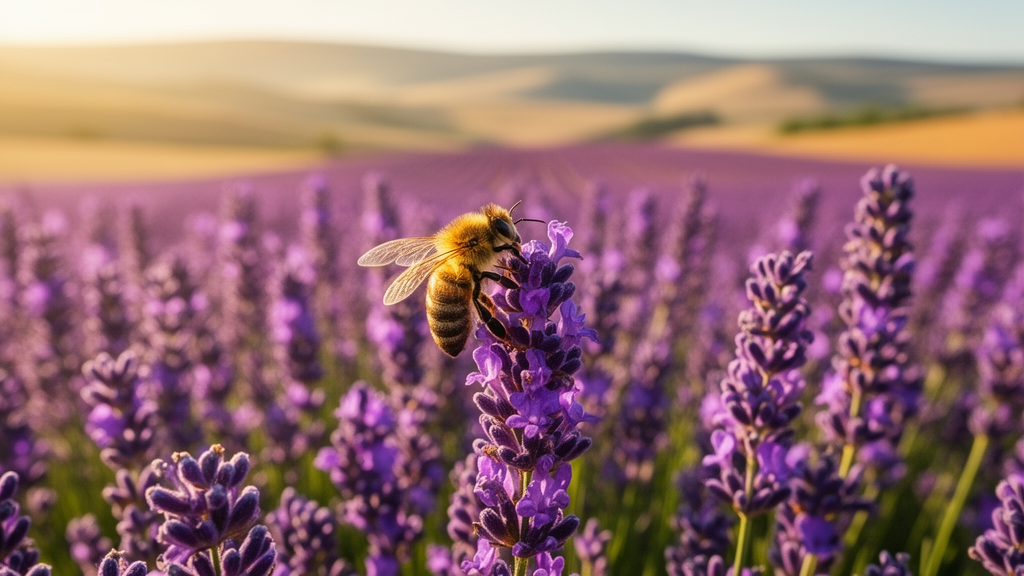
Lavender essential oil is a cornerstone of the global pharmaceutical, perfumery, and food industries, prized for its distinct aromatic profile and valuable pharmacological properties. As one of the key oils in aromatherapy, its economic importance is well established, with major producing regions including France, the United Kingdom, China, Spain, and Bulgaria. However, the precise biological mechanisms that dictate the quantity and quality of the harvested oil have remained a subject of ongoing scientific inquiry. Recent field studies conducted in Bulgaria have provided critical insights into the pollination dynamics of Lavandula angustifolia, revealing that insect pollinators are not merely beneficial but essential for optimal production. The research highlights a direct correlation between pollination success and the final yield of essential oil, challenging the traditional reliance on managed honeybee colonies and emphasizing the critical role of wild pollinator populations.
The study, published in the journal BioRisk, aimed to measure the occurrence of spontaneous self-pollination in Lavandula angustifolia and to identify the specific external pollinators responsible for fruit set. Field experiments were performed at two distinct sites: a lavender plantation near Gorna Lipnitza Village in north Bulgaria and the ex-situ lavender collection in the experimental plot of the Botanical Garden of Sofia University. The researchers selected these locations to capture a range of environmental conditions and pollinator communities. By excluding external pollinators from selected inflorescences and comparing them to control groups, the team sought to determine whether the plant could reproduce without insect assistance. This experimental design allowed for a rigorous assessment of the plant’s reproductive biology and its dependence on ecological interactions.
The results of the self-pollination test were definitive. In the experimental plot, the fruit set of all flowers from which pollinators were excluded was zero percent, whereas the control group, which was free to be pollinated, achieved a fruit set of 85.9 percent. This stark contrast strongly suggests a complete absence of spontaneous self-pollination in the studied Lavandula angustifolia plants. The plant possesses several biological adaptations to avoid self-fertilization, including heterostyly, genetic self-incompatibility, and cytoplasmic male sterility. These mechanisms ensure that cross-pollination is the primary mode of reproduction, making the presence of effective pollen vectors a prerequisite for seed production and, consequently, for the maintenance of the plant’s reproductive cycle.
Observations of pollinator activity revealed that bumblebees were the dominant visitors at both study sites, followed by honeybees. In the Botanical Garden, the average activity index for bumblebees was 5.08, compared to 1.14 for honeybees. At the Gorna Lipnitza plantation, the disparity was even more pronounced, with bumblebees recording an average activity index of 7.4 and honeybees at 4.9. This dominance is not surprising given the foraging behaviors of these insects. Bumblebees are polylectic foragers with longer tongues, allowing them to access nectar more efficiently and process lavender flowers up to three times faster than honeybees. Their ability to consolidate pollen adhering to their bodies into full pollen baskets further indicates their active role in pollen transfer, making them highly efficient pollinators for this specific crop.
While bees were the primary pollinators, the study also documented the presence of various other insect groups, including butterflies, moths, bee-flies, and beetles. Species such as Macroglossum stellatarum, a fast-flying hawkmoth, were observed hovering in mid-air to probe flowers for nectar. Other butterflies, including Plebejus argus and Pieris rapae, also visited the lavender, though their contribution to pollination was likely limited. Research indicates that many of these Lepidoptera species carry significantly fewer pollen grains compared to bees, with some functioning more as nectar thieves than effective pollen vectors. The spatial distribution of certain butterflies, such as Plebejus argus, is also constrained by the presence of host ant colonies, further limiting their role as consistent pollinators in agricultural settings.
The economic implications of these findings are significant for lavender growers. It has been demonstrated that the greatest quantity of essential oil is obtained near the end of the inflorescence anthesis, and this quantity is directly correlated with pollination success. Unpollinated flowers tend to drop, reducing the total biomass available for oil extraction. Furthermore, oil quality is highest at the end of the flowering period, a phenomenon related to the gradual increase of monoterpenes, particularly the valuable linalool, and the decrease of sesquiterpenes during flower ontogenesis. This chemical shift underscores the importance of ensuring that flowers are successfully pollinated to achieve both high yield and superior aromatic quality, which are critical for the commercial value of the final product.
Traditionally, lavender growers have placed beehives in their fields to ensure optimal essential oil production, relying on managed honeybee colonies to provide pollination services. However, this study highlights that wild pollinators, particularly bumblebees, play a crucial and often dominant role in the pollination of Lavandula angustifolia. The reliance on honeybees alone may be insufficient to maximize yield and quality, especially in regions where wild bee populations are robust. The findings suggest that a holistic approach to pollinator management is necessary, one that integrates the conservation of wild pollinator habitats with the use of managed bee colonies. This dual strategy could enhance the resilience of pollination services and improve the overall productivity of lavender crops.
The broader context of pollinator decline adds urgency to these findings. Negative non-target effects of pesticides and habitat loss have led to significant declines in insect populations, particularly in areas of intensive agriculture. This pollinator crisis demands action at multiple geographic and political levels, with a focus on science-based conservation strategies. In countries like Bulgaria, where baseline data on the status and population trends of wild pollinators are currently lacking, ongoing monitoring is essential. Understanding the specific roles of different pollinator species allows for more targeted conservation efforts and better-informed agricultural practices. By recognizing the value of wild pollinators, growers can contribute to both the sustainability of their crops and the preservation of local biodiversity.
In conclusion, the study provides compelling evidence that Lavandula angustifolia requires insect pollen vectors for fruit set and that wild bumblebees are the most efficient pollinators for this species. The absence of spontaneous self-pollination underscores the plant’s dependence on ecological interactions for reproduction. As the global demand for lavender essential oil continues to grow, the need for sustainable pollination strategies becomes increasingly apparent. By conserving wild pollinator populations and integrating them into agricultural management plans, growers can ensure optimal essential oil production while supporting the health of local ecosystems. This research serves as a call to action for both the scientific community and the agricultural sector to prioritize the protection of pollinators in the face of ongoing environmental challenges.
Subject of Research: Pollinators of Lavandula angustifolia Mill., an important factor for optimal production of lavender essential oil
Article Title: Pollinators of Lavandula angustifolia Mill., an important factor for optimal production of lavender essential oil
Article References: Valchev, H., Kolev, Z., Stoykova, B., & Kozuharova, E. (2022). Pollinators of Lavandula angustifolia Mill., an important factor for optimal production of lavender essential oil. BioRisk, 17, 297-307. https://doi.org/10.3897/biorisk.17.77364
Image Credits: AI Generated
Keywords: Pollinators, Lavandula, angustifolia, Mill, important, factor, optimal, production, lavender, essential, scientific research
Cite Scienmag News
Alan Morgan. (October 18, 2026). Wild Bees Drive Lavender Oil Quality and Yield. Scienmag. https://scienmag.com/wild-bees-drive-lavender-oil-quality-and-yield/
Alan Morgan. "Wild Bees Drive Lavender Oil Quality and Yield." Scienmag, 18 October 2026, https://scienmag.com/wild-bees-drive-lavender-oil-quality-and-yield/. Accessed 18 October 2026.
Alan Morgan. "Wild Bees Drive Lavender Oil Quality and Yield." Scienmag. October 18, 2026. https://scienmag.com/wild-bees-drive-lavender-oil-quality-and-yield/


