


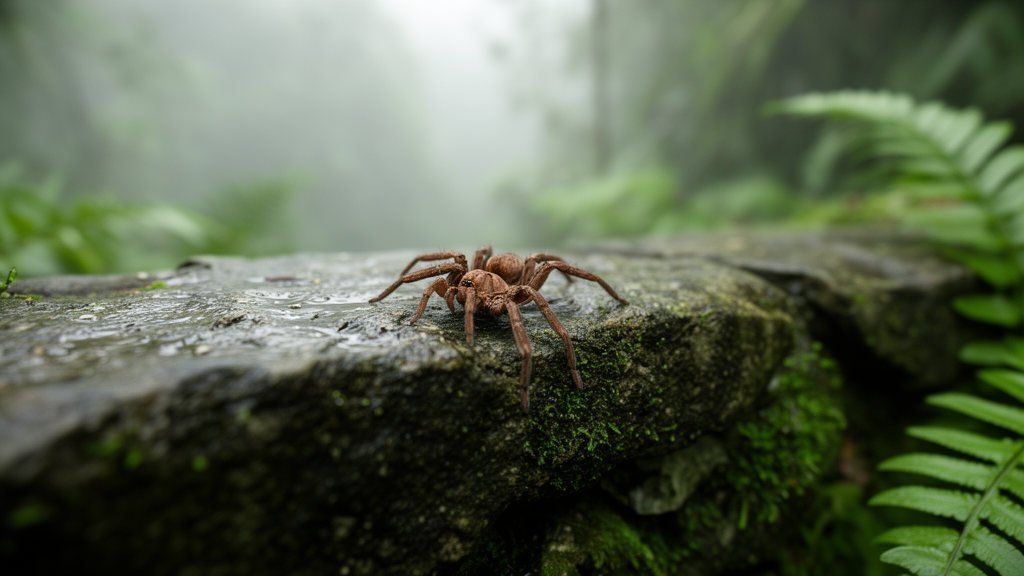
Researchers have identified a new species of crevice weaver spider in the urban environments of Colombia, marking a significant addition to the known biodiversity of the genus Pikelinia. The new species, designated as Pikelinia floydmuraria, was discovered in the department of Tolima and represents only the second recorded species of this genus within the country. This discovery highlights the ongoing potential for taxonomic surprises in human-modified landscapes, where spiders often thrive in the crevices of buildings and infrastructure. The finding underscores the importance of urban areas as habitats for specialized arachnids that may otherwise go unnoticed in traditional ecological surveys focused on natural ecosystems.
The genus Pikelinia, established in 1946, currently comprises twenty South American species distributed from Argentina to Colombia. These spiders are characterized by specific morphological traits, including a modified male metatarsus II that typically exhibits an excavation and conspicuous setae. Recent phylogenetic reviews have redefined the genus, incorporating species previously assigned to other genera such as Filistata and Filistatoides. Despite these taxonomic advances, the ecology and biology of the group remain poorly understood, with limited data available on their behavior, diet, and population dynamics in various regions of South America.
Pikelinia floydmuraria is morphologically closest to Pikelinia fasciata, a species endemic to the Galapagos Islands in Ecuador. The new species shares a nearly identical male palpal structure and leg II chaetotaxy with its Galapagos relative. However, distinct differences exist in their coloration and genitalia. Males of the new species have a concolor leg pattern, whereas P. fasciata exhibits annulate legs. Furthermore, the female spermathecae of P. floydmuraria feature long, slender, S-shaped receptacle necks, contrasting with the shorter, stouter, and C-shaped necks found in P. fasciata. These morphological distinctions are critical for accurate species identification and classification.
The specific epithet floydmuraria is a neologism derived from the name of the rock band Pink Floyd and the Latin word for wall, alluding to the album The Wall and the species’ habitat preference. The spiders were consistently found in urban environments, particularly in the walls of buildings near streetlights. Observations revealed high concentrations of individuals, with counts reaching twenty to thirty per square meter, including juveniles. No specimens were found in natural conditions far from urban habitats, suggesting a strong adaptation to human-modified ecosystems and a reliance on anthropic structures for shelter and foraging opportunities.
In addition to describing the new species, the study provided the first description and illustration of the female genitalia of Pikelinia fasciata from the Galapagos Islands. Previous descriptions had not illustrated the spermathecae, leaving a gap in the taxonomic knowledge of this species. The new illustrations reveal spermathecae with long and straight receptacle necks originating laterally on the outer side of the receptacle base. These features are accompanied by conspicuous glandular areas, providing valuable morphological data for future comparative studies and potential phylogenetic analyses involving Galapagos endemics.
Dietary analysis of Pikelinia floydmuraria and an unidentified Pikelinia population from Armenia, Quindío, revealed a predominance of Hymenoptera, accounting for approximately thirty-five percent of the prey items. Diptera and Coleoptera were also significant components of their diet. The spiders were observed preying on ants significantly larger than themselves, a behavior that suggests an adaptive specialization for consuming well-defended prey. This finding is particularly notable in the Ibagué population, which showed a clear preponderance of larger Hymenoptera compared to other prey orders, indicating potential intraspecific dietary plasticity.
The presence of dipterans from the families Muscidae and Culicidae in the diet mirrors patterns seen in other synanthropic spiders in the region. These flies are known urban pests, suggesting that Pikelinia floydmuraria may play a role in natural pest control within urban environments. The frequent placement of webs near artificial lights likely represents a strategic adaptation to exploit phototactic prey, enhancing foraging efficiency. This behavior highlights the ecological services provided by urban spiders, which can help regulate insect populations that may otherwise become nuisances or vectors for disease.
The biogeographic origin of Pikelinia floydmuraria remains uncertain, with its morphological affinities to Galapagos congeners and unresolved diversity in Colombian populations complicating its classification. Molecular analyses, including DNA barcoding, are recommended to clarify whether the species represents a native population exploiting urban niches or a recent introduction to Colombia. Such integrative taxonomic approaches could also help assess undiagnosed morphological variation in Andean populations and determine if observed traits are phylogenetically constrained or ecologically driven. Future studies should focus on resolving these questions to better understand the evolutionary history and ecological role of this genus in South America.
This study expands the known diversity and trophic ecology of the Pikelinia genus, providing new insights into the biology of synanthropic spiders in Colombia. The discovery of Pikelinia floydmuraria and the detailed description of Pikelinia fasciata’s female genitalia contribute to a more comprehensive understanding of this group. As urbanization continues to reshape landscapes worldwide, the study of urban-adapted spiders becomes increasingly important for assessing biodiversity and ecosystem services. Further research is needed to fully resolve the trophic role of these spiders and to quantify their impact on urban pest populations, potentially informing conservation and management strategies in human-dominated environments.
Subject of Research: Another web in the wall: A new Pikelinia Mello-Leitão, 1946 (Araneae, Filistatidae) from Colombia, with notes on its diet and description of the female genitalia of P. fasciata (Banks, 1902)
Article Title: Another web in the wall: A new Pikelinia Mello-Leitão, 1946 ( Araneae , Filistatidae ) from Colombia, with notes on its diet and description of the female genitalia of P. fasciata (Banks, 1902)
Article References: Villarreal, O., Delgado-Santa, L., González-Gómez, J. C., Rodríguez-Castro, G. A., Román, A. C., Agudelo, E., & García, L. F. (2026). Another web in the wall: A new Pikelinia Mello-Leitão, 1946 (Araneae, Filistatidae) from Colombia, with notes on its diet and description of the female genitalia of P. fasciata (Banks, 1902). Zoosystematics and Evolution, 102(1), 357-366. https://doi.org/10.3897/zse.102.175423
Image Credits: AI Generated
Keywords: Another, wall, Pikelinia, Mello-Leit, Araneae, Filistatidae, Colombia, notes, diet, description, female, genitalia
Cite Scienmag News
Margaret Porter. (October 18, 2026). New Wall-Dwelling Spider Species Discovered in Colombia. Scienmag. https://scienmag.com/new-wall-dwelling-spider-species-discovered-in-colombia/
Margaret Porter. "New Wall-Dwelling Spider Species Discovered in Colombia." Scienmag, 18 October 2026, https://scienmag.com/new-wall-dwelling-spider-species-discovered-in-colombia/. Accessed 18 October 2026.
Margaret Porter. "New Wall-Dwelling Spider Species Discovered in Colombia." Scienmag. October 18, 2026. https://scienmag.com/new-wall-dwelling-spider-species-discovered-in-colombia/


