


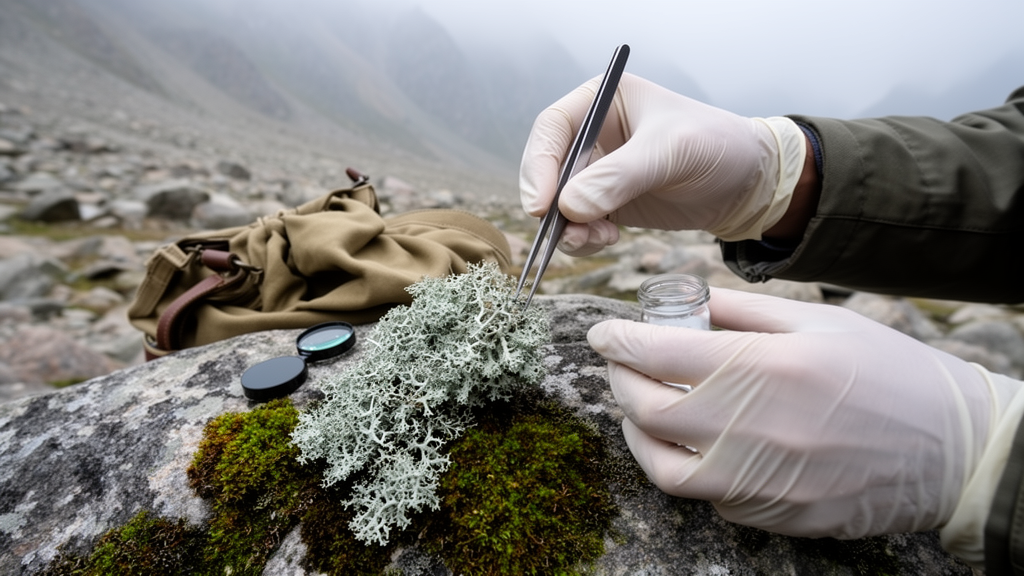
Pakistan’s rugged mountain ranges and diverse ecological zones harbor a rich but underexplored community of lichenized fungi, many of which remain undocumented in scientific literature. A recent systematic study published in the Italian Botanist has significantly advanced the understanding of this biodiversity by identifying three new lichen species for the country and providing the first molecular sequences for several others. The research, conducted across the Khyber Pakhtunkhwa and Gilgit-Baltistan regions, combines traditional morphological analysis with modern molecular techniques to offer a comprehensive view of the lichen flora in these high-altitude environments. This work not only expands the known lichen diversity of Pakistan but also provides critical data on the distribution and ecology of these symbiotic organisms, which play vital roles in ecosystem stability and environmental monitoring.
The study focused on collections made during field surveys in 2020 and 2023, targeting areas with distinct climatic conditions ranging from dry temperate zones to cold alpine environments. Researchers identified Dimelaena altissima, Lecanora chlarotera, and Usnea lapponica as new records for Pakistan, marking their first documented presence in the country. Additionally, the team generated nuclear internal transcribed spacer (nrITS) sequences for Evernia prunastri, Lecanora horiza, Lecanora hybocarpa, Peltigera polydactylon, and Peltigera praetextata, which had previously been identified only through morphological means. These molecular data provide a robust foundation for future phylogenetic studies and help clarify the evolutionary relationships among lichen species in the region, bridging the gap between historical taxonomic records and modern genetic insights.
Dimelaena altissima, a crustose lichen belonging to the family Caliciaceae, was found growing on rocks at varying elevations, from 841 meters in the Kohistan district to over 4,173 meters in the Babusar Top area of Gilgit-Baltistan. The species is characterized by its yellowish-green to yellowish-white thallus and frequent, black, pruinose apothecia. Phylogenetic analysis using nrITS sequences confirmed that the Pakistani specimens cluster closely with sequences from China, receiving strong bootstrap support of 90% in maximum likelihood trees. This finding validates the morphological identification and highlights the trans-Himalayan distribution of the species. The presence of D. altissima in such diverse habitats suggests a high degree of ecological adaptability, capable of thriving in both low-elevation dry temperate zones and high-altitude alpine environments with significant temperature fluctuations.
Evernia prunastri, commonly known as oakmoss, was identified in the Kumrat Valley of Khyber Pakhtunkhwa, growing on the bark of trees in cold temperate mountainous regions at elevations above 2,000 meters. This fruticose lichen is widely distributed across the Northern Hemisphere, including Asia, Europe, and North America, and is known for its role in traditional medicine and as a bioindicator of air quality. The study provided the first molecular confirmation of E. prunastri in Pakistan, with ITS sequences from Pakistani collections being identical to those reported from Norway. This genetic consistency across such a vast geographic range underscores the species’ widespread adaptability and the reliability of nrITS markers for identifying lichen species across different continents. The habitat is dominated by coniferous and deciduous trees, including Indian horse-chestnut and deodar, which provide the necessary substrate for this epiphytic lichen.
Lecanora chlarotera, another new record for Pakistan, was found on bark in the Kumrat Valley and Kaghan Valley, both located in Khyber Pakhtunkhwa. This crustose lichen is part of the L. subfusca complex and is widespread in Europe, North America, and parts of Asia. The Pakistani specimens exhibited morphological characteristics consistent with descriptions from the Czech Republic, although with slightly smaller apothecia and smoother margins. Phylogenetic analysis revealed that the Pakistani sequences cluster with those from the United Kingdom and Sweden, confirming their identity as L. chlarotera. The species was found in cold temperate regions with moderate to high rainfall, indicating a preference for moist environments. The discovery of this species in Pakistan adds to the growing body of evidence that the country’s lichen flora shares significant affinities with European and Central Asian species, reflecting historical biogeographic connections.
The study also documented the first molecular sequences for Lecanora horiza and Lecanora hybocarpa, both of which were previously known from Pakistan based on morphological identification. L. horiza was found in Kohistan, while L. hybocarpa was recorded in Diamer, Gilgit-Baltistan. These species are part of the Lecanoraceae family and are commonly found on nutrient-rich substrates such as bark and rock. The generation of nrITS sequences for these species provides a crucial reference for future studies, allowing for more accurate identification and phylogenetic placement. The molecular data showed that L. horiza clusters with sequences from North Macedonia, Switzerland, and the USA, while L. hybocarpa groups with sequences from Spain. These findings highlight the global connectivity of lichen species and the importance of molecular tools in resolving taxonomic ambiguities that have long plagued lichenology.
Peltigera polydactylon subsp. udeghe and Peltigera praetextata, both members of the Peltigeraceae family, were also included in the study, with the former found in Fairy Meadows, Gilgit-Baltistan, and the latter in Kumrat Valley, Khyber Pakhtunkhwa. P. polydactylon is a foliose lichen characterized by its dark, lobate thallus and association with the cyanobacterium Nostoc, which enables it to fix atmospheric nitrogen. The Pakistani specimen of P. polydactylon subsp. udeghe clustered with sequences from China and the USA, confirming its identity. P. praetextata, on the other hand, is distinguished by its tomentose lobe margins and phyllidia. The study provided the first molecular confirmation of P. praetextata in Pakistan, with sequences grouping with those from Norway and Russia. These findings contribute to the understanding of the distribution and ecology of nitrogen-fixing lichens in the Himalayan region, which play a crucial role in nutrient cycling in nutrient-poor soils.
Usnea lapponica, a fruticose lichen in the Parmeliaceae family, was identified in the Naltar Valley, Gilgit-Baltistan, growing on bark at an elevation above 3,228 meters. This species is characterized by its erect to pendent thallus with deeply excavated soralia and farinose soredia. The Pakistani specimen was found in a cold and dry temperate mountainous region, with annual rainfall varying between 254 and 400 mm. Phylogenetic analysis showed that the Pakistani sequence clusters with those from Austria, India, Sweden, and Switzerland, confirming its identity as U. lapponica. This is the first report of the species from Pakistan, adding to the known diversity of Usnea in the region. The presence of U. lapponica in such high-altitude, cold environments highlights its resilience and adaptability to extreme climatic conditions, making it a valuable subject for studying the limits of lichen survival in changing climates.
The integration of morphological, anatomical, and molecular data in this study provides a robust framework for understanding the lichen diversity of Pakistan. The findings not only add new species to the national checklist but also offer insights into the ecological and biogeographic patterns of lichenized fungi in the region. The use of nrITS markers has proven to be an effective tool for resolving taxonomic uncertainties and confirming species identities, particularly in cases where morphological characters are ambiguous or overlapping. The study underscores the importance of continued field surveys and molecular analyses in documenting the biodiversity of underexplored regions like Pakistan, where the lichen flora remains largely unknown. As climate change and environmental pressures continue to impact ecosystems, a detailed understanding of lichen diversity and ecology is essential for conservation efforts and for assessing the health of mountainous environments.
Future research should focus on expanding the geographic scope of lichen surveys in Pakistan, particularly in remote and high-altitude areas that have received little attention. The development of comprehensive molecular databases for Pakistani lichens will facilitate more accurate identification and phylogenetic studies, contributing to a global understanding of lichen diversity and evolution. Additionally, studies on the ecological interactions between lichens and their environments, including the effects of climate change and pollution, are needed to assess the vulnerability of these organisms and their role in ecosystem functioning. The present study serves as a foundation for these future investigations, highlighting the rich and diverse lichen flora of Pakistan and the potential for further discoveries in this biogeographically significant region.
Subject of Research: Molecular and morphological characterization of lichenized fungi in Pakistan
Article Title: A systematic study of some lichenized fungi from Pakistan using nrITS marker
Article References: Ahmad, U. F., Zulfiqar, R., Naheed, M., Nadeem, M., Habib, K., Niazi, A. R., & Khalid, A. N. (2024). A systematic study of some lichenized fungi from Pakistan using nrITS marker. Italian Botanist, 18, 75-96. https://doi.org/10.3897/italianbotanist.18.133246
Image Credits: AI Generated
DOI: 10.3897/italianbotanist.18.133246
Keywords: lichenology, Pakistan, nrITS marker, biodiversity, phylogenetics, molecular identification, Himalayan flora, taxonomic revision, systematic, some, lichenized, fungi
Cite Scienmag News
Drew Townsend. (October 18, 2026). Molecular Markers Reveal New Lichen Species in Pakistan. Scienmag. https://scienmag.com/molecular-markers-reveal-new-lichen-species-in-pakistan/
Drew Townsend. "Molecular Markers Reveal New Lichen Species in Pakistan." Scienmag, 18 October 2026, https://scienmag.com/molecular-markers-reveal-new-lichen-species-in-pakistan/. Accessed 18 October 2026.
Drew Townsend. "Molecular Markers Reveal New Lichen Species in Pakistan." Scienmag. October 18, 2026. https://scienmag.com/molecular-markers-reveal-new-lichen-species-in-pakistan/


