


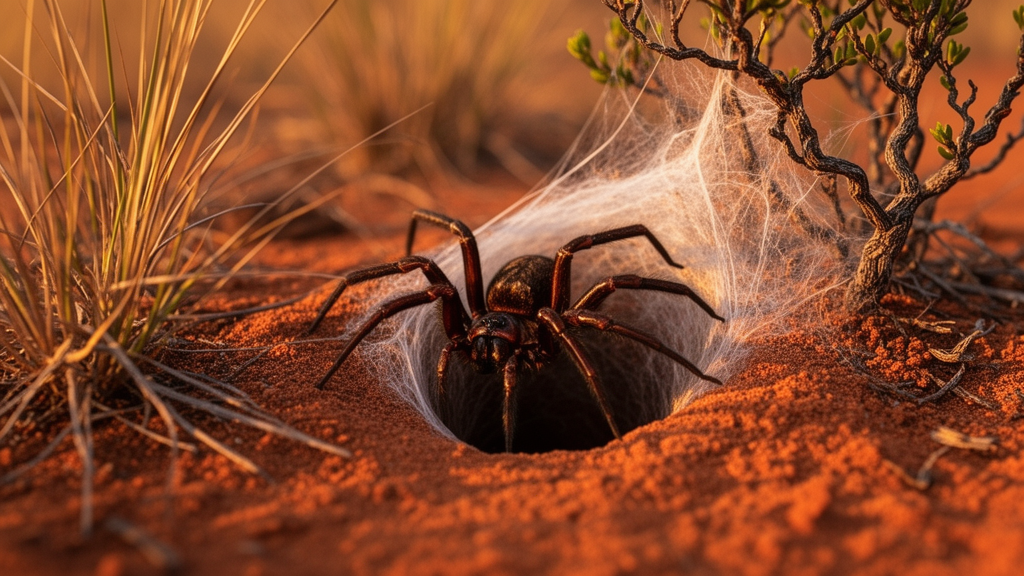
Deep in the savannas of central Brazil, a spider that scientists thought belonged exclusively to the Amazon rainforest has been quietly living under their noses. A team of Brazilian arachnologists has described a new species of funnel-web tarantula relative from Brasília, the capital of Brazil, and in doing so has dramatically redrawn the known map of an entire genus. The species, named Harmonicon candango, belongs to the family Dipluridae, a group of nocturnal mygalomorph spiders that spin sheet-like webs at the mouths of their burrows. The discovery, published in the journal Evolutionary Systematics, marks the first record of Harmonicon outside the Amazon biome and the southernmost occurrence of the genus anywhere in the world.
The find is also a story of patience and old museum drawers. The specimens that revealed the new species were collected in Brasília in October 1973 and have been housed in the arachnology laboratory of the Museu Nacional in Rio de Janeiro ever since. Only now, through careful comparison with the genus’s known species, have researchers recognized that these spiders represent something distinct. The holotype, an adult male, is accompanied by a female paratype, four additional males, and nineteen juveniles, all from the same locality in the Distrito Federal. Because both sexes are available, the species could be characterized fully, something that is often impossible in spider taxonomy, where many species rest on a single specimen.
The name candango carries a deliberate cultural weight. In Brazilian Portuguese, the word designates the inhabitants of Brasília, and especially the migrants from the country’s Northeast who built the modernist capital in the late 1950s. By naming the spider after these pioneers, the authors tied the species to the very landscape and history of the place where it was found. It is a small taxonomic gesture, but one that anchors a scientific discovery to a human story, and it follows a long tradition of using regional vernacular terms in species epithets.
Harmonicon is not an ordinary spider genus. It belongs to the Diplurinae, a subfamily of funnel-web builders distributed almost entirely across the Neotropics. What sets Harmonicon and its closest relatives apart is a structure called the lyra, a stridulatory apparatus on the inner surface of the maxilla, the mouthpart segment of the pedipalps. The lyra consists of a row of rigid, thickened bristles that the spider presumably rubs against other setae to produce sound. In Harmonicon, this row contains five to eight macrosetae, each with a distinctly curved tip, and the shape and number of these bristles are among the most reliable characters for telling species apart. Only one other diplurine genus, Linothele, lacks the lyra altogether, which makes the organ a defining feature of the rest of the group.
What makes the new species immediately recognizable is the shape of those lyra bristles. In all previously described Harmonicon species, the bristles carry thin, strongly curved, hook-like tips. In H. candango, the setae curve from their base and end in spatulate, spoon-shaped tips, a configuration not seen in any of its relatives. The males also differ in the fine architecture of their mating apparatus: the tibia of the first leg bears a retrolateral spur with a thinner and more curved thorn than in the similar-looking H. oiapoqueae, the embolus, the intromittent part of the palpal bulb, is proportionally longer at roughly one and a half times the length of the bulb itself, and a ventral macroseta sits near a tubercle on the first metatarsus. Females are distinguished by their spermathecae, the paired sperm-storage organs, whose median branch carries three to four apical lobules and whose lateral branch ends in a wide, multilobulate tip.
The paper does more than add a species. It also delivers the first redescription of Harmonicon rufescens, the type species of the genus, based on an adult female for the first time in the genus’s 128-year history. The trouble began with the original description: F. O. Pickard-Cambridge established the genus in 1896 on the basis of a specimen from Santarém in the Brazilian state of Pará, believing it to be a female. Later examination revealed that the holotype is in fact a juvenile male, which left the defining species of the genus without a documented adult female. The new redescription is based on a mature female collected in Altamira, also in Pará, roughly 300 kilometers from Santarém, in similar lowland Amazonian forest within the same biogeographical region, making the identification secure.
That redescription yielded diagnostic details that will help future workers separate H. rufescens from its congeners. The female’s spermathecae have two thick branches rising from a common base, with the lateral branch’s tip folded back over its stem and lacking lobules, and the tarsal claw of the pedipalp carries a double row of teeth. The species also shows the classic Harmonicon lyra of six to seven thick, regularly curved setae. Measurements from six females show total body lengths ranging from about 24 to 33 millimeters, with the fourth pair of legs longest, a typical proportion for diplurids, whose elongated hind legs and long posterior spinnerets give them their characteristic silhouette.
The biogeographical implication of the new species is the most striking part of the story. Until now, all four known Harmonicon species came from the Amazon region, with records from northern Brazil and French Guiana, including H. cerberus, a cave-dwelling species with reduced eyes and a pale carapace from the iron-ore canga country of Carajás. Finding a fifth species more than a thousand kilometers to the south, in the Cerrado, the vast tropical savanna that covers central Brazil, means the genus is not an Amazonian endemic at all. The authors also note records of undescribed Harmonicon species from Amazonian Peru, Brazil’s Northeast, and additional central-western states, hinting that the genus’s true diversity and range are considerably larger than the current literature suggests.
The work also involved a careful re-reading of older publications. The authors found that published drawings of the palpal bulbs of H. cerberus and H. oiapoqueae were likely mislabeled, with views described as retrolateral and prolateral better interpreted as dorsal and ventral, probably because the specimens had twisted during collection or preservation. Such corrections matter in a family where genital geometry is the primary currency of species identification, and they underline why redescriptions based on well-preserved adult material, ideally of both sexes, remain essential even for genera described more than a century ago.
For a genus of nocturnal, burrow-dwelling spiders that rarely cross paths with people, Harmonicon has now made two headlines at once: a brand-new species named for the builders of a capital city, and a type species finally seen in adulthood. The Cerrado, one of the world’s most biodiverse savannas and one of its most heavily converted to agriculture, continues to yield surprises even from specimens collected half a century ago. As more of Brazil’s understudied regions are sampled, and as museum collections are revisited with modern comparative methods, the funnel-webs of South America seem likely to keep rewriting their own distribution maps, one drawer at a time.
Subject of Research: Taxonomic description of a new Dipluridae spider species from the Brazilian Cerrado and redescription of the genus Harmonicon
Article Title: A new species of Harmonicon F. O. Pickard-Cambridge, 1896, from central-west Brazil and redescription of H. rufescens F. O. Pickard-Cambridge, 1896 ( Araneae , Mygalomorphae , Dipluridae )
Article References: Wermelinger-Moreira, G., de Souza Castanheira, P., & Baptista, R. L. C. (2024). A new species of Harmonicon F. O. Pickard-Cambridge, 1896, from central-west Brazil and redescription of H. rufescens F. O. Pickard-Cambridge, 1896 (Araneae, Mygalomorphae, Dipluridae). Evolutionary Systematics, 8(2), 261-271. https://doi.org/10.3897/evolsyst.8.141847
Image Credits: AI Generated
DOI: 10.3897/evolsyst.8.141847
Keywords: Harmonicon candango, Dipluridae, spider taxonomy, Cerrado, Brazil, new species, mygalomorph, lyra, spermathecae, Brasília, Amazon, Evolutionary Systematics
Cite Scienmag News
Drew Townsend. (October 18, 2026). New funnel-web spider species from Brazil’s Cerrado pushes a once-Amazonian genus far south. Scienmag. https://scienmag.com/new-funnel-web-spider-species-from-brazils-cerrado-pushes-a-once-amazonian-genus-far-south/
Drew Townsend. "New funnel-web spider species from Brazil’s Cerrado pushes a once-Amazonian genus far south." Scienmag, 18 October 2026, https://scienmag.com/new-funnel-web-spider-species-from-brazils-cerrado-pushes-a-once-amazonian-genus-far-south/. Accessed 18 October 2026.
Drew Townsend. "New funnel-web spider species from Brazil’s Cerrado pushes a once-Amazonian genus far south." Scienmag. October 18, 2026. https://scienmag.com/new-funnel-web-spider-species-from-brazils-cerrado-pushes-a-once-amazonian-genus-far-south/


