


Deep beneath the limestone ridges of Bulgaria, an entire world of pale, eyeless creatures has been quietly accumulating a scientific record. That record now includes two brand-new species of cave-adapted bristletails, described in a study that transforms our understanding of just how rich Europe’s subterranean fauna really is. The research, published in the Deutsche Entomologische Zeitschrift, draws on four decades of painstaking collection by biospeleologists at the National Museum of Natural History in Sofia and pushes the known diversity of subterranean campodeid diplurans in the eastern Balkan Peninsula from 12 to 14 species. That figure places the region alongside the Dinarides and the eastern Iberian Peninsula as one of the three great hotspots of cave-dwelling dipluran biodiversity in Europe.
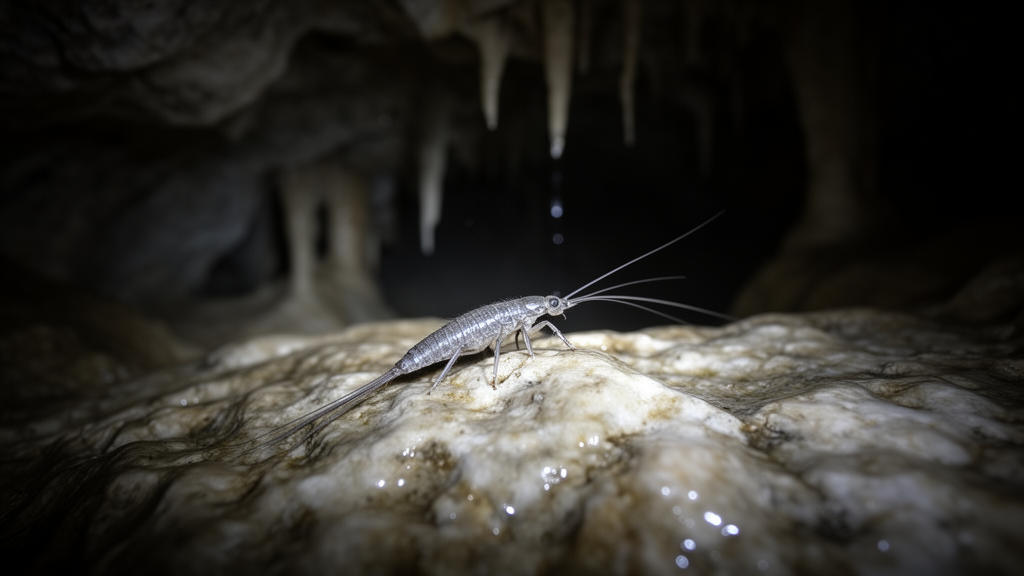
The animals in question belong to the subfamily Plusiocampinae, a lineage of two-pronged bristletails that has become one of the most successful invertebrate groups in cave habitats worldwide. Diplurans are easily recognized by the paired appendage at the tip of their abdomen, which gives them their common name. They are small, soft, completely depigmented creatures ranging from about one millimeter to eighty millimeters in length, and they lack eyes entirely. What makes cave-dwelling Plusiocampinae so striking is how far they have diverged from their soil-dwelling relatives. Cave forms possess noticeably slender bodies and exceptionally long appendages, most dramatically their legs, antennae, and cerci, the paired tail filaments that trail behind them as they move through the dark.
Globally, slightly more than one thousand dipluran species have been described, and 109 of them belong to Plusiocampinae. Remarkably, 86 percent of these are cave-adapted, living exclusively underground. Intensive sampling across Euro-Mediterranean caves has identified this region as a global center of Plusiocampinae diversity, with 84 recorded species. Yet eastern Asia, where fewer than 20 species have been discovered so far, could actually be the evolutionary cradle of the entire subfamily. The new Bulgarian species add fresh weight to the idea that Europe’s karst landscapes are evolutionary museums where ancient lineages have survived in isolation for millions of years.
The first new species, Plusiocampa balcanica, was found in Yulen Ere cave, also known as Vodnata Peshtera, near the village of Hristo Danovo in the Central Stara Planina Mountains. The cave sits at an altitude of 970 meters and stretches 227 meters in length. The second new species, Plusiocampa petrovi, was discovered in Pukoya cave in the Vrachanska Planina Mountains, a vertical system 48 meters long and 178 meters deep that begins with a short horizontal gallery before plunging through two consecutive shafts. The middle sections are so narrow that ropes are required to reach the bottom, where water is present. Neither cave had yielded a Plusiocampa record before, making these discoveries all the more significant for understanding how widely these animals are distributed across Bulgaria’s karst.
What distinguishes these new species from their relatives is a combination of subtle but reliable morphological characters. Plusiocampa balcanica possesses very unequal pretarsal claws, with the posterior claw measuring 1.6 to 1.8 times the length of the anterior one, and it lacks medial posterior macrosetae on both the mesonotum and metanotum. Only one other species, Plusiocampa ternovensis from Slovenia, shares this combination, but balcanica can be separated from it by having 2+2 lateral anterior macrosetae on the pronotum rather than 4+4, three ventral tibial macrosetae rather than one, 5+5 posterior macrosetae on urosternites V through VII rather than 4+4, and larger, thicker appendages in both males and females. Plusiocampa petrovi, assigned to the subgenus Stygiocampa, shows a pronounced reduction in the number of notal and urotergal macrosetae, a hallmark of deep cave adaptation, and its claws are more unequal than those of its geographically closest congener, Plusiocampa bureschi.
The technical descriptions rely on a battery of microscopic techniques. Specimens were washed with distilled water, mounted on slides using Marc André II solution, and examined under a Leica DMLS phase-contrast optical microscope. Illustrations were made with a drawing tube, and measurements were taken with an ocular micrometer. Fourteen specimens were coated with palladium-gold for scanning electron microscopy on a Hitachi S-4900, allowing researchers to measure sensilla, the tiny sensory organs on the antennae, with extraordinary precision. The term gouge sensilla refers to concavo-convex-shaped sensory structures on the antennae, and their number, length, and arrangement differ consistently between species, providing a kind of fingerprint for taxonomic identification.
Beyond the two new species, the study also records Plusiocampa isterina from Bulgaria for the first time. Until now, this species was known only from Movile Cave in Southern Dobruja, Romania, a site famous for its unique chemoautotrophy-based ecosystem that supports 51 invertebrate species, 37 of them endemic. The Bulgarian specimens came from two caves on the Shumen Plateau and one in the Strandzha Mountains. The known ranges of several other poorly understood species have also been extended to new geographic areas. Plusiocampa arbanisiensis, previously known from only two geographically distant karst regions, has now been re-established at its type locality and found in three additional Bulgarian caves, extending its range by roughly 200 kilometers to the southeast and 100 kilometers to the northeast.
The study is inseparable from the story of Boyan Petrov, a zoologist at the National Museum of Natural History in Sofia and one of the most active Bulgarian biospeleologists of the past three decades. For more than twenty years, Boyan systematically collected diplurans from caves across the Balkan Peninsula and maintained a detailed database of everything he gathered. In 2018, he went missing without a trace in China while climbing Shishapangma, an eight-thousander in the Himalayas. After his disappearance, his collection and all his research materials were entrusted to Pavel Stoev, who has continued to curate and manage them. The new species Plusiocampa petrovi is named in his honor, a fitting tribute to a scientist whose fieldwork underpins much of what is now known about Bulgaria’s cave fauna.
The material examined comprises several hundred specimens collected from more than 60 caves across mountain ranges including the Rhodopes, Stara Planina, Pirin, Vitosha, Slavyanka, Vlahina, and Strandzha, as well as lower-lying regions such as the Predbalkan, the Shumen Plateau, the Danubian Plain, and Thasos Island. Collections were made from some of the highest and most inaccessible caves in Bulgaria, including sites above 2,000 meters in the Pirin Mountains, as well as cave systems exceeding 1,000 meters in length. Most specimens were hand-collected during faunal surveys, with pitfall traps employed on two occasions. All were preserved in 70 percent alcohol or mounted on slides for laboratory study.
The eastern Balkan Peninsula, defined as the area east of the Vardar and Morava rivers and south of the Danube, covers roughly 220,000 to 230,000 square kilometers, comparable in size to the Dinarides and the eastern Iberian Peninsula. Yet despite decades of biospeleological effort, the cave fauna of the region remains relatively poorly studied. Beron’s comprehensive monograph on Bulgaria’s cave fauna summarizes data from 813 caves and 866 animal species, including 130 cave-adapted terrestrial troglobites and 72 cave-adapted aquatic stygobites, but this represents only about 14 percent of the more than 6,000 caves in the country. In Greece, biospeleological studies had been conducted in 780 caves as of 2016, revealing 970 species, while data on eastern Serbia, North Macedonia, and European Turkey remain scarce. The authors note that the subterranean dipluran fauna of the eastern Balkans is far from satisfactorily known, and that future studies combining molecular, morphological, and phylogenetic analyses will likely reveal that some currently recognized species are synonyms while others hide distinct lineages waiting to be split.
Subject of Research: Cave-adapted Plusiocampinae (Diplura, Campodeidae) from the eastern part of the Balkan Peninsula
Article Title: Cave-adapted Plusiocampinae ( Diplura , Campodeidae ) from the eastern part of the Balkan Peninsula
Article References: Sendra, A., Stoev, P., & Selfa, J. (2025). Cave-adapted Plusiocampinae (Diplura, Campodeidae) from the eastern part of the Balkan Peninsula. Deutsche Entomologische Zeitschrift, 72(2), 317-340. https://doi.org/10.3897/dez.72.162647
Image Credits: AI Generated
Keywords: Cave-adapted, Plusiocampinae, Diplura, Campodeidae, eastern, part, Balkan, Peninsula, scientific research
Cite Scienmag News
Gavin Prescott. (October 18, 2026). Two New Cave Bristletail Species Elevate Balkans to European Subterranean Hotspot. Scienmag. https://scienmag.com/two-new-cave-bristletail-species-elevate-balkans-to-european-subterranean-hotspot/
Gavin Prescott. "Two New Cave Bristletail Species Elevate Balkans to European Subterranean Hotspot." Scienmag, 18 October 2026, https://scienmag.com/two-new-cave-bristletail-species-elevate-balkans-to-european-subterranean-hotspot/. Accessed 18 October 2026.
Gavin Prescott. "Two New Cave Bristletail Species Elevate Balkans to European Subterranean Hotspot." Scienmag. October 18, 2026. https://scienmag.com/two-new-cave-bristletail-species-elevate-balkans-to-european-subterranean-hotspot/


