


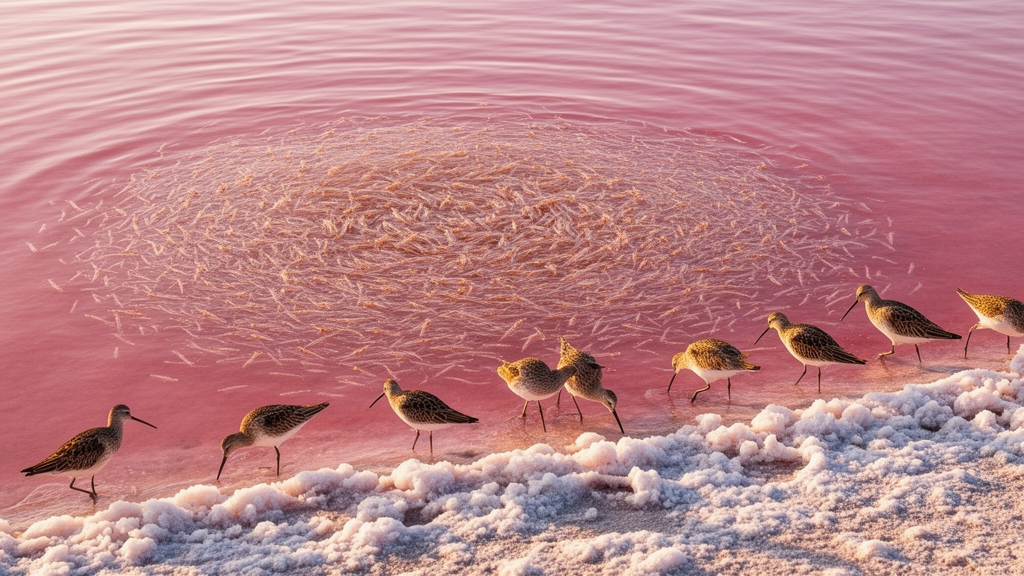
In the shallow evaporation ponds of Spain’s Odiel saltpans, one of the last strongholds of a native brine shrimp has vanished in a matter of months. A new study published in NeoBiota documents, for the first time from the very beginning of an invasion, how the American brine shrimp Artemia franciscana displaced the native clonal Artemia parthenogenetica in a protected Mediterranean wetland — and how that takeover is quietly unravelling a parasite transmission chain that connects the ponds to flamingos, gulls, shorebirds and ducks.
Brine shrimp are the keystone macrozooplankton of hypersaline ecosystems. They filter phytoplankton from the water, shaping its clarity and productivity, and they form the main prey base for numerous water-bird species. Crucially, they also serve as intermediate hosts for at least 22 species of cestode parasites, each of which matures in a specific group of birds. The larval cysticercoids of these tapeworms do more than simply ride along inside their shrimp hosts: they manipulate host behaviour and appearance, converting shy, pale-pink filter feeders into conspicuous, bright-red swarms that are far easier for birds to spot and far more nutritious to eat. In doing so, the parasites intensify the trophic links that move energy through the entire food web.
The Odiel Marshes in Huelva, south-western Spain, sit on the East Atlantic flyway and are protected as a Biosphere Reserve, a Ramsar site and a nature reserve. Their saltpans have been monitored for Artemia populations and cestode infections since 2000, and the site was considered one of the last refuges of native A. parthenogenetica in the Iberian Peninsula. In October 2015, more than 4,000 individuals examined from the evaporation zone were all native. By January 2016, the invasive A. franciscana had arrived — and by the end of that spring, the native shrimp had effectively disappeared from the monitored ponds, never to be recorded again in subsequent surveys.
To capture this transition, the research team compared monthly samples from January to June in 2011, when only the native species was present, with equivalent samples in 2016, at the very start of the invasion. They measured shrimp density, biomass and vertical distribution in the water column, and dissected thousands of individuals under the microscope to quantify cestode infections. In total, 1,310 native shrimp were examined in 2011 and 5,631 brine shrimp in 2016, including 972 native and 4,659 invasive individuals.
The demographic takeover was stark. A. franciscana dominated both the surface and the bottom of the water column in every month sampled, accounting for an average of 71 per cent of individuals at the surface and 84 per cent at the bottom. Its density, averaging 111 individuals per sample unit, was significantly higher than that of the native species, which averaged just under 26. Statistical models showed that date and the interaction between date and salinity explained much of the invasive shrimp’s rise, with both species peaking in the warmer months — but the invader’s advantage was already overwhelming by April.
The parasitological story was equally dramatic. Both shrimp species hosted the same seven cestode species in 2016, yet infection levels diverged enormously. Nearly half of the native shrimp — 47.33 per cent — carried cestode larvae, compared with just 5.30 per cent of the invaders. The flamingo parasite Flamingolepis liguloides, the most common species in adult shrimp, was 18 times more prevalent in the native host. When infected, native females suffered far more severe consequences: 96.5 per cent of infected native females were castrated by the parasite, compared with 64.5 per cent of infected invasive females, and more than half of infected native shrimp turned the parasite-favoured bright red, versus fewer than one in five of the invaders.
There was one twist. The invasive shrimp showed a markedly higher proportion of dead and degraded cysticercoids — 13.3 per cent versus 0.3 per cent in the native host — suggesting a stronger immune response against a parasite with which it shares no evolutionary history. This pattern fits the enemy release hypothesis, which predicts that introduced species escape the full weight of native parasites, and it echoes findings from other invasion systems, such as invasive round gobies whose acanthocephalan parasites die prematurely in the novel host while thriving in native fish.
Paradoxically, the invasion did not dilute parasite pressure on the remaining natives. Overall cestode prevalence was actually about 10 per cent higher in 2016 than in 2011, driven largely by F. liguloides, which infected half of all parasitised shrimp in 2016 compared with under a third in 2011. By June, more than 80 per cent of the native shrimp were infected by this castrating cestode. The researchers suggest that this intensified parasite burden — which reduces feeding rates, halts reproduction and makes hosts more visible to predators — may have accelerated the native species’ collapse, effectively a parasite-mediated competitive exclusion.
The ecosystem consequences ripple outward. Because parasites manipulate native shrimp into red, swarming, lipid-rich prey, they enhance the foraging profitability of the ponds for birds; shorebirds preferentially select infected red shrimp. As the resistant invader replaces the susceptible native, parasite transmission will decline, potentially starving the avian definitive hosts of a food subsidy and reducing the energetic value of the wetlands. Meanwhile, an unparasitised invader may graze phytoplankton harder, altering water clarity and triggering cascading effects through the food web. Over longer timescales, the loss of the native host could even drive its specialised cestodes to co-extinction, erasing a hidden but substantial component of biodiversity.
The study offers a rare field-based window into how quickly an invasion can rewire host–parasite dynamics in a protected ecosystem — within a single season. It also underscores that the impacts of biological invasions extend far beyond the visible displacement of one species by another, reaching into the invisible architecture of parasite transmission, food-web energetics and the evolutionary futures of both hosts and their manipulators. Understanding these cascades, the authors argue, is essential for predicting how hypersaline ecosystems will function as native brine shrimp continue to retreat across the Mediterranean region.
Subject of Research: Ecological and parasite-mediated impacts of the invasive brine shrimp Artemia franciscana on native Artemia and hypersaline ecosystems
Article Title: Artemia franciscana invasion causes rapid and dramatic ecological changes in hypersaline ecosystems
Article References: Lukić, D., Redón, S., Mata, M., Hortas, F., Green, A. J., & Sánchez, M. I. (2026). Artemia franciscana invasion causes rapid and dramatic ecological changes in hypersaline ecosystems. NeoBiota, 106, 339-355. https://doi.org/10.3897/neobiota.106.173707
Image Credits: AI Generated
DOI: 10.3897/neobiota.106.173707
Keywords: Artemia franciscana, Artemia parthenogenetica, biological invasion, cestode parasites, hypersaline ecosystems, saltpans, enemy release, parasite-mediated competition, water-birds, Odiel Marshes, trophic cascades, co-extinction
Cite Scienmag News
Patricia Pace. (October 18, 2026). Invasive brine shrimp rapidly reshapes hypersaline ecosystems and disrupts bird parasites. Scienmag. https://scienmag.com/invasive-brine-shrimp-rapidly-reshapes-hypersaline-ecosystems-and-disrupts-bird-parasites/
Patricia Pace. "Invasive brine shrimp rapidly reshapes hypersaline ecosystems and disrupts bird parasites." Scienmag, 18 October 2026, https://scienmag.com/invasive-brine-shrimp-rapidly-reshapes-hypersaline-ecosystems-and-disrupts-bird-parasites/. Accessed 18 October 2026.
Patricia Pace. "Invasive brine shrimp rapidly reshapes hypersaline ecosystems and disrupts bird parasites." Scienmag. October 18, 2026. https://scienmag.com/invasive-brine-shrimp-rapidly-reshapes-hypersaline-ecosystems-and-disrupts-bird-parasites/


