


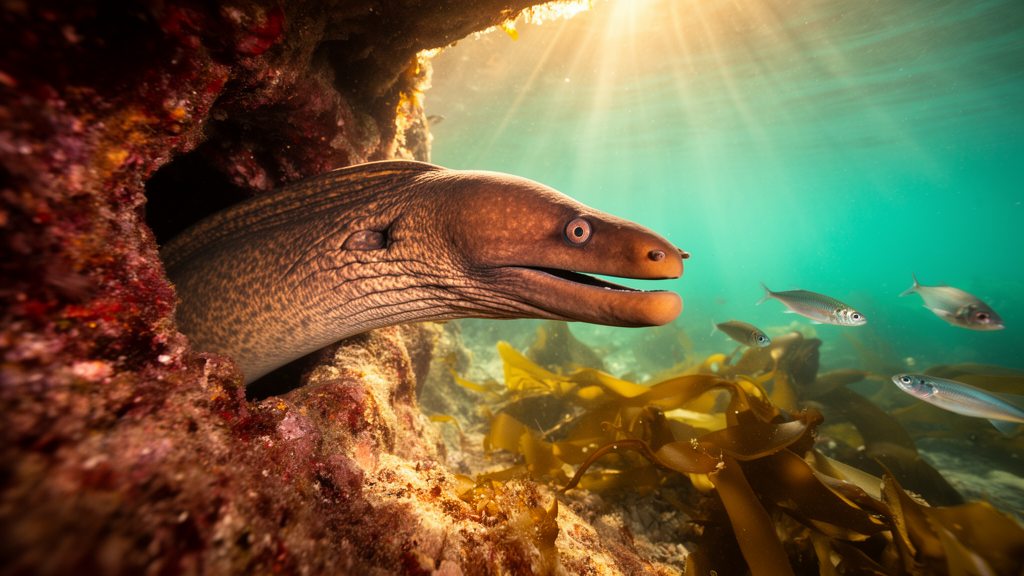
A massive moray eel hauled up from the southern Yellow Sea has turned out to be a species never before confirmed in Korean waters, and its capture pushes the known range of this tropical predator to the coldest latitude it has ever been recorded from. The specimen, a four-pore slender giant moray (Strophidon tetraporus), was collected off Heuksan-do Island in Sinan-gun, Jeollanam-do, in December 2023, and a new study published in Acta Ichthyologica et Piscatoria documents the find with a combination of old-fashioned anatomy and modern DNA barcoding.
The animal was no small catch. Measuring 2318 millimeters in total length, the single individual was taken with a stow net at a station off Heuksan-myeon and handed to researchers by the Korea Fisheries Resources Agency. After five days of fixation in 5% formalin and permanent preservation in 70% ethanol, the specimen was deposited at the National Marine Biodiversity Institute of Korea under catalog number MABIK PI00060540, where it now serves as the physical voucher anchoring the first verified record of the species in the country.
Moray eels are among the most recognizable predators of tropical and subtropical reefs, a family currently comprising 16 genera and 223 species worldwide. They are set apart from other eels by relatively small gill openings, the complete absence of pectoral fins, and formidable jaws bristling with strong teeth. Korea, sitting at the temperate northern edge of the family’s range, has previously recorded only 10 species from 4 genera, most of them in the speciose genus Gymnothorax. The genus Strophidon, to which the new arrival belongs, was represented by just two Korean species before this study.
Strophidon is a genus of extremes. Its members carry extremely elongated bodies in which the body depth fits 21 to 81 times into the total length, tails roughly twice as long as the trunk, and eyes pushed well forward on the snout. A distinctive median serrated line runs along the body, and the jaws bear teeth arranged in two rows, an arrangement that separates the genus from all other muraenids. Five species are currently recognized worldwide, and Strophidon tetraporus was described as new to science only in 2020, during a taxonomic revision that split the once-catch-all slender giant morays into cleaner species boundaries.
Identifying the Korean specimen demanded careful counting. Using digital Vernier calipers accurate to 0.1 millimeters, X-ray radiography for the skeleton, and a stereomicroscope for the sensory pores, the team assembled a full morphometric profile. The result: 195 total vertebrae, split into 8 predorsal and 79 preanal, a dorsal fin of 498 rays, and an anal fin of 339 rays, both continuous with the caudal fin. The head carried three supraorbital pores, four infraorbital pores, six preoperculo-mandibular pores, and four branchial pores, and it was the presence of that distinct fourth infraorbital pore, the trait that gives the species its name, that stood out as the decisive diagnostic character.
Every count landed squarely within the ranges documented for the type specimens. Proportional measurements told the same story: the head length fit 9.8 times into the total length, the snout 3.0 times into the head length, the eye diameter 23.8 times into the head length, and the body depth at the gill opening 22.4 times into the total length. In preservation, the eel showed a uniformly dark brown dorsal surface fading to lighter brown on the ventral side, with fin membranes matching the adjacent body color and darkening toward their margins. Taken together, the meristic, morphometric, and coloration evidence converged on a single identification.
To seal the case, the researchers turned to the mitochondrial cytochrome oxidase subunit I gene, the workhorse of animal DNA barcoding. A 667-base-pair fragment was amplified from muscle tissue using universal fish primers, sequenced on an ABI 3730xl, and compared against reference sequences from the holotype and paratypes of Strophidon tetraporus as well as specimens from Taiwan, the Philippines, and Vietnam. The Korean eel clustered with these conspecific individuals in a monophyletic clade, and pairwise genetic distances computed under the Kimura 2-parameter model showed a divergence of only 0.02 to 0.03 percentage points from the type material, an extraordinarily tight match.
The contrast with its closest relatives could not have been sharper. Against Strophidon ui, the Korean specimen diverged by 11.2 to 11.6 percentage points; against Strophidon sathete by 11.4 to 11.6 points; and against Strophidon dorsalis by 12.5 to 12.7 points, with a mean interspecific distance of 11 percentage points across the genus. A neighbor-joining phylogenetic tree built with 1000 bootstrap replications placed the Korean eel firmly inside the tetraporus clade, with the outgroup Gymnothorax prionodon rooting the analysis. Morphology and molecules, in other words, agreed completely.
The biogeographic implications are what make this record genuinely newsworthy. Strophidon tetraporus lives on sandy bottoms across the western Pacific, with confirmed records from Thailand, Vietnam, the Philippines, Indonesia, and southern Japan, where it was known to spawn in the South China Sea. Its southernmost limit sat at Nusa Tenggara Barat in Indonesia, and its northernmost at southern Japan. The Heuksan-do specimen now extends that distribution to its highest recorded latitude, deep into the southern Yellow Sea and well beyond the warm refuges the species was thought to occupy.
Why a tropical-leaning eel should appear this far north remains an open question, and the authors of the study frame the find as a new insight into the dispersal ecology and biogeographic range limits of this large muraenid. Whether the individual was a stray carried north by currents, a sign of a gradually shifting range in a warming ocean, or simply a species overlooked by Korean surveys until now, only further sampling can tell. What the record does establish is that Korea’s marine fauna is still being charted, and that a nearly 2.3-meter predator can slip through the nets of science in one of the world’s most intensively fished seas until a single stow net off a small island island finally reveals it.
Subject of Research: First confirmed record of the moray eel Strophidon tetraporus in Korean waters
Article Title: First record of the four-pore slender giant moray, Strophidon tetraporus ( Actinopterygii , Anguilliformes , Muraenidae ), from Sinan, Korea
Article References: Sohn, M.-S., Kwun, H.-J., & Kim, J.-K. (2025). First record of the four-pore slender giant moray, Strophidon tetraporus (Actinopterygii, Anguilliformes, Muraenidae), from Sinan, Korea. Acta Ichthyologica et Piscatoria, 55, 413-417. https://doi.org/10.3897/aiep.55.174404
Image Credits: AI Generated
Keywords: moray eel, Strophidon tetraporus, Korea, new record, DNA barcoding, COI gene, marine biodiversity, Yellow Sea, biogeography, ichthyology, First, record
Cite Scienmag News
Juliet Wilcox. (October 18, 2026). Slender giant moray makes record-breaking appearance in Korean waters. Scienmag. https://scienmag.com/slender-giant-moray-makes-record-breaking-appearance-in-korean-waters/
Juliet Wilcox. "Slender giant moray makes record-breaking appearance in Korean waters." Scienmag, 18 October 2026, https://scienmag.com/slender-giant-moray-makes-record-breaking-appearance-in-korean-waters/. Accessed 18 October 2026.
Juliet Wilcox. "Slender giant moray makes record-breaking appearance in Korean waters." Scienmag. October 18, 2026. https://scienmag.com/slender-giant-moray-makes-record-breaking-appearance-in-korean-waters/


