


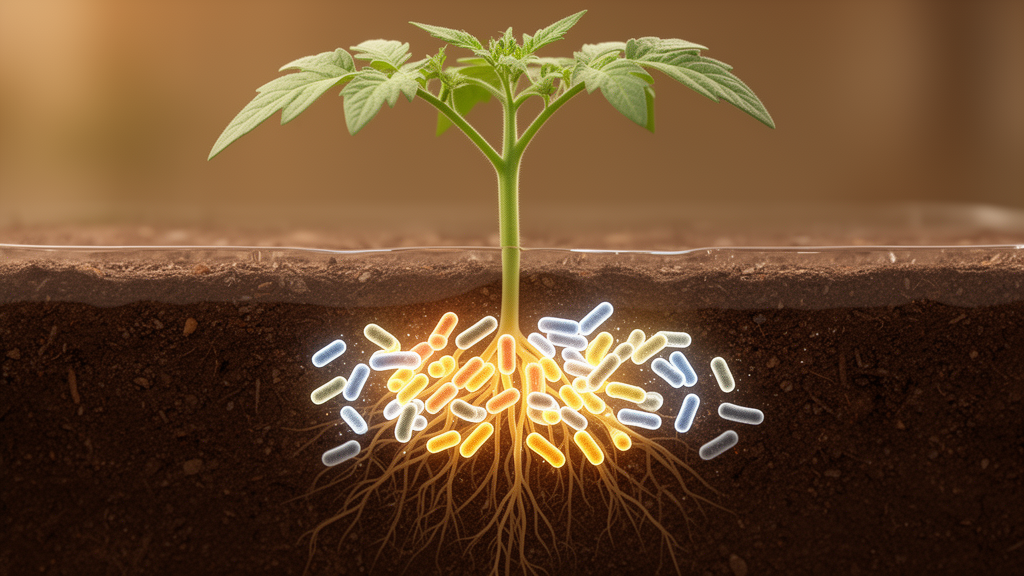
When two strains of soil bacteria meet on a petri dish, the encounter can end in cooperation or in chemical warfare. A new study published in Plant Cell Reports shows that this seemingly simple compatibility test between Bacillus strains carries consequences far beyond the laboratory plate, rippling outward to shape synthetic bacterial communities, the assembly of the rhizosphere microbiome, and ultimately the growth performance of tomato plants. The findings, led by Abdur Rashid Khan and colleagues working across institutions in China, the United Arab Emirates, Pakistan, and Belarus, offer a technical framework for designing stable microbial inoculants at a time when agriculture urgently needs alternatives to chemical fertilizers and pesticides.
The research focused on synthetic communities, or SynComs, which are deliberately constructed mixtures of microbial strains designed to perform specific functions in the plant root zone. Compatibility among the member strains has long been recognized as a critical variable for SynCom stability and functionality, yet the ecological and physiological consequences of compatibility for plant-microbe interactions have remained insufficiently understood. The team set out to close this gap by systematically comparing compatible and incompatible Bacillus-based SynComs and measuring their effects on tomato growth, rhizosphere microbiome assembly, and the organization of microbial interaction networks in the soil surrounding the roots.
The first line of evidence came from co-culture experiments on solid media. When compatible Bacillus strains were grown together, they displayed distinctive merged colony phenotypes: colonies grew into one another, biofilm formation was enhanced, and growth dynamics shifted in ways that suggested cooperative metabolism. Incompatible combinations, by contrast, formed sharp demarcation zones between colonies, a visible signature of antagonism in which each strain deploys antimicrobial compounds or competitive strategies against the other. These macroscopic phenotypes provided a rapid, screenable readout of the underlying social behavior of the strains, echoing a growing body of literature showing that competition, rather than cooperation, often dominates interactions among culturable microorganisms, and that positive interactions, while less frequent, can be reliably identified and harnessed when they occur.
Among the strain pairs tested, the compatible combination NMCN6 plus LNXM12 stood out. This pair showed higher attached biomass in co-culture and elevated relative production of indole-3-acetic acid, a plant hormone that Bacillus strains synthesize and release to stimulate root growth and development. Auxin production by plant growth-promoting rhizobacteria is one of the principal mechanisms by which these bacteria enhance plant performance, so the finding that a compatible pair produces more of this hormone than most incompatible combinations or single-strain inoculations points to a concrete physiological benefit of compatibility. The result suggests that when strains coexist peacefully, their combined metabolic output can exceed the sum of their individual contributions, a phenomenon consistent with emergent properties reported in mixed microbial consortia used in bioprocesses.
The team then moved from the petri dish to the greenhouse, where the consequences of compatibility became visible in plant architecture and physiology. Tomato plants inoculated with compatible SynComs grew significantly better than controls: plant height increased, root systems elongated, and measurements of photosynthesis and stomatal conductance rose, indicating that the plants were fixing carbon more efficiently and regulating gas exchange more actively. These gains align with the well-documented capacity of Bacillus species to promote plant growth through hormone production, nutrient mobilization, and induced systemic resistance against pathogens. Incompatible combinations produced a different pattern, with distinct soluble sugar responses in the plants rather than consistent evidence of stress, a nuance the authors interpret carefully, noting that soluble sugars participate in both stress signaling and normal carbon allocation, so their shifts cannot be read as a simple stress marker.
To understand how these above-ground and whole-plant effects related to the underground microbial world, the researchers turned to amplicon sequencing of the rhizosphere bacterial communities. The sequencing data revealed treatment-associated variation in community composition, meaning that the identity of the inoculated SynCom left a detectable fingerprint on the broader bacterial assemblage in the soil. Compatible SynComs were associated with the enrichment of specific bacterial taxa, suggesting that these communities selectively favored certain resident microbes, potentially those with beneficial or synergistic functions. Incompatible combinations produced distinct taxonomic profiles, indicating that antagonistic interactions among the inoculated strains reshaped the rhizosphere in a different direction.
Beyond taxonomy, the study examined the structure of microbial co-occurrence networks, which map statistical associations among bacterial taxa and serve as proxies for the underlying ecological interaction web. Compatible SynComs produced more interconnected and stable networks, whereas incompatible combinations yielded comparatively fragmented microbial associations. This distinction matters because network architecture is increasingly recognized as a determinant of microbiome stability: highly connected communities can be more resilient to perturbation, while fragmented networks may be more vulnerable to collapse or invasion. The results resonate with theoretical work on the ecology of the microbiome, which holds that networks, competition, and stability are tightly intertwined, and with empirical findings that host selection shapes crop microbiome assembly and network complexity.
Yet the authors are careful not to overstate the explanatory power of compatibility alone. Community composition differed significantly among individual treatments, but not among the broader compatibility categories when the analysis accounted for unequal within-group dispersion, a statistical subtlety that guards against attributing all observed variation to the compatibility label. The observed co-culture, plant, and microbiome responses, the team concludes, highlight differences among the selected Bacillus combinations that cannot be attributed to compatibility alone. This measured interpretation is a reminder that microbial social behavior is one thread in a complex web of strain-specific traits, environmental context, and plant genotype effects, and that rigorous experimental design must disentangle these factors before drawing broad conclusions.
The practical implications of the work are nonetheless substantial. The study provides a rational framework for selecting Bacillus strain combinations for further evaluation as plant inoculants, prioritizing pairs and consortia whose compatibility has been verified through simple co-culture screens before they are advanced to greenhouse and field trials. This approach addresses a persistent limitation of microbial inoculant technology, namely that multistrain products often fail in the field because member strains compete with one another or fail to establish in the rhizosphere. By screening for compatibility first, developers can assemble consortia whose members reinforce rather than undermine each other, improving the odds that the inoculant will persist, function, and deliver measurable agronomic benefits.
As agriculture confronts the dual challenges of feeding a growing population and reducing its reliance on hazardous chemical inputs, the ability to rationally design stable, compatible synthetic communities represents a meaningful step forward. The convergence of co-culture phenotyping, plant physiology, and microbiome sequencing in this study illustrates how multi-scale evidence can guide the engineering of the plant microbiome, transforming what was once a trial-and-error enterprise into a principled design discipline. If the framework holds up in broader strain collections and field conditions, the humble petri dish test of bacterial compatibility may become a standard first checkpoint on the road to more sustainable crop production.
Subject of Research: Bacillus synthetic communities, rhizosphere microbiome, plant-microbe interactions, microbial inoculants, tomato growth promotion
Article Title: Compatibility among Bacillus strains is linked to synthetic communities function, rhizosphere microbiome assembly and plant performance
Article References: Khan, A. R., Ali, Q., Khalid, S., Ayaz, M., Li, L., Jinbiao, M., Mundra, S., Kuptsov, V., Kolomiets, E., Gu, Q., Wu, H., & Gao, X. (2026). Compatibility among Bacillus strains is linked to synthetic communities function, rhizosphere microbiome assembly and plant performance. Plant Cell Reports, 45(11), Article 334. https://doi.org/10.1007/s00299-026-03998-0
Image Credits: AI Generated
DOI: 10.1007/s00299-026-03998-0
Keywords: Compatibility, Bacillus, strains, linked, synthetic, communities, function, rhizosphere, microbiome, assembly, plant, performance
Cite Scienmag News
Morgan Morrow. (October 17, 2026). Bacillus Strain Compatibility Shapes Synthetic Communities, Rhizosphere Microbiome and Tomato Growth. Scienmag. https://scienmag.com/bacillus-strain-compatibility-shapes-synthetic-communities-rhizosphere-microbiome-and-tomato-growth/
Morgan Morrow. "Bacillus Strain Compatibility Shapes Synthetic Communities, Rhizosphere Microbiome and Tomato Growth." Scienmag, 17 October 2026, https://scienmag.com/bacillus-strain-compatibility-shapes-synthetic-communities-rhizosphere-microbiome-and-tomato-growth/. Accessed 17 October 2026.
Morgan Morrow. "Bacillus Strain Compatibility Shapes Synthetic Communities, Rhizosphere Microbiome and Tomato Growth." Scienmag. October 17, 2026. https://scienmag.com/bacillus-strain-compatibility-shapes-synthetic-communities-rhizosphere-microbiome-and-tomato-growth/


