


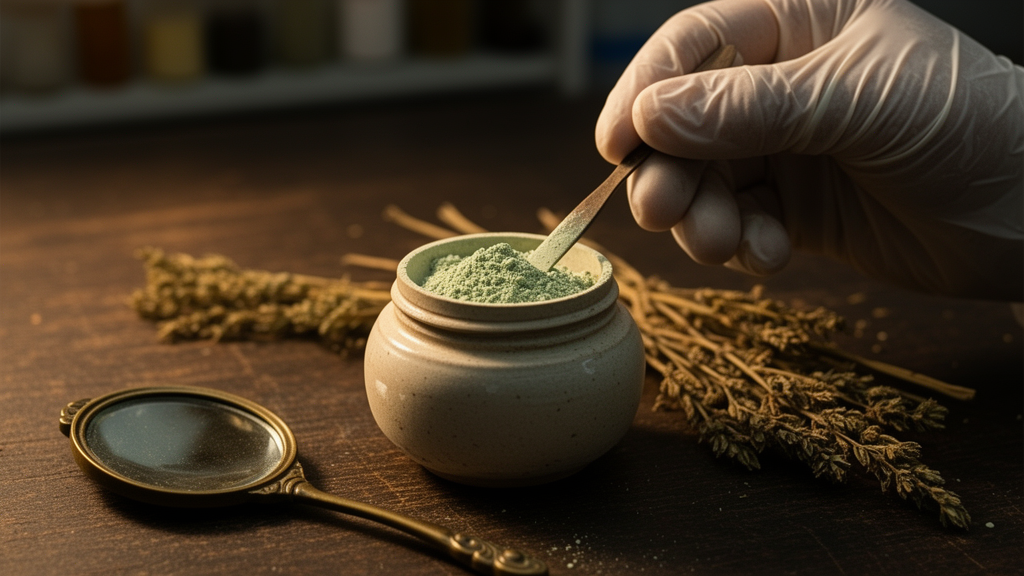
Archaeologists and chemists have joined forces to analyze chalk pieces recovered from two female burials of the 2nd to 4th centuries AD in the Eastern Aral Sea region of Kazakhstan, and the results suggest that the Jetyasar people, an enigmatic culture that flourished from the late 1st millennium BC to the 8th century AD, were not only skilled at working with local mineral resources but were also plugged into the long-distance trade networks of the Great Silk Road. The study, published in npj Heritage Science, represents the first complex analytical examination of cosmetic materials from this archaeological culture, and it paints a picture of a community that combined locally available writing chalk with aromatic plant oils that may have traveled all the way from India.
The Jetyasar culture occupied a pivotal position in the Eastern Aral Sea region, where oasis agriculturists and steppe nomads came into contact and likely gave rise to the distinctive archaeological signature that researchers now recognize. Burials from this culture have yielded a variety of grave goods, but the chalk pieces found alongside two female individuals stood out as candidates for cosmetic use. To determine whether these were indeed beauty products rather than pigments for other purposes or materials with entirely different functions, the research team deployed an impressive battery of instrumental techniques, including gas chromatography coupled with mass spectrometry, X-ray fluorescence, scanning electron microscopy, micro-Raman microscopy, and X-ray diffraction.
The mineralogical foundation of the samples turned out to be a coccolithic microstructure, a telltale signature of writing chalk. Coccoliths are the microscopic calcite plates produced by marine algae, and their presence in the material confirms that the powder derives from a natural chalk deposit rather than from a synthetic or processed mineral source. This finding anchors the cosmetic in the local geology of the region, suggesting that the Jetyasar people sourced their base material from chalk formations accessible in the Eastern Aral area. Writing chalk, prized for its softness and whiteness, has a long history of use in cosmetics across many ancient cultures, and its identification here fits comfortably within that broader tradition.
But the base material was only part of the story. Gas chromatography-mass spectrometry, the workhorse technique for identifying organic compounds in complex mixtures, revealed a complicated assemblage of organic molecules adsorbed within the chalk matrix. Among the compounds detected, the researchers identified signatures consistent with plants such as wormwood, cinnamon, and probably mint. These are not random botanical traces; they represent deliberate additions of aromatic plant materials or their essential oils to the chalk base, transforming a simple white powder into a scented cosmetic product. Wormwood, known for its bitter aromatic qualities, cinnamon for its warm spicy fragrance, and mint for its cooling freshness together suggest a sophisticated understanding of scent blending.
The presence of cinnamon is particularly striking from a trade perspective. Cinnamon is native to South and Southeast Asia, and its appearance in a burial context in the Eastern Aral region during the 2nd to 4th centuries AD points to the reach of the Great Silk Road, the network of trade routes that connected China, Central Asia, India, Persia, and the Mediterranean world. The researchers propose that the aromatic oils used in the Jetyasar cosmetics may have been imported from India, traveling along the same commercial arteries that carried silk, spices, glass, and precious metals across the Eurasian landmass. If confirmed, this would place the Jetyasar people squarely within the economic and cultural currents of their time.
The combination of local chalk and imported aromatics tells a story of resourcefulness and connectivity. The Jetyasar people appear to have manufactured their cosmetics from materials available in their immediate environment while enhancing them with exotic ingredients obtained through long-distance exchange. This dual sourcing strategy is consistent with the hypothesis that the culture itself emerged from contacts between oasis agriculturists and steppe nomads, a hybrid society positioned at the crossroads of agricultural and pastoral worlds, and one that would naturally have participated in the exchange networks linking settled oases with nomadic steppes and, ultimately, with the great civilizations of Eurasia.
From a technical standpoint, the analytical approach exemplifies modern archaeological science. X-ray fluorescence provided elemental composition data, allowing the team to characterize the inorganic components of the samples. Scanning electron microscopy, coupled with energy-dispersive X-ray spectroscopy, revealed the microstructure of the chalk at high magnification, confirming the coccolithic origin. X-ray diffraction identified the crystalline phases present, while micro-Raman microscopy offered molecular-level information about both mineral and organic components. Gas chromatography-mass spectrometry then unlocked the organic chemistry, detecting and identifying the volatile and semi-volatile compounds that betrayed the presence of aromatic plant materials. Each technique contributed a different layer of information, and together they produced a picture that no single method could have provided alone.
The burial context of the samples adds another dimension to the findings. The chalk pieces were recovered from two female burials dating to the 2nd to 4th centuries AD, a period when the Jetyasar culture was well established in the Eastern Aral region. The placement of cosmetic materials in female graves suggests that these items held personal significance for the deceased individuals, whether as everyday objects of grooming, as symbols of beauty and status, or as items deemed necessary for the afterlife. Cosmetic use in ancient burial contexts is well documented across many cultures, and the Jetyasar evidence adds a Central Asian data point to this global pattern.
The research was supported by the Russian Science Foundation under a project investigating migrations in the Central Asian region at the end of the 1st millennium BC and the first half of the AD millennium according to comprehensive bioarchaeological study. Analytical work using scanning electron microscopy with energy-dispersive spectroscopy, X-ray diffraction, and Raman spectroscopy was carried out using the scientific equipment of the Core Facilities Center at the Institute of Archaeology of the Russian Academy of Sciences in Moscow. The team brought together researchers from MSU-BIT University in Shenzhen, Lomonosov Moscow State University, the State Oriental Museum, and the Institute of Archaeology RAS, reflecting the interdisciplinary and international character of the investigation.
As the first complex analytical study of cosmetic materials from the Jetyasar culture, this work opens a window onto the daily lives, aesthetic practices, and trade connections of a people who inhabited the arid lands east of the Aral Sea two thousand years ago. The finding that they may have blended local chalk with cinnamon and other aromatics possibly sourced from India underscores the remarkable reach of Silk Road commerce and the sophistication of ancient cosmetic chemistry. Future analyses of additional samples from Jetyasar burials promise to refine this picture further, potentially revealing more about the recipes, rituals, and trade relationships that shaped beauty practices on the ancient steppe frontier.
Subject of Research: Archaeology
Article Title: Cosmetic powder of 2000-years old Jetyasar culture. A complex analytical study
Article References: Polyakova, O. V., Kondratyeva, M. S., Garshev, A. V., Bolelov, S. B., Galieva, Z. S., Zubavichus, E. Y., Saprykina, I. A., Lebedev, A. T., & Mednikova, M. B. (2026). Cosmetic powder of 2000-years old Jetyasar culture. A complex analytical study. npj Heritage Science. https://doi.org/10.1038/s40494-026-02983-w
Image Credits: AI Generated
DOI: 10.1038/s40494-026-02983-w
Keywords: Cosmetic, powder, years, Jetyasar, culture, complex, analytical, scientific research
Cite Scienmag News
Courtney Benton. (October 17, 2026). Ancient Jetyasar Cosmetic Powder Reveals Silk Road Trade in Aromatic Oils. Scienmag. https://scienmag.com/ancient-jetyasar-cosmetic-powder-reveals-silk-road-trade-in-aromatic-oils/
Courtney Benton. "Ancient Jetyasar Cosmetic Powder Reveals Silk Road Trade in Aromatic Oils." Scienmag, 17 October 2026, https://scienmag.com/ancient-jetyasar-cosmetic-powder-reveals-silk-road-trade-in-aromatic-oils/. Accessed 17 October 2026.
Courtney Benton. "Ancient Jetyasar Cosmetic Powder Reveals Silk Road Trade in Aromatic Oils." Scienmag. October 17, 2026. https://scienmag.com/ancient-jetyasar-cosmetic-powder-reveals-silk-road-trade-in-aromatic-oils/


