


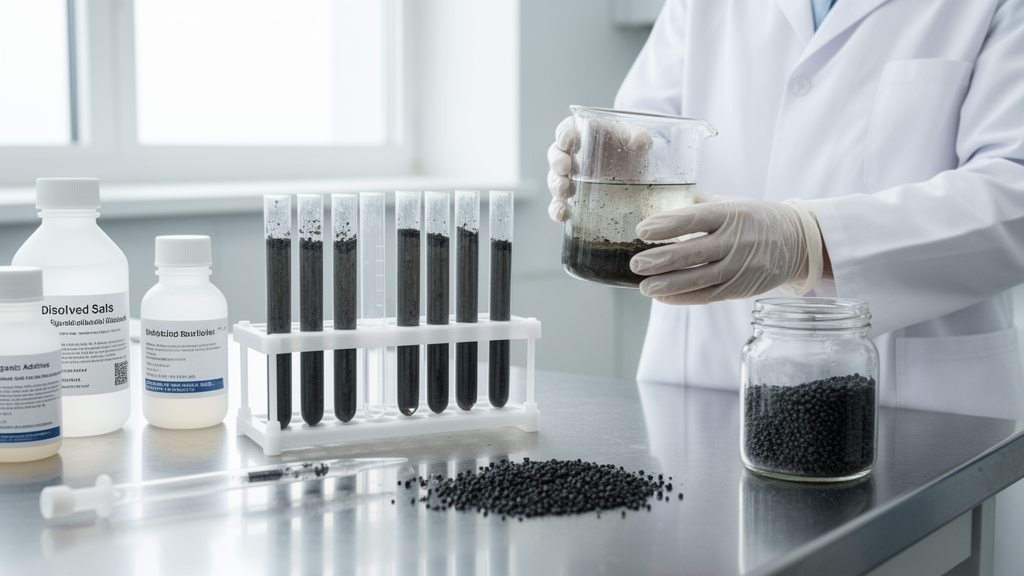
Antibiotics do not stay neatly confined to the bottles and syringes through which they enter the world. Oxytetracycline, one of the most widely used veterinary antibiotics, ends up in groundwater, streams, and livestock drinking water across the globe, where it persists long enough to drive the evolution of resistant bacteria and to disrupt aquatic ecosystems. Engineers have responded with an arsenal of adsorbent materials designed to strip such molecules from water, but most of those materials are tested under laboratory conditions that are far cleaner than anything found in a real river or a real wastewater stream. A new study from Argentine researchers now shows just how much that gap matters, revealing that the invisible additives inside a commercial drug formulation can slash the performance of promising clay–carbon adsorbents by nearly an order of magnitude, while the microplastics everyone feared might interfere barely register at all.
The research, led by María Emilia Zelaya-Soulé of the National University of Luján and published in Environmental Science and Pollution Research, set out to evaluate how well montmorillonite and two montmorillonite–carbon hybrid materials remove oxytetracycline from water under both controlled and deliberately complicated conditions. Montmorillonite, a naturally abundant swelling clay, has long been known to bind tetracycline antibiotics through cation exchange and other interactions at its negatively charged surfaces. The hybrids used in this work combine that clay with carbon derived from carbohydrates, creating composite materials that merge the ion-exchange chemistry of the mineral with the hydrophobic, structurally heterogeneous adsorption sites of carbon. The idea is simple in principle: if you can fuse the binding strengths of two very different classes of surfaces into one material, you should get an adsorbent that works across a broader range of pollutant chemistries and water conditions than either component alone.
The team began with the classic controlled experiments. Using batch adsorption tests, they measured how much oxytetracycline each material could remove as a function of contact time, concentration, and pH, fitting the data to kinetic and equilibrium models to extract mechanistic information. The results were striking. One of the hybrids, designated MDac3-210–500, achieved a maximum adsorption capacity of approximately 0.6 millimoles per gram at neutral pH, a figure that places it among the more capable clay-based adsorbents reported for this class of antibiotics. At neutral pH, oxytetracycline exists as a mixture of zwitterionic and anionic species, and the hybrid’s carbon-rich surfaces appear to provide the right combination of hydrophobic domains and polar functional groups to capture these molecules efficiently.
Mechanistic analysis of the kinetic data revealed something important about how the two classes of materials actually work. For plain montmorillonite, the adsorption behavior was consistent with chemisorption playing a dominant role, meaning that the antibiotic forms relatively strong chemical bonds with specific sites on the clay surface rather than simply sticking through weak physical forces. For the hybrids, by contrast, the data pointed toward intraparticle diffusion and surface heterogeneity as the controlling factors. In other words, the rate-limiting step is not the formation of a chemical bond but the physical journey of antibiotic molecules diffusing into the porous interior of the carbon–clay composite, where they encounter a patchwork of binding sites with varying affinities. This distinction matters for engineers because it suggests the hybrids behave more like sponges with distributed capture zones, while the clay behaves more like a surface with a finite set of high-affinity anchors.
But the researchers did not stop at the clean-water benchmark. They recognized that in the real world, oxytetracycline almost never arrives alone. When farmers administer the antibiotic to livestock, they typically use commercial veterinary formulations that contain not just the active molecule but a suite of additives, stabilizers, solubilizers, and preservatives designed to keep the drug effective in the bottle. These additives, though chemically minor compared to the active ingredient, can be highly competitive adsorbates in their own right. To approximate this reality, the team repeated their adsorption experiments using an actual veterinary commercial oxytetracycline formulation rather than the pure analytical standard.
The outcome was dramatic. In the presence of the commercial formulation, the adsorption capacity of the hybrid materials plummeted to between 0.05 and 0.08 millimoles per gram, a reduction of roughly 90 percent compared to the clean-water maximum. The interpretation is that the formulation additives compete directly with oxytetracycline for the same active sites on the hybrid surfaces, effectively crowding the antibiotic out of its preferred binding zones. This is a textbook example of what adsorption scientists call matrix effects, where the chemical complexity of the surrounding solution fundamentally alters how an adsorbent performs. The finding carries a sobering implication: laboratory tests that use only pure analytical standards may dramatically overestimate how well a given adsorbent will work in a real treatment scenario, because they ignore the molecular competition that inevitably arises from coexisting compounds.
Yet the study contained a genuine surprise in the opposite direction. Microplastics, particularly polyethylene terephthalate or PET, have become one of the most discussed co-contaminants in water treatment research, with numerous studies suggesting that plastic particles can either compete with antibiotics for adsorbent sites or even act as carriers that concentrate pollutants and transport them through the environment. The Argentine team tested this directly by adding PET microplastics smaller than 112 micrometers at a concentration of 0.5 grams per liter to their adsorption experiments. Under the conditions tested, the PET particles did not substantially modify oxytetracycline adsorption by the hybrid materials. The contrast with the commercial formulation could hardly be sharper: one coexisting contaminant devastated performance, while the other, at least in this experimental setup, was essentially neutral.
The authors are careful to note that this neutrality applies to the specific conditions they tested, including the particular particle size, concentration, and degree of aging of the PET microplastics. Other research has shown that weathered or photoaged microplastics can develop increased surface functionality and stronger interactions with antibiotics, and that smaller particles at higher concentrations might behave differently. But the finding still matters because it suggests that not every coexisting contaminant deserves equal weight when evaluating adsorbent performance. The molecular identity and concentration of coexisting compounds, not simply their presence, determine whether they will interfere with treatment. Formulation additives, being small, soluble, and chemically similar to the target antibiotic, turn out to be far more dangerous competitors than relatively inert plastic particles.
What makes this study particularly valuable is that it provides a quantitative basis for thinking about adsorbent performance under realistic water chemistry rather than idealized conditions. The sensitivity of oxytetracycline adsorption to coexisting compounds, as the authors put it, emphasizes the importance of considering matrix composition when evaluating any adsorbent material. For engineers designing water treatment systems for livestock operations, veterinary clinics, or agricultural runoff, the message is clear: the performance of a clay–carbon hybrid measured against a pure standard tells only part of the story. The real test is how that material behaves when the antibiotic arrives packaged with the very additives that make it usable in the first place.
The broader significance extends beyond oxytetracycline itself. Tetracycline antibiotics are among the most detected pharmaceuticals in surface waters and groundwater worldwide, and their persistence fuels the spread of antimicrobial resistance, a problem the World Health Organization has identified as one of the top global public health threats. Clay–carbon hybrids, being built from abundant natural montmorillonite and renewable carbohydrate-derived carbon, offer a potentially scalable and low-cost route to removing such pollutants. But this research shows that the path from laboratory promise to real-world impact runs directly through the messy chemistry of actual contaminated water, where additives, plastics, dissolved organic matter, and countless other coexisting species all compete for the same limited binding sites. Understanding which of those competitors matter most, and by how much, is the kind of unglamorous but essential knowledge that turns a promising material into a working technology.
Subject of Research: Removal of the antibiotic oxytetracycline from water by montmorillonite and clay–carbon hybrid adsorbents under realistic conditions including formulation additives and PET microplastics
Article Title: Oxytetracycline adsorption by clay–carbon hybrids: effects of pH, commercial formulation additives, and PET microplastics
Article References: Zelaya-Soulé, M. E., Montes, M. L., Villanueva, M. E., & Fernández, M. A. (2026). Oxytetracycline adsorption by clay–carbon hybrids: effects of pH, commercial formulation additives, and PET microplastics. Environmental Science and Pollution Research. https://doi.org/10.1007/s11356-026-38315-5
Image Credits: AI Generated
DOI: 10.1007/s11356-026-38315-5
Keywords: oxytetracycline, clay–carbon hybrids, montmorillonite, adsorption, antibiotics, water treatment, PET microplastics, formulation additives, matrix effects, Environmental Science and Pollution Research, clay, carbon
Cite Scienmag News
Violet Maxwell. (October 17, 2026). Clay–Carbon Hybrids Trap Antibiotics in Water, but Real-World Additives Undermine Them. Scienmag. https://scienmag.com/clay-carbon-hybrids-trap-antibiotics-in-water-but-real-world-additives-undermine-them/
Violet Maxwell. "Clay–Carbon Hybrids Trap Antibiotics in Water, but Real-World Additives Undermine Them." Scienmag, 17 October 2026, https://scienmag.com/clay-carbon-hybrids-trap-antibiotics-in-water-but-real-world-additives-undermine-them/. Accessed 17 October 2026.
Violet Maxwell. "Clay–Carbon Hybrids Trap Antibiotics in Water, but Real-World Additives Undermine Them." Scienmag. October 17, 2026. https://scienmag.com/clay-carbon-hybrids-trap-antibiotics-in-water-but-real-world-additives-undermine-them/


