


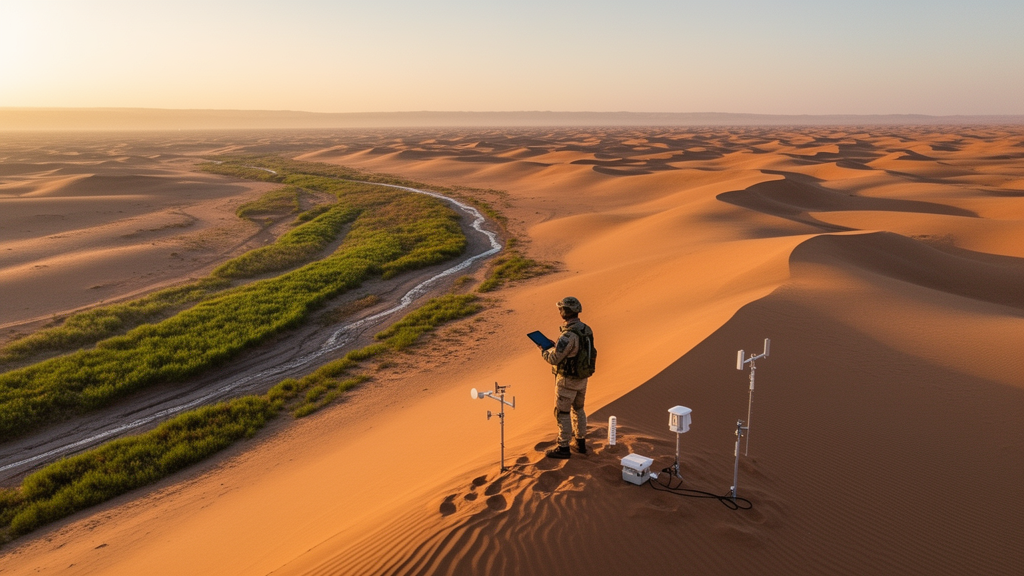
Deep in the heart of China’s Xinjiang region lies the Taklamakan Desert, one of the largest shifting-sand deserts on Earth, a place so hostile that its name is popularly said to mean “you can get into it, but you cannot get out.” For decades, scientists have struggled to answer a deceptively simple question about this vast sea of dunes: is its ecological environment getting better or worse? Now, a research team led by Na Jiang and Jianmin Liu of the School of Resources and Environmental Engineering at Hefei University of Technology has delivered one of the most rigorous answers to date, and their findings, published in Environmental Monitoring and Assessment, reveal a landscape that remains stubbornly barren yet shows surprising pockets of recovery concentrated along its life-giving river corridors.
The challenge of measuring ecological quality in an extremely arid desert is fundamentally different from doing so in a forest or a wetland. The standard tool for satellite-based environmental assessment is the remote sensing ecological index, or RSEI, which was designed to condense four crucial pieces of information—greenness, moisture, dryness, and heat—into a single score using a principal component analysis of Landsat imagery. But the Taklamakan breaks the assumptions behind that index. In a hyper-arid environment where vegetation covers only a tiny fraction of the surface, where soil salinity glints in the sun, and where wind-blown sand constantly reshapes the ground, the moisture and greenness signals that dominate RSEI in wetter regions become weak and misleading. The team therefore constructed a modified version, which they call the arid remote sensing ecological index, or ARSEI, specifically tuned to the physics of dryland ecosystems.
The technical refinement matters because the original RSEI relies on the normalized difference vegetation index for greenness, the normalized difference moisture index for wetness, a bare-soil measure for dryness, and land surface temperature for heat. In the Taklamakan, the researchers adjusted these components to better capture the heterogeneous conditions of an arid landscape, accounting for the salinity-encrusted surfaces and the sparse, river-fed vegetation belts that punctuate the otherwise lifeless sand. To validate their new index, they compared it directly against the traditional RSEI across the study area. The results were striking: the first principal component of the ARSEI captured an average of 85.58 percent of the total variance in the input data, roughly four percentage points higher than the RSEI, and its average absolute correlation with the five underlying ecological indicators reached 0.79. In plain terms, the ARSEI squeezed measurably more meaningful environmental information out of the same satellite pixels than the standard index could.
To track change over time, the team harnessed the power of cloud computing. Rather than downloading and processing terabytes of imagery on local machines, they used Google Earth Engine to access Landsat data for four snapshot years: 2010, 2014, 2018, and 2022. This approach allowed them to compute the ARSEI consistently across the entire desert for each period, then use difference analysis to map where ecological quality improved, declined, or stayed the same between 2010 and 2022. The mean ARSEI values for the four years came out at 0.1626, 0.2007, 0.1390, and 0.2030 respectively—a trajectory that dips and rises but ultimately lands higher in 2022 than it began in 2010.
Those numbers tell a nuanced story. On a scale from zero to one, values hovering around 0.14 to 0.20 confirm that the Taklamakan’s overall ecological quality remains very low, exactly what one would expect for a desert where annual precipitation is measured in millimeters and summer surface temperatures can exceed 60 degrees Celsius. Yet the direction of change is quietly encouraging. When the researchers classified every pixel into improvement, degradation, or no change, they found that 10.00 percent of the desert improved, 5.62 percent degraded, and 84.39 percent remained essentially stable. Improvement outpaced degradation by nearly a factor of two, suggesting that the fragile ecological gains of the past decade have not been entirely erased by the harsh forces working against them.
Perhaps the most vivid finding is where those changes occurred. Ecological improvement clustered tightly in the oases and along the corridors of the Tarim, Hotan, and Yarkand rivers—the slender green ribbons of poplar and tamarisk that trace the paths of snowmelt-fed water from the Kunlun and Tianshan mountains into the desert interior. These riverine belts act as natural refuges, where even modest increases in water availability can translate into visible gains in vegetation cover and soil stability. In contrast, degradation concentrated in the transition zones where oases meet open desert, and in areas subjected to frequent wind erosion. These ecotones are the front lines of desertification, where shifting sands can bury farmland and where the balance between vegetation and bare ground is most precarious. The spatial pattern suggests that conservation efforts aimed at stabilizing oasis margins could yield outsized benefits for the region’s overall ecological trajectory.
To understand why ecological quality varies across the desert in the way it does, the team turned to a statistical tool called geodetector, which quantifies how much of the spatial variation in a variable can be explained by another factor. Applying it to the 2022 ARSEI pattern, they ranked the explanatory power of six potential drivers: vegetation coverage, precipitation, land use, mean annual wind speed, elevation, and slope. Vegetation coverage emerged as the single strongest factor, with a q-statistic of 0.3102, followed by precipitation at 0.2359. This hierarchy makes intuitive sense—where plants grow, the environment is healthier, and where rain falls, plants can grow—but the real surprise came when the researchers examined how these factors interact.
Geodetector does not just measure individual drivers; it can also test whether two factors combined explain more of the spatial pattern than either one alone. When the team paired vegetation coverage with precipitation, the combined explanatory power soared to a q-value of 0.7104, more than double the strength of either factor on its own, and the interaction exhibited what statisticians call nonlinear enhancement. In other words, water and vegetation do not simply add their separate influences; they multiply each other’s effects. Rain enables plants to establish, and established plants improve soil structure, reduce wind erosion, and create microclimates that make the landscape more resilient to drought. This feedback loop, captured statistically for the first time at this scale in the Taklamakan, underscores why even small ecological interventions in the desert’s wetter corners can ripple outward across the entire system.
The implications extend far beyond the Taklamakan itself. As climate change alters precipitation patterns and wind regimes across Central Asia’s drylands, and as China continues massive ecological engineering projects such as the Three-North Protective Forest Program along the desert’s northern margins, tools like the ARSEI offer a way to monitor whether these interventions actually work. Because the index is computed entirely from freely available Landsat imagery and cloud-based processing, it can be updated regularly and applied to other extremely arid regions, from the Sahara to the Arabian Peninsula, where traditional ecological indices struggle. The researchers suggest their approach provides a reference for remote sensing assessment, dynamic monitoring, and ecological management in hyper-arid desert environments worldwide.
For now, the Taklamakan remains what it has always been: an immense, mostly barren expanse where survival is measured in millimeters of rain and in the narrow green lifelines of rivers. But the new analysis shows that this desert is not static. Nearly one-tenth of its area has grown ecologically healthier over the past twelve years, concentrated in the oases and river corridors where water and vegetation reinforce each other in a delicate, measurable dance. As satellites continue to watch from orbit, the ARSEI gives scientists a sharper lens on one of Earth’s harshest environments, revealing that even in a place defined by sand and wind, the forces of recovery are quietly at work.
Subject of Research: Evaluation of ecological environment quality and analysis of driving forces in the Taklamakan Desert based on arid remote sensing ecological index
Article Title: Evaluation of ecological environment quality and analysis of driving forces in the Taklamakan Desert based on arid remote sensing ecological index
Article References: Jiang, N., Liu, J., Chen, Y., Xu, Y., Shang, D., & Zhao, H. (2026). Evaluation of ecological environment quality and analysis of driving forces in the Taklamakan Desert based on arid remote sensing ecological index. Environmental Monitoring and Assessment, 198(11), Article 1210. https://doi.org/10.1007/s10661-026-16065-8
Image Credits: AI Generated
DOI: 10.1007/s10661-026-16065-8
Keywords: Evaluation, ecological, environment, quality, analysis, driving, forces, Taklamakan, Desert, based, arid, remote
Cite Scienmag News
Gavin Prescott. (October 17, 2026). New Desert Index Reveals Hidden Ecological Shifts in the Taklamakan. Scienmag. https://scienmag.com/new-desert-index-reveals-hidden-ecological-shifts-in-the-taklamakan/
Gavin Prescott. "New Desert Index Reveals Hidden Ecological Shifts in the Taklamakan." Scienmag, 17 October 2026, https://scienmag.com/new-desert-index-reveals-hidden-ecological-shifts-in-the-taklamakan/. Accessed 17 October 2026.
Gavin Prescott. "New Desert Index Reveals Hidden Ecological Shifts in the Taklamakan." Scienmag. October 17, 2026. https://scienmag.com/new-desert-index-reveals-hidden-ecological-shifts-in-the-taklamakan/


