


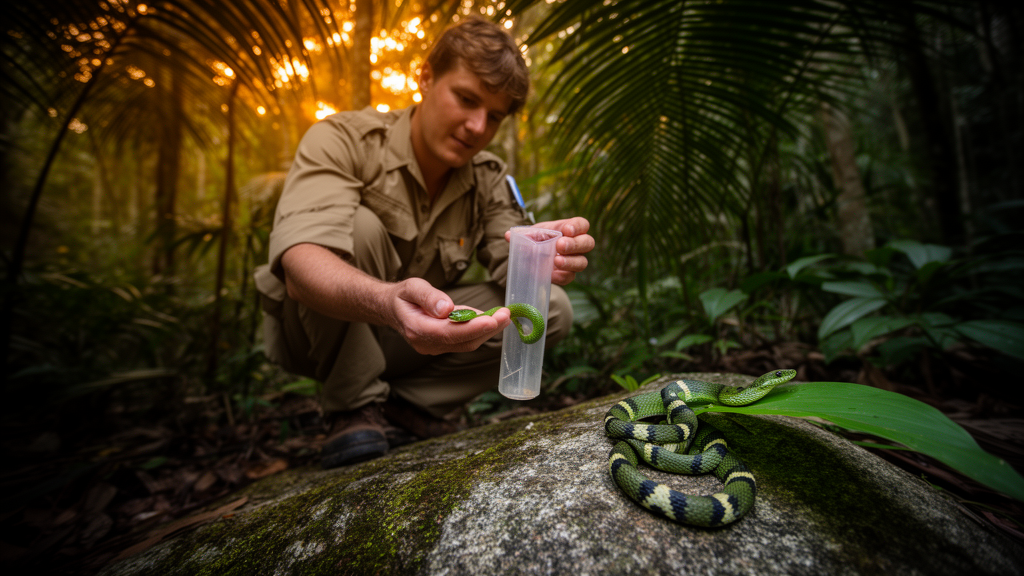
On the Gulf of Thailand island of Ko Pha-ngan, famous for its Full Moon Party and more than one million annual visitors, a team of field biologists spent nearly three years systematically searching for snakes. Their findings, published in the Biodiversity Data Journal, document 21 snake species across the 125 km² island, including a Vulnerable king cobra, a Near Threatened rat snake and one species found nowhere else on Earth. The study adds 17 species to the island’s official records, which previously listed only four, and establishes the first comprehensive baseline for snake conservation on an island whose forests are being steadily carved apart by tourism-driven development.
Islands are hotspots of both biodiversity and extinction risk. Roughly 20% of Earth’s biodiversity occurs on islands, yet these ecosystems disproportionately house about half of the world’s threatened vertebrate species. Snakes, as mesopredators that regulate rodent and amphibian populations and contribute to seed dispersal, are vital components of these systems, but their secretive nature and persistent cultural persecution make them one of the least studied vertebrate groups. Only about 20% of insular snake species have been surveyed in the past decade, and most research on snakes focuses on venom rather than ecology, leaving fundamental information about species occurrence and community composition lacking for many island systems in Southeast Asia.
From February 2021 through September 2023, researchers conducted surveys approximately twice a week for 78 weeks, completing 1,343 survey hours between 19:00 and 02:00. They walked 32 transects spanning three habitat categories: human settlement, human-disturbed forest and national park forest. Transect lengths varied from 500 metres to 1.5 kilometres, with elevations ranging from sea level to 630 metres. In addition to foot surveys, nine drift-line fence traps were deployed across the island from February 2022, checked daily over 236 days. These traps, configured with funnels and a central pitfall, proved particularly effective for detecting fossorial and cryptic species that are difficult to observe during visual surveys.
The results revealed a clear pattern: the Than Sadet-Ko Pha-ngan National Park, which covers approximately one-third of the island, harboured the highest snake diversity. Twenty of the 21 species were detected in national park forest, compared with 13 in human-disturbed forest and 11 in human settlement areas. The Shannon-Wiener Diversity Index, which accounts for both species richness and evenness, was highest in national park forest at 2.61, followed by human settlement at 2.10 and human-disturbed forest at 1.96. Simpson’s Diversity Index showed the same pattern, with national park forest scoring 0.898. Thirteen species were detected in all three habitat types, indicating broad habitat tolerance amongst several taxa, while six species were restricted to a single habitat, five of which were recorded exclusively within national park forest.
Amongst the most abundant species detected were the vine snake Ahaetulla prasina with 52 individuals, the green cat-eyed snake Boiga cyanea with 18, the common wolf snake Lycodon capucinus with 18 and the sunbeam snake Xenopeltis unicolor with 11. Visual surveys accounted for nearly 70% of all detections, opportunistic encounters contributed over 23% and drift-line traps yielded approximately 8% of records. Detectability likely influenced the observed patterns, as arboreal species and cryptic fossorial species are inherently challenging to spot. The monocled cobra Naja kaouthia, for instance, may well inhabit national park forest but is more readily encountered and reported in human settlement areas due to its large size and potential danger.
Two species stand out as conservation concerns. The Indo-Chinese rat snake Ptyas korros is assessed as Near Threatened, and the king cobra Ophiophagus bungarus is listed as Vulnerable with decreasing numbers according to the IUCN Red List. The island also harbours one endemic species, the Phangan kukri snake Oligodon phangan, described only in 2021. This nocturnal, semi-fossorial species was detected seven times, primarily in national park forest, and was observed eating reptile eggs. Notably, researchers documented male combat behaviour in this species behind a private residence, a rare observation that adds to its ecological significance.
The island’s geological history has profoundly shaped its present-day snake assemblage. During the late Pleistocene, when sea levels were lower, Ko Pha-ngan formed part of the exposed Sunda Shelf, allowing terrestrial dispersal between the island and mainland Southeast Asia. The island sits on the Sibumasu Terrane, a peri-Gondwanan fragment forming much of Peninsular Thailand and Malaysia. Subsequent Holocene sea-level rise isolated the island, and rather than producing a highly distinct snake assemblage, this isolation appears to have influenced overall species richness while retaining a strong continental faunal signature. Regional comparisons support this: Phuket, the largest island in Thailand at 543 km² and much closer to the mainland, harbours approximately 60 snake species, 18 of which also occur on Ko Pha-ngan.
Historical land-use practices have decimated large tracts of primary forest on Ko Pha-ngan. The island experienced extensive tin mining in the 1970s, followed by widespread coconut plantation development. Today, tourism-driven development has intensified habitat fragmentation, posing significant threats to snake populations, which are particularly sensitive to habitat loss given their reliance on intact ecosystems. As habitat degradation escalates on a finite island, the available space for species diminishes, intensifying competition for resources. Forest-associated species recorded exclusively within national park forest, including the white-spotted slug snake Pareas margaritophorus, the striped bronzeback Dendrelaphis caudolineatus and the speckle-bellied keelback Rhabdophis chrysargos, emphasise the importance of intact forest habitats for specialised taxa.
The researchers highlight the need for additional monitoring to better understand the dynamics of insular populations and to assess the ongoing impacts of tourism-driven development on species within finite island habitats. Protecting the island’s national park forest remains critical, as it provides a refuge for forest-dependent species and maintains ecological stability. Community-reported rescue records documented frequent snake encounters within human settlements during the study period, suggesting that public education campaigns could help reduce unnecessary persecution and improve coexistence, particularly where adaptable species like the monocled cobra are frequently encountered. The occurrence data for all species recorded during the surveys have been deposited in the Global Biodiversity Information Facility, providing a critical baseline for future conservation efforts on this island.
Subject of Research: Insular snake biodiversity and conservation on Ko Pha-ngan, Thailand
Article Title: Snakes of Ko Pha-ngan in the Surat Thani Province, Thailand
Article References: Cook-Price, D. R., Makchai, S., & Suwanwaree, P. (2026). Snakes of Ko Pha-ngan in the Surat Thani Province, Thailand. Biodiversity Data Journal, 14, Article e199297. https://doi.org/10.3897/bdj.14.e199297
Image Credits: AI Generated
Keywords: Ko Pha-ngan, Thailand, snakes, biodiversity, island biogeography, conservation, IUCN Red List, national park, habitat fragmentation, tourism, Pha-ngan, Surat
Cite Scienmag News
Margaret Porter. (October 17, 2026). Snake Survey Reveals Hidden Diversity on Thailand’s Ko Pha-ngan Island. Scienmag. https://scienmag.com/snake-survey-reveals-hidden-diversity-on-thailands-ko-pha-ngan-island/
Margaret Porter. "Snake Survey Reveals Hidden Diversity on Thailand’s Ko Pha-ngan Island." Scienmag, 17 October 2026, https://scienmag.com/snake-survey-reveals-hidden-diversity-on-thailands-ko-pha-ngan-island/. Accessed 17 October 2026.
Margaret Porter. "Snake Survey Reveals Hidden Diversity on Thailand’s Ko Pha-ngan Island." Scienmag. October 17, 2026. https://scienmag.com/snake-survey-reveals-hidden-diversity-on-thailands-ko-pha-ngan-island/


