


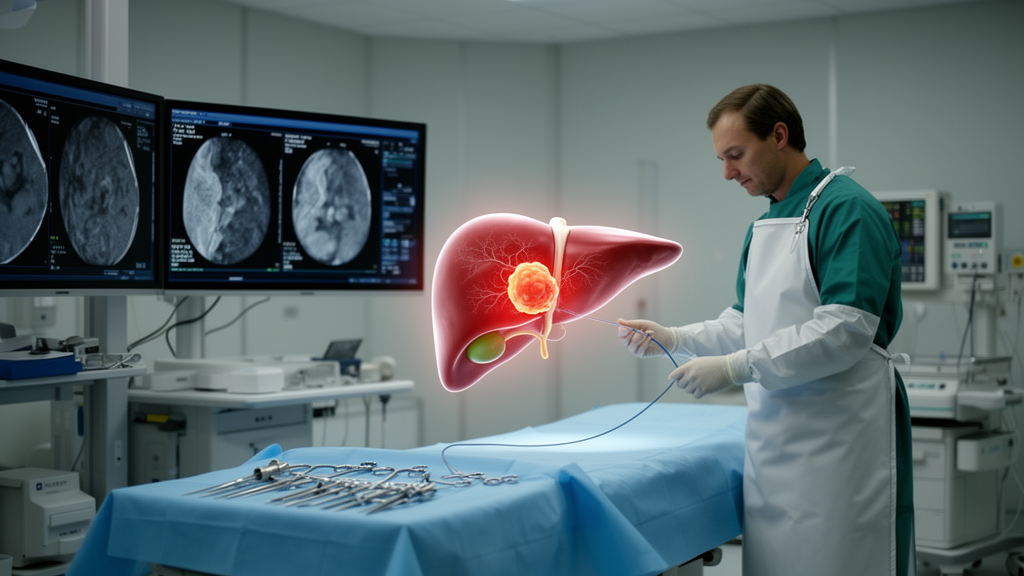
Interventional radiologists are quietly becoming some of the most important players in the fight against liver cancer, and a new analysis of Medicare data now puts hard numbers on that shift. A study published online on Oct. 12, 2026, in the Journal of Vascular and Interventional Radiology, funded by the Society of Interventional Radiology, found that interventional radiologists treated nearly 51 percent of Medicare patients with liver cancer between 2016 and 2021, a cohort of roughly 110,000 patients per year. The finding underscores how a specialty once viewed primarily as a diagnostic support service has evolved into a therapeutic powerhouse for both primary liver cancer and cancers that spread to the liver from elsewhere in the body.
The study’s authors traced the growing reliance on interventional radiology across two dimensions. On the support side, routine oncologic care increasingly depends on image-guided procedures such as biopsy, venous access, and drainage that fall squarely within the interventional radiology skill set. On the therapeutic side, interventional radiologists now deliver treatments aimed directly at the tumor itself, including percutaneous ablation and transarterial therapies that attack liver tumors from inside the body while sparing healthy tissue. As these roles expanded, the volume of liver cancer patients treated by interventional radiologists rose steadily over the study period.
Primary liver cancer remains one of the world’s deadliest malignancies. It is the third leading cause of cancer-related death globally, with approximately 900,000 new cases reported each year, about 43,000 of them in the United States. Metastatic liver disease compounds the burden, because the liver is a common site of spread for cancers such as colorectal and breast cancer. For this vast patient population, the minimally invasive, image-guided techniques championed by interventional radiology offer an alternative to more aggressive surgical approaches, often with fewer side effects and faster recovery.
At the heart of the specialty’s therapeutic arsenal are transarterial chemoembolization and transarterial radioembolization, procedures that thread catheters through the bloodstream to deliver chemotherapy or radiation directly into the arteries feeding liver tumors, cutting off their blood supply at the same time. Percutaneous thermal and non-thermal ablation techniques, meanwhile, use image guidance to destroy tumor cells in place with heat, cold, or other energy sources. Nishita Kothary, an interventional radiologist and professor at Stanford University School of Medicine who serves as secretary of the Society of Interventional Radiology and co-authored the paper, described these image-guided interventions as capable of being curative, adjunct to systemic therapies, or a bridge to organ transplantation, with fewer side effects than systemic treatments and a faster recovery time that places less strain on a patient’s quality of life.
The economic analysis at the core of the paper reveals a striking asymmetry. Physician payments and patient out-of-pocket costs climbed sharply during the study window, with oncology accounting for the steepest increase at 72 percent over five years. Yet interventional radiology’s overall cost burden to the health care system remained comparatively low. The specialty accounted for just 7.4 percent of total payments while performing 11.7 percent of Work Relative Value Units, a standard Medicare-derived metric that measures the time, skill, and intensity a physician invests in each patient service. By contrast, oncologists accounted for 52.5 percent of total payments while performing 13.7 percent of Work Relative Value Units, and radiation oncologists accounted for 5.4 percent of payments while performing 4.5 percent of those units.
Those figures suggest that interventional radiology delivers a disproportionate share of the work involved in liver cancer care relative to the payments it receives. C. Matthew Hawkins, an interventional radiologist and professor at Emory University School of Medicine who serves as treasurer of the Society of Interventional Radiology and co-authored the study, argued that the specialty provides the same quality of care at a fraction of the cost of oncology, a difference he framed as potentially more valuable to patients, payors, and health care systems when faster recovery times and the frequent absence of hospital stays after interventional radiology treatment are factored in.
The cost-efficiency argument arrives at a moment when the American health care system is under intensifying pressure to rein in spending on cancer care. Hawkins noted that as payors and regulators push for more cost-effective care, the urgency for interventional radiologists to be present at the table in discussions of cancer care policy, cost, and resource allocation only grows. The study’s findings give that argument quantitative teeth: a specialty performing nearly 12 percent of the measured work for under 8 percent of the payments represents exactly the kind of value equation that alternative payment models are designed to reward.
Kothary emphasized that liver cancer demands complex, multidisciplinary care and that interventional radiologists have a central and transformative role to play on the care team. That framing reflects a broader evolution in how the specialty sees itself. Increasingly, interventional radiologists are sub-specializing in oncology, building dedicated practices around tumor ablation, transarterial therapies, and the supportive procedures that keep cancer patients on track with their treatment plans. The result, according to the study, is a care model in which image-guided specialists contribute both the essential infrastructure of modern oncology and increasingly the definitive therapy itself.
Hawkins extended the argument beyond economics, stating that interventional radiology can offer cost-efficient care for hepatobiliary disease with comparable or improved clinical efficacy compared with alternative treatment options offered by other specialties. He insisted that interventional radiologists must be part of the discussion, especially as the system moves toward alternative payment models designed to control the costs of care. For patients, the practical implications are tangible: targeted therapies that can be curative or bridge them to transplantation, delivered through pinhole incisions rather than open surgery, with fewer systemic side effects and recovery measured in days rather than weeks.
As liver cancer incidence continues to climb worldwide and metastatic disease touches hundreds of thousands more patients each year, the study suggests that the trajectory of interventional radiology will keep bending upward. The Medicare data from 2016 to 2021 captured a specialty in ascent, one whose minimally invasive ethos aligns with the simultaneous demands of clinical efficacy, patient quality of life, and system-level cost control. Whether the specialty’s share of payments catches up with its share of work remains an open policy question, but the evidence assembled by the Society of Interventional Radiology-funded team makes a clear case that the future of liver cancer treatment will be increasingly image-guided, increasingly transarterial, and increasingly interventional.
Subject of Research: Interventional Radiology in Liver Cancer Treatment
Article Title: New paper outlines growing role of interventional radiology in liver cancer treatment
Article References: New paper outlines growing role of interventional radiology in liver cancer treatment. (n.d.). Original publication
Image Credits: AI Generated
DOI: Not provided
Keywords: interventional radiology, liver cancer, hepatobiliary cancer, transarterial chemoembolization, radioembolization, tumor ablation, Medicare data, health care costs, minimally invasive therapy, Society of Interventional Radiology, Journal of Vascular and Interventional Radiology, cancer care policy
Cite Scienmag News
Nathaniel Bowman. (October 17, 2026). Interventional Radiology Takes Center Stage in Liver Cancer Care, Study Finds. Scienmag. https://scienmag.com/interventional-radiology-takes-center-stage-in-liver-cancer-care-study-finds/
Nathaniel Bowman. "Interventional Radiology Takes Center Stage in Liver Cancer Care, Study Finds." Scienmag, 17 October 2026, https://scienmag.com/interventional-radiology-takes-center-stage-in-liver-cancer-care-study-finds/. Accessed 17 October 2026.
Nathaniel Bowman. "Interventional Radiology Takes Center Stage in Liver Cancer Care, Study Finds." Scienmag. October 17, 2026. https://scienmag.com/interventional-radiology-takes-center-stage-in-liver-cancer-care-study-finds/


